Will follow SC order on releasing water to Tamil Nadu, will keep farmers interest in mind too: DKShi
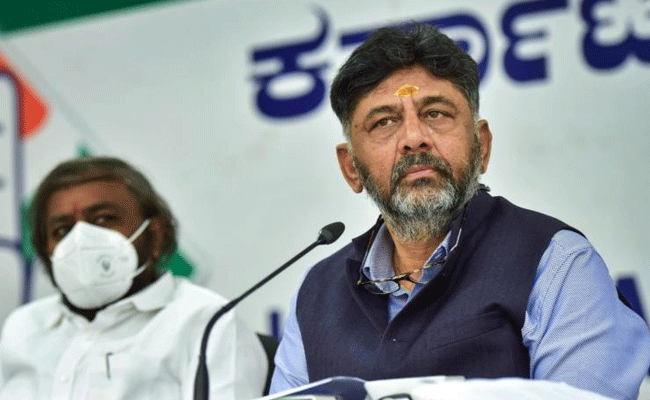
Deputy Chief Minister DK Shivakumar, who is responsible for the water resources portfolio, announced on Friday that the Karnataka government will adhere to the Supreme Court's order to release water to Tamil Nadu while safeguarding the interests of Cauvery basin farmers in Karnataka.
The Supreme Court has directed Karnataka to release 5,000 cusecs of water daily to Tamil Nadu for a period of 15 days. The court is set to hear Tamil Nadu's plea regarding directives to Karnataka for Cauvery water release on September 6.
A three-judge bench consisting of Justices BR Gavai, PS Narasimha, and PK Mishra ruled that the daily release of 5,000 cusecs for 15 days, as per the order of the Cauvery Water Management Authority, will continue until the upcoming hearing.
Shivakumar stated, "Tamil Nadu had requested 24,000 cusecs, and we argued that we could only release 3,000 cusecs due to the distressing situation. As a result of our argument, the court ordered us to release 5,000 cusecs, and we will comply. We have also requested an inspection of the storage status at our dams. They can do that."
He noted that Tamil Nadu should consider Karnataka's plight as the latter does not have enough water to meet its drinking water needs. Shivakumar reminded the neighboring state that it had consumed 80% more water last year and reiterated that the proposed Mekedatu balancing reservoir project is the solution to the ongoing Cauvery River water-sharing issue between both states.
"Opposition parties want us to stop releasing water to Tamil Nadu. We cannot do that as it would amount to a violation of the court's order. We have presented our case before the authority, and the Supreme Court has rendered its verdict," Shivakumar emphasized.
Let the Truth be known. If you read VB and like VB, please be a VB Supporter and Help us deliver the Truth to one and all.
Women BJP MLAs protest against opposition in UP assembly premises
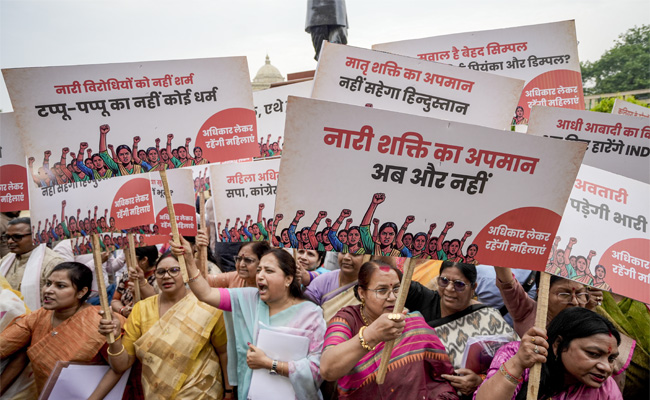
Lucknow (PTI): Women BJP MLAs held a protest in the Vidhan Bhawan complex before the one-day special session of Uttar Pradesh assembly, slamming the opposition for defeating the passage of a bill, which would have led to implementation of the Women's Reservation Law, in the Lok Sabha.
This followed another demonstration by Samajwadi Party MLAs, who alleged that the BJP was misleading public in the name of women's reservation.
The women BJP legislators assembled in front of Chaudhary Charan Singh's statue in the assembly premises, holding banners inscribed with the slogan "Insult to Matrushakti (women's power), India will not tolerate it". The protesting members entered the main hall of Vidhan Bhawan carrying the banners.
Participating in the protest, the state Minister for Women Welfare and Child Development, Baby Rani Maurya, told reporters that all opposition parties, including the Samajwadi Party and the Congress, had opposed the women's reservation, a stance for which they would have to pay a heavy political price.
"On this issue, all of us women stand united. We will ensure that we secure our reservation," she said.
BJP MLA Ketki Singh remarked that their protest represents the collective outrage of millions of women across the state.
Singh asserted that the opposition has betrayed women by creating hurdles in the path of women's reservation. The current demonstration is merely the beginning, and very soon, women from every street, intersection and household will join the protest movement, she said.
Minister Vijaylakshmi Gautam said, "We strongly condemn the despicable act committed by the Samajwadi Party and the Congress in an attempt to hold back 'half the population' (women). Their action was directed against the very bill that Prime Minister Narendra Modi had introduced to empower and strengthen Nari Shakti (women's power), and which he strived to pass expeditiously."
Uttar Pradesh assembly is holding a one-day special session on Thursday. During the session, the government is set to move a censure motion against the opposition parties over their failure to pass the Constitution Amendment Bill, which would have led to implementation of the Women's Reservation Act, in the Lok Sabha.