Will work towards bringing back BJP-JD(S) coalition govt in Karnataka: H D Kumaraswamy
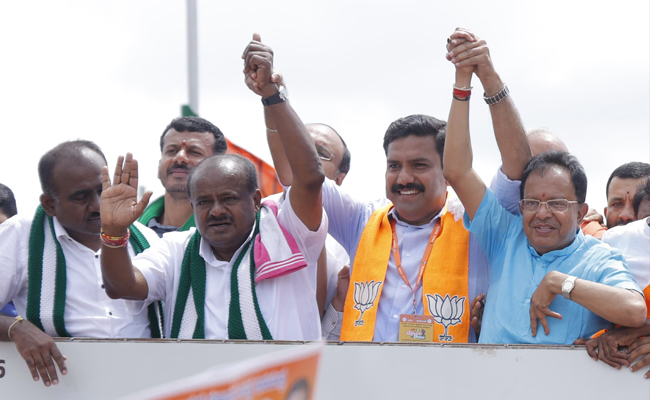
Ramanagara (Karnataka) (PTI): Union Minister H D Kumaraswamy on Sunday said he will work together with the leaders and workers of the BJP and JD(S) to bring back an NDA government in the state.
There is no question of his party joining hands with the Congress once again, the JD(S) state president said.
The JD(S) had been in power twice in the state, in coalition with both national parties, despite being a junior partner -- for 20 months with BJP from February 2006 and for 14 months with the Congress after the May 2018 assembly polls. Kumaraswamy was the chief minister on both occasions.
Ahead of the 2024 Lok Sabha polls, the JD(S) joined hands with the BJP and became a part of the NDA.
"I appeal to the BJP and JD(S) workers to work together. Who should become chief minister is not important to me. With your blessings I have been the chief minister of the state twice. Welfare and development of the state and its people are important for me," Kumaraswamy said.
Addressing workers of the BJP and JD(S), ahead of the second day of a week-long protest march from Bengaluru to Mysuru against the MUDA 'scam', he said, "I will work for your sake in the days ahead with the aim of bringing back the BJP-JD(S) coalition government."
"Our fight is ultimately to bring in a pro-people government in the state, which will look after the welfare of every family. We want to bring such a government under the leadership of Prime Minister Narendra Modi. For that, myself, B Y Vijayendra (BJP state president) and all leaders and workers from both parties will work together," he added.
Speaking about his experience of running the government with the Congress party in the past for 14 months, the former CM said, "There is no question of going to Congress in my life."
"It was neither there then (2018), nor now. I had not come to you (Congress) with an application to make me the chief minister. You pleaded and made me the chief minister. But I did not utilise the opportunity (as CM) to loot money, I tried to save farmers by waiving Rs 25,000 crore of farmers' loan," he said.
Recalling the support given to him by the BJP and its leader B S Yediyurappa during his first stint as chief minister in 2006, Kumaraswamy said, he did not "betray" Yediyurappa, and that certain political developments and the deeds of some people led to the situation, where transfer of power to the BJP did not happen.
"If Kumaraswamy is known to the people of the state, it is because of the blessings of the people of Ramanagara district, and the good administration we gave by forming a government with the help of Yediyurappa. I cannot forget that the workers of BJP and JD(S) have nurtured me. The coalition between BJP and JD(S) has disturbed the sleep of Congress leaders; they are worried," he added.
In 2006, Kumaraswamy had rebelled and walked out of the JD(S)-Congress coalition with 42 MLAs, reportedly against the wishes of his father former PM and JD(S) patriarch H D Deve Gowda, citing a threat to the party. He then formed the government with the BJP, becoming the chief minister during his very first term as MLA. Yediyurappa was the deputy chief minister.
Under an arrangement with the BJP for the two parties' chosen leaders to take turns as chief minister, Kumaraswamy helmed the state for 20 months.
But when the BJP's turn for chief ministership came, he reneged on the promise to transfer power and brought down the Yediyurappa government within seven days.
Kumaraswamy occupied the CM's post for the second time after the 2018 assembly polls by forging a coalition with the Congress, despite the JD(S) finishing a poor third in the polls.
But his tenure was short-lived as the wobbly coalition government that he headed collapsed after 14 months in power, because of internal differences.
Let the Truth be known. If you read VB and like VB, please be a VB Supporter and Help us deliver the Truth to one and all.
Bengal: Over 55 pc turnout till 1 pm in repoll in 15 booths of 2 assembly seats
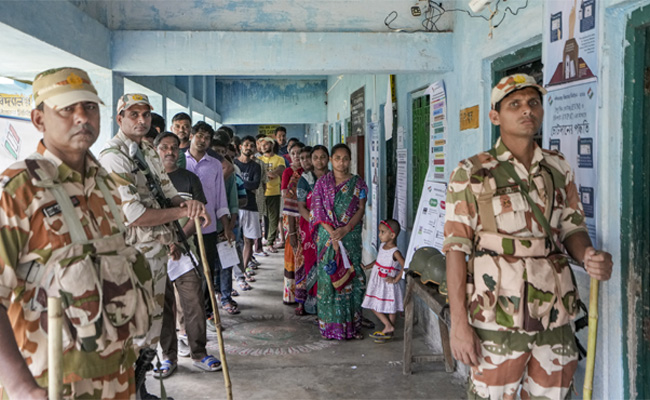
Kolkata (PTI): Over 55 per cent turnout was recorded till 1 pm in repoll in 15 booths of two assembly constituencies in West Bengal's South 24 Parganas district on Saturday, an official said.
Voting was underway more or less peacefully at 11 polling stations of Magrahat Paschim assembly constituency and four in Diamond Harbour, where the EC ordered repoll a day ago, following reports of electoral malpractices.
However, at booth number 179 at Chanda Primary School of Diamond Harbour seat, the Trinamool Congress alleged that a specially abled voter and his mother were harassed by central forces. The alleged incident sparked protests by party workers and locals.
The TMC claimed that the voter's mother, who had entered the booth to assist him, and her son were detained for a considerable time by central forces over alleged rule violations.
ALSO READ: Man arrested for duping Delhi resident of Rs 2 lakh in online car sale fraud
"TMC leaders Manmohini Biswas and Pratik Ur Rahman reached the spot and led the protests, with residents terming the action unwarranted harassment. The matter has been taken care of by our officials there," an official of the poll body said.
Polling was otherwise peaceful across 15 booths in the area, he added.
Voting began at 7 am and will continue till 6 pm, the official said, adding that till 1 pm, the turnout was 55.57 per cent.
Magrahat Paschim registered 56.33 per cent voter turnout, while in Diamond Harbour, it was 54.9 per cent, a poll official stated.
Voting in these two assembly constituencies was held in the second phase of the state elections on April 29.
The repoll order was based on reports received from returning officers and observers of the two constituencies and "material circumstances", the Election Commission official said.
In Magrahat Paschim, TMC's Md Samim Ahamed Molla is pitted against BJP nominee Goursundar Ghosh, while Abdul Majid Halder of the Congress and ISF candidate Abdul Aziz Al Hassan are also in the fray.
TMC candidate Panna Lal Halder is contesting against Dipak Kumar Halder of the BJP in the Diamond Harbour seat. Goutam Bhattacharya of the Congress and CPI(M)'s Samar Naiya are among other candidates.
The BJP had alleged rampant electoral malpractices in certain polling stations of both the assembly seats under the Diamond Harbour Lok Sabha constituency, which is represented by TMC national general secretary Abhishek Banerjee.
The EC had deputed its special observer, Subrata Gupta, to fact-check the allegations from the ground.
The poll panel will decide on repolling in the Falta assembly constituency on Saturday.
The West Bengal assembly elections were held in two phases -- April 23 and April 29 -- amid unprecedented security arrangements.
Counting of votes will take place on May 4.