Won't allow moral policing incidents in Karnataka anymore: Siddaramaiah
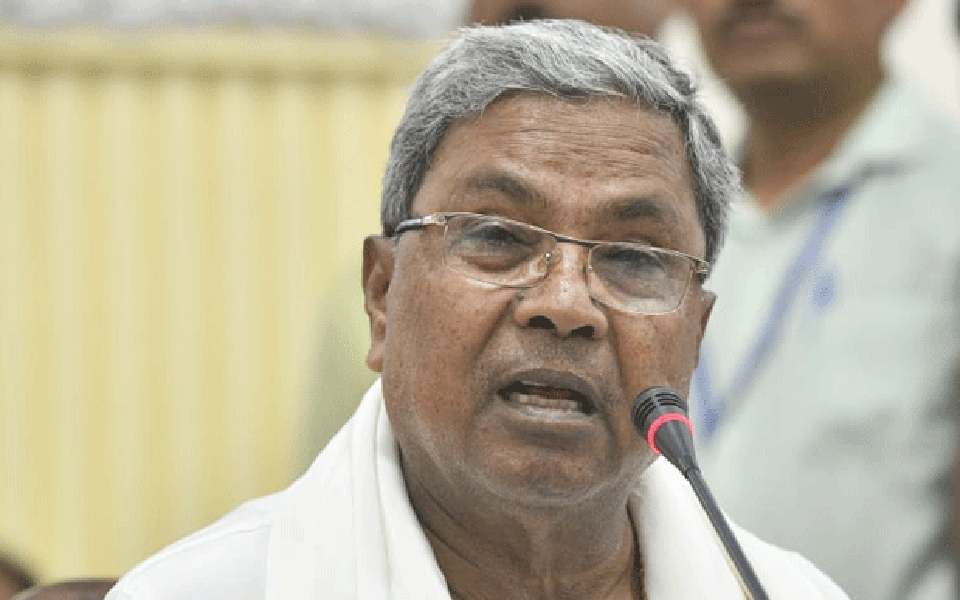
Chief Minister Siddaramaiah made a significant announcement on Saturday, stating that moral policing will no longer be permitted in the state of Karnataka. During a meeting with senior police officials, he emphasized the need for a people-friendly administration and instructed the police to be approachable and friendly towards individuals who come to register complaints.
Addressing the media at his official residence, "Krishna," the Chief Minister highlighted the importance of treating everyone equally and not allowing any biases based on religion or other factors to influence the legal actions taken by the police. He made it clear that the Deputy Commissioner of Police (DCP) and Superintendent of Police (SP) would be held accountable if any illegal activities occur under their jurisdiction.
ALSO READ: Won't let department get saffronised: DK Shivakumar warns top police officers of Karnataka
“While taking legal action should not be influenced by religion. The police have been asked to treat everyone equally." he said.
Let the Truth be known. If you read VB and like VB, please be a VB Supporter and Help us deliver the Truth to one and all.
Vice president releases latest edition of Constitution in Sindhi
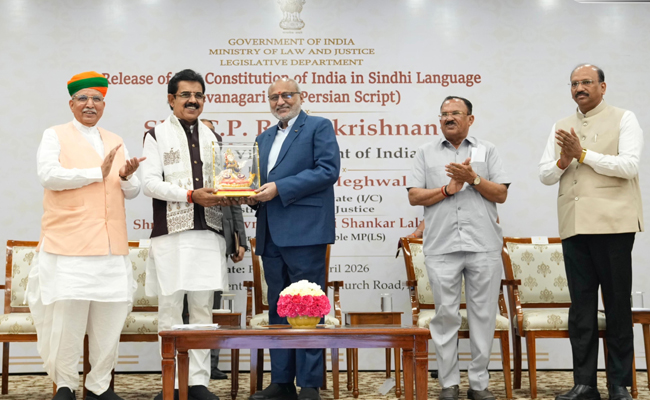
New Delhi (PTI): Vice President C P Radhakrishnan on Friday released the latest edition of the Constitution in Sindhi language, in both Devanagari and Persian scripts here.
Addressing a gathering, the vice president extended greetings to the Sindhi-speaking community on the occasion of Sindhi Bhasha Diwas.
He described Sindhi as one of the oldest and most melodious languages, noting that its literary tradition reflects a unique confluence of Vedantic philosophy and Sufi thought, promoting universal values of oneness, love, and brotherhood.
Highlighting the significance of the occasion, he said that the release of the Constitution in Sindhi, particularly in the Devanagari script for the first time since Independence, marks an important milestone in promoting linguistic inclusivity.
He emphasised that the Constitution is not merely a legal document but the living spirit of the nation, embodying its aspirations, safeguarding rights, and guiding democratic governance.
He observed that India stands unique in making its Constitution available in a wide range of languages and recalled similar initiatives undertaken in recent years, including translations in Bodo, Dogri, Santhali, Tamil, Gujarati, and Nepali. These efforts, he said, celebrate India’s linguistic diversity and reinforce democratic values.