Works worth Rs 1,499 crore completed under Smart City Project: UT Khader
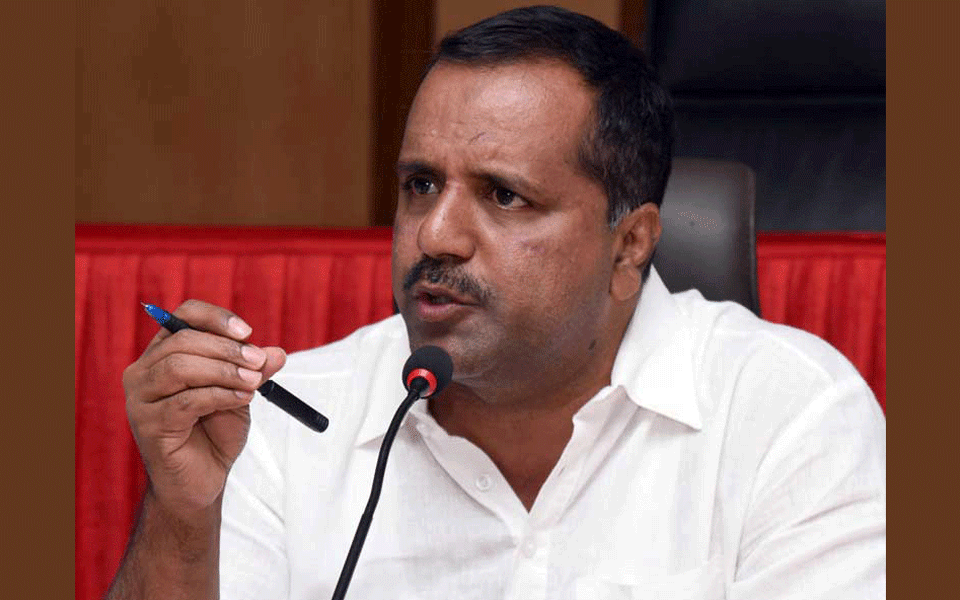
Bengaluru, Jan 31: Urban Development Minister UT Khader said that so far, works worth Rs 1,499 crore were completed under the Smart City Project of the Central government and tenders were completed for other works worth Rs 1,407 crore.
Speaking to reporters at his office at Vikasa Soudha here on Thursday, the Minister said that the works worth rs 2,728 crore were in the DPR and all proposed works would start by February end.
Belagavi, Bengaluru, Mangaluru, Shivamogga, Hubballi-Dharwad, Tumkur and Davangere cities were selected under the Smart City Project and in five years, Rs 7,000 crore would be spent on various works, of which Rs 3,500 crore would be spent by the state government, he said.
The Smart City Project which has achieved zero per cent growth, has been accelerated and now the state was in the 9th position in the country.
Priority would be given to develop roads, vehicle stands, playgrounds and in each city, separate zones would be selected under the Smart City Project.
For example, in Davangere, puffed rice was famous and efforts were being made to produce them using modern technology. The funds would be utilized to develop slums. In Bengaluru, priority would be given to road developments, fixing LED lights to street lights and market development, he said.
It was not possible to develop the entire city under the Smart City Project. Any one part of the city could be developed as a model one. Works would be taken up only after getting approval from the central government.
In Mangaluru, proposals have been submitted to the centre on setting up of solid waste management, development of hospitals and slaughterhouses.
But so far, the state government has not received any response from the centre. Once again, letter would be written to the centre govt, he said.
On giving licences to construct buildings in local bodies like city corporation and city municipal councils, the Urban Development Department has finalized a by-law and issued an order. But the power to implement that by-law was left to the discretionary power of respective local bodies, he said.
In order to encourage the solar usage, concession was given from FAR norms which was considering the solar panel as the separate floor and measurement, he said.
Let the Truth be known. If you read VB and like VB, please be a VB Supporter and Help us deliver the Truth to one and all.
AIITA welcomes Karnataka’s ban on obscene songs in school events

Bhatkal: The Karnataka unit of the All India Ideal Teachers Association (AIITA) has welcomed the Karnataka government’s decision to strictly ban school children from dancing to obscene songs during educational and cultural programmes in government, aided, and private schools across the state.
AIITA Karnataka State President M. R. Manvi congratulated the government for taking what he termed an important step to preserve the sanctity of education.
“Such decisions to safeguard the dignity of school children and uphold the values of education are the need of the hour. This rule should not be limited to government schools alone but must be strictly implemented in all private educational institutions as well,” he said.
He further urged the government to address other concerns within school programmes.
“The government should not only prohibit obscene dances in the name of school anniversaries, but also ensure that plays and dialogues that incite religious hatred are avoided. Schools should be centres of harmony, not platforms for spreading hatred,” he added.
According to a recent circular issued by the Department of School Education and Literacy, obscene dances are adversely affecting the mental health and moral values of students.
In this regard, schools have been advised to use songs that promote nationalism, positive thinking, the greatness of Kannada culture, and value-based traditions instead of inappropriate content during programmes.
The circular also emphasises that students should be dressed in decent attire.
AIITA also backed the department’s warning that disciplinary action would be taken against head teachers if such guidelines are violated. The association has further demanded that district Deputy Directors of Public Instruction strictly monitor the implementation of these rules.