32 missions, including Chandrayaan-2, planned for 2019: ISRO
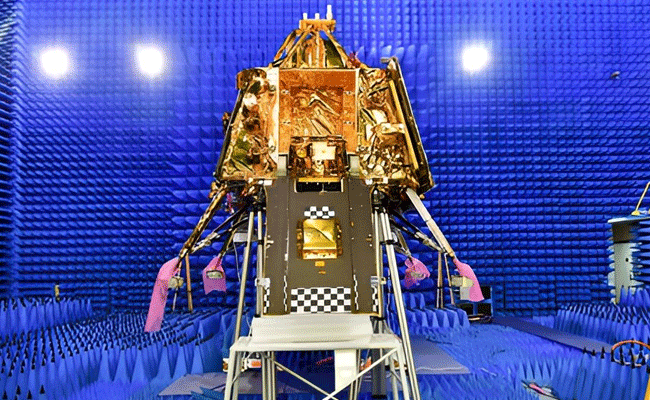
Bengaluru, Jan 3: India has planned 32 missions, including the "most complex" Chandrayaan-2 during 2019, the Indian Space Research Organisation has said.
India's maiden human spaceflight programme 'Gaganyaan' activities would go full steam to accomplish the various development and qualification milestones during the year, the space agency said.
"The year 2019 promises to be much more challenging to the ISRO community with 32 planned missions (14 launch vehicles, 17 satellites and 1 Tech demo missions)," ISRO Chairman K Sivan said in a New Year message.
"This includes the most complex Chandrayaan-2, which will be the 25th mission from SLP (second launch pad), and the development flights of Small Satellite Launch Vehicle (SSLV)," he said.
ISRO had earlier said Chandrayaan-2 will be launched in a window from January-February 16, 2019.
Sources said it is expected by the middle of next month but no date has been finalised.
"We are all trying hard. Definitely, it should be possible to launch the mission in February," a senior ISRO official told PTI.
"There is no impediment. It's on track," the official said.
Chandrayaan-2 mission, costing nearly Rs 800 crore, is an advanced version of the previous Chandrayaan-1 mission about 10 years ago.
This spacecraft to be launched on board GSLV-Mk III is a totally indigenous mission, comprising an Orbiter, Lander and Rover.
Sivan said during the year, Gaganyaan activities would go "full steam" to accomplish the various development and qualification milestones.
The Union Cabinet gave its nod for the Rs 9,023-crore programme last Friday.
The objective of the mission is to carry a three-member crew to low earth orbit and return them safely to a predefined destination on earth.
Prime Minister Narendra Modi had on Independence Day announced that the mission would be undertaken by 2022.
ISRO is aiming to reinstate its microwave remote-sensing capability through the RISAT (Radar Imaging Satellite) series and attain operational Geo-imaging capability through the GISAT (GEO Imaging Satellite) series, according to Sivan.
It is also planned to progressively improve the payload capability of GSLV (Geosynchronous Satellite Launch Vehicle) and its variants.
The country would meet the high throughput bandwidth requirement of Digital India and also in-flight connectivity with the launch of GSAT-20.
On the application side, crop production estimation would be enhanced to cover 10 additional crops and also provide vital inputs for water and energy security, Sivan said.
He said 2019 is the birth centenary of the founding father of Indian Space Programme, Vikram A Sarabhai, and year-long celebrations, consisting of a host of national and international events, would commence August 12, 2019.
Terming 2018 as a year of many 'firsts' and 'beginnings' with profound growth in all directions, he said during the year ISRO completed 16 missions, signing off with seven successful missions within 35 days.
This included two successful GSLV missions in a single year.
Among other things, the period also witnessed active discussions and partnerships with other space agencies in advanced technology areas of human spaceflight and other areas like LOX/Methane propulsion, joint satellite missions, among others, he said.
A major initiative has been the UNNATI programme, which is an international programme to train participants on nano satellite assembly, and has evoked major respo ISRO-LD CHANDRAYAAN from 34 countries.
Let the Truth be known. If you read VB and like VB, please be a VB Supporter and Help us deliver the Truth to one and all.
'Godman' Kharat held in 8th sexual exploitation case; court denies police remand, sends him to jail
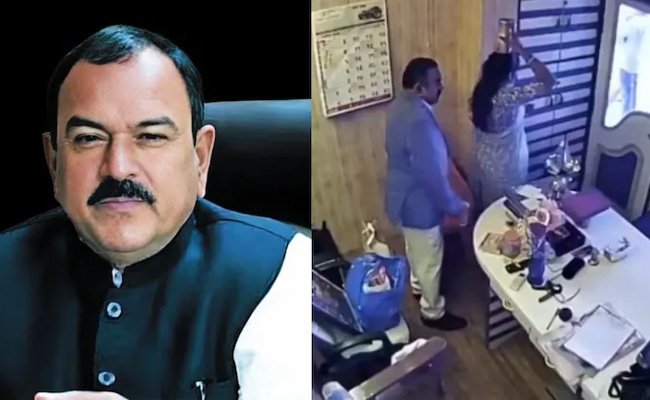
Nashik (PTI): Police took custody of self-proclaimed godman-cum-astrologer Ashok Kharat in an eighth case related to sexual exploitation of women and produced him before a Nashik district court which sent him to jail till May 12 after rejecting the plea for his police remand on Thursday.
On April 29, the Special Investigation Team (SIT) of the Nashik police in north Maharashtra filed a request application in the court demanding Kharat's custody in the eighth case.
After the court granted them the necessary permission, the SIT took custody of Kharat, who was in jail in connection with the seventh case of sexual exploitation registered against him.
The 'godman', named in a dozen FIRs related to rape and financial fraud, was produced before Chief Judicial Magistrate B N Ichpurani in the eighth case through video conferencing due to security reasons.
The eighth case related to Kharat allegedly sexually exploiting a woman who had approached him in search of solutions to her family problems, according to police.
During the hearing, the prosecution demanded police custody of the accused in the latest case.
However, the defence strongly opposed the demand and argued that the SIT was giving same reasons for police custody every time and there was no strong reason for accepting their plea.
The court accepted the argument put forth by the defence and remanded Kharat to judicial custody till May 12 in the eighth case.
The SIT will produce Kharat in the court on Friday again and seek his police custody in the ninth case. As the self-styled godman has been granted judicial custody in the eighth case, he will be sent to Nashik Road Central Jail and the SIT will take his custody from there.
Meanwhile, Kharat's judicial custody in the fourth case ended on Thursday. On April 18, the accused was remanded to judicial custody till April 30 in the fourth case of sexual exploitation of women.
In a related development, the SIT conducted a search at Kharat's office in the 'Canada Corner' area of Nashik city on Wednesday. A 'panchnama' (record of search and seizure proceedings) was conducted and the office was locked and sealed again.
Kharat, a well-heeled man with political connections, was arrested for the first time on March 18 after a woman alleged he had repeatedly raped her for three years.
He is accused of sexually exploiting several women by claiming to have divine powers and knowledge of black magic, and also committing large-scale financial fraud.
The SIT is conducting a probe into 12 cases of sexual exploitation and financial fraud registered against the astrologer in Nashik and Ahilyanagar districts.