A million species risk extinction, are we one of them?
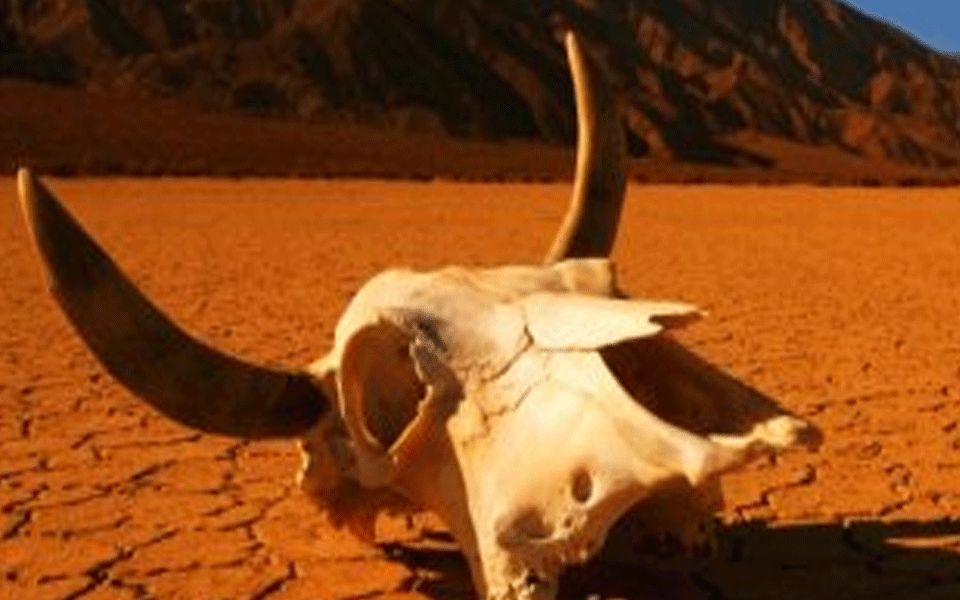
Paris: Humanity is rapidly destroying the natural world upon which our prosperity -- and ultimately our survival -- depends, according to a landmark UN assessment of the state of Nature released Monday.
Changes wrought by decades of pillaging and poisoning forests, oceans, soil and air threaten society "at least as much as climate change," said Robert Watson, who chaired the 132-nation meeting that validated a Summary for Policymakers forged by 450 experts.
One million animal and plant species face extinction, many within decades, they reported. Alarmingly, the accelerating pace at which unique life-forms are disappearing -- already tens to hundreds of times faster than during the last ten million years -- could tip Earth into the first mass extinction since non-avian dinosaurs died out 66 million years ago.
In the short term, humans are not at risk, said Josef Settele, a professor at the Helmholtz Centre for Environmental Research in Germany and co-chair of the UN Intergovernmental Science-Policy Platform on Biodiversity and Ecosystem Services (IPBES).
"In the longer term, it is hard to say," he told AFP. "If humans do go extinct, Nature will find its way, it always does." Halting and reversing these dire trends will require "transformative change" -- a sweeping overhaul of the way we produce and consume almost everything, especially food, the report concluded. "We are eroding the very foundations of our economies, livelihoods, food security, health and quality-of-life worldwide," said Watson.
"By transformative change, we mean a fundamental, system-wide reorganisation." The pushback from "vested interests," he added, is likely to be fierce.
Drawing from 15,000 sources and an underlying 1,800-page report, the executive summary details how our species' growing footprint and appetites have compromised the natural renewal of resources that sustain civilisation, starting with fresh water, breathable air, and productive soil.
An October report from the UN's climate science panel painted a similarly dire picture for global warming, and likewise highlighted the need for social transformation "on an unprecedented scale" to cap the rise in temperature at 1.5 degrees Celsius (2.7 Fahrenheit).
The global thermometer has already gone up by 1C, and on current trends will rise another 3C by century's end. Climate change and biodiversity loss, it turns out, feed off each other in a vicious cycle.
Deforestation and industrial agriculture are major drivers of species and ecosystem decline, but also account for at least a quarter of man-made greenhouse gas emissions.
Trees release planet-warming carbon dioxide when cut down, and the destruction each year of tropical forests covering an area the size of England shrinks the vegetal sponge that helps to absorb it.
Global warming, in turn, is pushing thousands of animals and plants out of their comfort zones, and intensifies the kind of heatwaves and droughts that recently fuelled unprecedented fires in Australia, Indonesia, Russia, Portugal, California and Greece.
The overlapping drivers of global warming and biodiversity loss point to shared solutions, but there is potential for policy conflict too, the new report cautioned.
Plans to green the global economy reserve a crucial role for burning biofuels and locking away the CO2 released, a technology known as BECCS.
But the huge tracts of land needed to grow energy crops on this scale -- roughly twice the size of India -- would clash with the expansion of protected areas and reforestation efforts, not to mention food production.
For the first time, the UN body has ranked the top five causes of species lost and the degradation of Nature. By a long shot, the first two are diminished or degraded habitat, and hunting for food or trade -- often illicit -- in body parts.
All but seven percent of major marine fish stocks, for example, are in decline or exploited to the limit of sustainability despite efforts by regional management organisations to fish sustainably.
Global warming is third on the list, but is likely to move up.
"We can see the climate change signal getting stronger really, really quickly," IPBES co-chair Sandra Diaz, a professor at the National University of Cordoba in Argentina, told AFP.
Numbers four and five are pollution -- 400 million tonnes of heavy metals, toxic sludge and other waste are dumped into oceans and rivers each year -- and alien species, such as rats, mosquitoes, snakes and plants that hitch rides on ships or planes.
"There are also two big indirect drivers of biodiversity loss and climate change -- the number of people in the world and their growing ability to consume," said Watson.
The heavily negotiated text does not set benchmarks for progress or "last chance" deadlines for action, as does the 2018 climate report. Nor is the panel mandated to make explicit policy recommendations.
But it does point unmistakably to actions needed: reduce meat consumption, halt deforestation in tropical countries, discourage luxury consumption, slash perverse subsidies, embrace the concept of a low-growth economy.
The report will "serve as a basis for redefining our objectives" ahead of a key meeting of the UN Convention on Biological Diversity in China in October 2020, said co-author Yunne Jai Shin, a scientist at the Research Institute for Development in Marseilles.
Let the Truth be known. If you read VB and like VB, please be a VB Supporter and Help us deliver the Truth to one and all.
Sujit Nair raises concerns over speculation of DMK-AIADMK understanding to block TVK

Chennai: Journalist and political commentator Sujit Nair has expressed concern over speculation that the Dravida Munnetra Kazhagam and the All India Anna Dravida Munnetra Kazhagam could explore a post-poll understanding to prevent Vijay-led Tamilaga Vettri Kazhagam from forming the government in Tamil Nadu.
In a social media post, Sujit Nair said the election verdict in Tamil Nadu reflected a clear public demand for political change and argued that the mandate should be respected irrespective of political preferences.
Referring to reports and political discussions surrounding a possible understanding between the DMK and AIADMK, he said he hoped such developments remained only speculative conversations and did not turn into reality.
Nair stated that if such an alliance were to take shape, it would raise serious questions about ideological politics in the country. He said TVK had emerged through a democratic electoral process and that the legitimacy to govern in a parliamentary democracy comes from the people’s verdict.
According to him, attempts to prevent an electoral winner from forming the government through unexpected political arrangements may be constitutionally valid, but many people could view them as politically opportunistic.
He further said that such a move could particularly affect the political image of the DMK, which has historically projected itself around ideology, social justice and opposition politics. Nair said that in ideological terms, the DMK appeared closer to TVK than to the AIADMK, and joining hands with its long-time political rival only to remain in power could weaken its broader political narrative.
He added that the same questions would apply to the AIADMK as well, as the party had spent decades positioning itself against the DMK and such an arrangement could create discomfort among its cadre and supporters.
Drawing a comparison with Maharashtra politics in 2019, Nair said he had expressed similar views when the Shiv Sena formed an alliance with the Indian National Congress and the Nationalist Congress Party after the Assembly elections.
He said post-poll alliances between long-standing political rivals often create a public perception that ideology and electoral mandates become secondary when political power equations come into play.
Nair also said such developments increase public cynicism towards politics and reinforce the belief among voters that ideology is often sidelined after elections.
He maintained that the Tamil Nadu verdict was emphatic and said respecting both the spirit and substance of the mandate was important for the credibility of democratic politics.