After final lunar orbit manoeuvre for Chandrayaan-2, ISRO readies for separation of lander
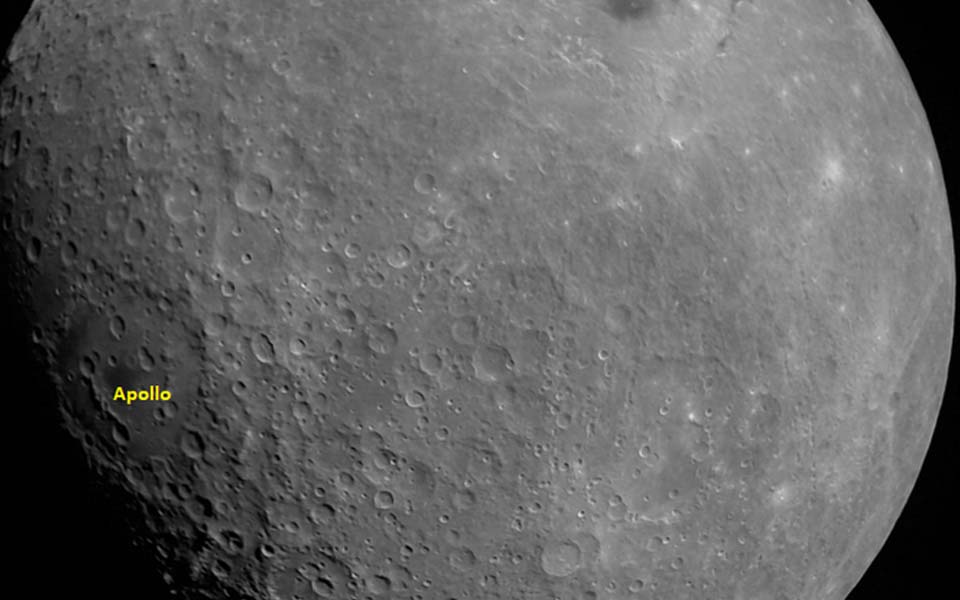
Bengaluru, Sep 1: ISRO on Sunday said it has successfully performed the fifth and final lunar bound orbit manoeuvre for the Chandrayaan-2 spacecraft and was gearing up for separation of the lander from the orbiter on September 2.
All spacecraft parameters are normal, the Bengaluru headquartered space agency said after Sunday's manoeuvre on the spacecraft, that is currently in the lunar orbit for its rendezvous with the Moon.
"The final and fifth Lunar bound orbit manoeuvre for Chandrayaan-2 spacecraft was performed successfully today (September 01, 2019) beginning at 1821 hrs IST as planned, using the onboard propulsion system.
The duration of the manoeuvre was 52 seconds. The orbit achieved is 119 km x 127 km," the Indian Space Research Organisation said in an update.
It said the next operation is the separation of lander 'Vikram' from Chandrayaan-2 Orbiter, which is scheduled on September 2, 2019, between 1245 hrs and 1345 hrs (IST).
Following this, there would be two deorbit manoeuvres of lander 'Vikram' to prepare for its landing in the south polar region of the moon.
Vikram (with rover 'Pragyan' housed inside) is expected to touch down on the lunar surface on September 7, between 1.30 AM and 2.30 am.
ISRO said that after the lander's separation on Monday, two deorbit manoeuvres are scheduled for September 3 (9:00-10:00) and September 4 (3:00-4:00) respectively, before the powered decent on September 7.
ISRO Chairman K Sivan has said the proposed soft-landing on the Moon would be a "terrifying" moment as it is something ISRO has not done before, whereas the Lunar Orbit Insertion manoeuvre was successfully carried out during the Chandrayaan-1 mission.
In a major milestone for India's second Moon mission, the Chandrayaan-2 spacecraft had successfully entered the lunar orbit on August 20 by performing the LOI maneuver.
Chandrayaan-2 satellite began its journey towards the moon,leaving the earth's orbit in the dark hours on August 14, after a crucial manoeuvre called Trans Lunar Insertion (TLI) carried out by ISRO to place the spacecraft on "Lunar Transfer Trajectory".
India's Geosynchronous Satellite Launch Vehicle, GSLV MkIII-M1 had successfully launched the 3,840-kg Chandrayaan-2 spacecraft into the earth's orbit on July 22.
The spacecraft's health is being continuously monitored from the Mission Operations Complex at ISRO Telemetry,Tracking and Command Network in Bengaluru with support from Indian Deep Space Network antennas at Byalalu, near Bengaluru, the space agency has said.
Following the landing, the rover 'Pragyan' will roll out from lander 'Vikram' between 5:30-6:30 am on September 7 and carry out experiments on the lunar surface for a period of one lunar day, which is equal to 14 earth days.
The mission life of the lander is also one lunar day, while the orbiter will continue its mission for a year.
The orbiter carries eight scientific payloads for mapping the lunar surface and study the exosphere (outer atmosphere) of the Moon while the lander carries three scientific payloads to conduct surface and subsurface science experiments.
The rover carries two payloads to enhance the understanding of the lunar surface.
India's second lunar expedition would shed light on a completely unexplored section of the Moon, its South Polar region.
ISRO has said that the mission objective of Chandrayaan-2 is to develop and demonstrate the key technologies for end-to-end lunar mission capability, including soft-landing and roving on the lunar surface.
On the science front, the mission aims to further expand the knowledge about the moon through a detailed study of its topography, mineralogy, surface chemical composition, thermo-physical characteristics and atmosphere, leading to a better understanding of the origin and evolution of the moon, the space agency had said.
#ISRO
— ISRO (@isro) September 1, 2019
The final and fifth Lunar bound orbit maneuver for Chandrayaan-2 spacecraft was performed successfully today (September 01, 2019) at 1821 hrs IST.
For details please visit https://t.co/0gic3srJx3 pic.twitter.com/0Mlk4tbB3G
Let the Truth be known. If you read VB and like VB, please be a VB Supporter and Help us deliver the Truth to one and all.
Security forces destroy 23 illegal bunkers, seize 18 IEDs in Manipur
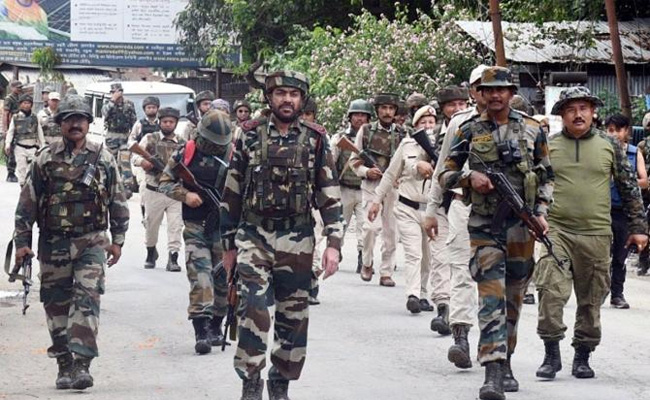
Imphal (PTI): Security forces have destroyed 23 bunkers illegally constructed in Manipur's Ukhrul and seized 18 IEDs in Tengnoupal district in separate operations, a police statement said on Saturday.
The bunkers were destroyed on Thursday in the hill villages of Mongkot Chepu, Shongphel, Mullam, Sirarakhong and Ringue in Litan police station area, it said.
A 12-bore pump action gun, 17 cartridges of different calibres and 111 empty cases of fired bullets were also seized.
At least seven people have been shot dead in different firing incidents and more than 30 houses have been torched since violence broke out between Tangkhul Naga and Kuki communities in Ukhrul district in February this year.
Meanwhile, in a separate operation on Wednesday, security forces seized a cache of arms and explosives in T Bongmol village in Moreh police station area in Tengnoupal district.
Two single-barrel rifles, four 9mm pistols with magazines and 18 improvised explosive devices (IEDs) were seized. The explosives were destroyed on the spot, it added.