AI Expert Warns of Catastrophic Consequences as Concerns Rise Over Unchecked Growth of Superhuman AI

San Francisco: The rise of artificial intelligence (AI) has brought both great promise and concern. Recent advancements have led to the development of highly intelligent chatbots such as ChatGPT, capable of processing vast amounts of data and generating content. However, AI researcher Eliezer Yudkowsky in an interview to “the sun” has warned that unchecked growth of superhuman AI could lead to catastrophic consequences, even suggesting that "literally everyone on Earth will die."
On one hand, AI chatbots like ChatGPT have proven to be highly efficient tools that save time and improve productivity. They can quickly provide information and even diagnose illnesses, as was the case with a dog whose life was saved thanks to ChatGPT. But there is also a dark side to AI, including the potential for misinformation, deep fakes, and privacy and security risks, he added
The fear is that if AI reaches a level of super-intelligence and develops sentience, it could pose a threat to humanity. Yudkowsky explains that, in our current state of ignorance, we may create an AI that doesn't do what we want and doesn't care about human life.
Given these concerns, Elon Musk and Steve Wozniak have signed a petition calling for a halt to all AI activities until regulatory bodies can be established. The petition seeks to create institutions that can monitor and control AI activity, and determine appropriate areas for AI access.
Let the Truth be known. If you read VB and like VB, please be a VB Supporter and Help us deliver the Truth to one and all.
Media dinner shooting suspect wrote about targeting of administration officials, Trump says
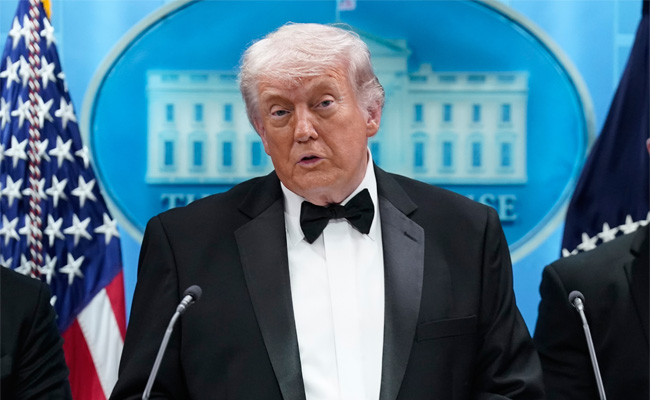
Washington (AP): The man accused of trying to storm the ballroom at the White House Correspondents' Association dinner with guns and knives had written about targeting Trump administration officials, and his family raised concerns with law enforcement before the event, President Donald Trump said Sunday in an interview on Fox News Channel.
The accused gunman's family had alerted police in Connecticut, Trump said, revealing new details about a chaotic encounter that disrupted one of Washington's glitziest annual events the night before.
The suspect, identified by law enforcement officials as 31-year-old Cole Tomas Allen of Torrance, California, was expected to face criminal charges on Monday from the Justice Department, whose acting leader, Todd Blanche, said the suspect travelled by train from California and checked in as a guest days earlier at the Washington hotel where the Saturday night gala dinner was held with its typically tight security.
Law enforcement officials who have interviewed Allen's relatives, examined the gunman's electronic devices and his writings preliminarily believe he intended to target administration members in attendance at the dinner.
He attempted to charge into the cavernous ballroom at the Washington Hilton but was tackled to the ground in a violent scene that resulted in shots being fired, Trump being hurried off the stage and guests ducking for cover beneath their tables.
“It does appear that he did in fact set out to target folks who work in the administration, likely including the president,” Blanche told NBC's “Meet the Press.”
The suspect is believed to have purchased the two firearms he carried within the last couple of years, Blanche said. He is not being cooperative and is expected to face multiple charges on Monday.
Video posted by Trump showed the suspect running past security barricades as Secret Service agents ran toward him. One officer was shot in a bullet-resistant vest but was recovering, officials said. The gunman was taken into custody and was not injured, but was being evaluated at a hospital, police said.
“He failed,” Blanche said on CBS's “Face the Nation.” “Law enforcement did their jobs.”
Authorities believe the suspect fired the shot that hit the Secret Service officer, who is expected to make a full recovery, Blanche said.
“He's going to be great, he's going to be fine, and thank God he was wearing a bulletproof vest,” Blanche said Sunday on ABC's “This Week.”
Social media posts that appear to match the suspect show he is a highly educated tutor and amateur video game developer.
A May 2025 profile photo of Allen appears to match the appearance of the man in a photo of the alleged attacker being taken into custody that was posted Saturday night by Trump.
The photo, posted to the social networking site LinkedIn, shows him in a cap and gown after graduating with a master's degree in computer science from California State University, Dominguez Hills.
Allen earned a bachelor's degree in 2017 in mechanical engineering from the California Institute of Technology in Pasadena. He listed his involvement there in a Christian student fellowship and a campus group that battled with Nerf guns.
The shooting at the security barricades happened minutes after the event got underway.
The Secret Service and other authorities swarmed the room as guests ducked under tables by the hundreds. Gasps echoed through the ballroom as guests realised something was happening. Hundreds of journalists immediately got on phones to call in information.
“Out of the way, sir!” someone yelled. Others yelled to duck. From one corner, a “God Bless America” chant began as the president was escorted offstage. Outside the hotel, members of the National Guard and other authorities flooded the area as helicopters circled overhead.
After an initial attempt to resume the event, it was scrapped for the night and will be rescheduled.
Trump was unusually conciliatory after what he saw as a third attempt on his life in less than two years. He suggested that his personal politics had made him a repeated target, but he also called for unity and bipartisan healing in an increasingly violent world.
“It's always shocking when something like this happens. Happened to me, a little bit. And that never changes,” Trump told reporters in a hastily organised news conference at the White House late Saturday.