AI not just about creating content, it can predict road crashes too!
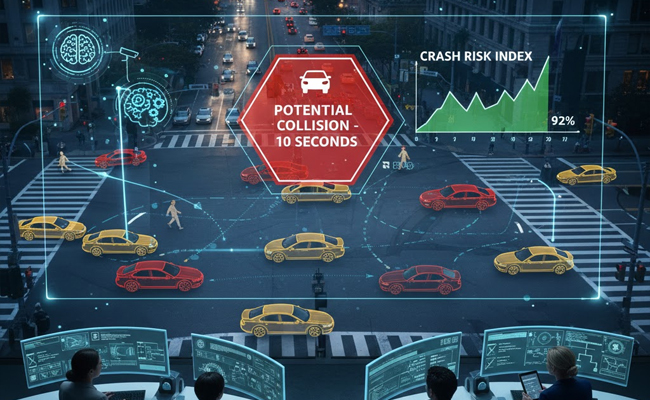
Davos (PTI): Artificial Intelligence is not just about creating text, images, graphics and videos online; it can make a big change in the physical life and for humanity by even predicting road crashes.
The assertion was made by SaveLife Foundation Founder and CEO Piyush Tewari here during the World Economic Forum Annual Meeting.
Tewari, who ventured into the area of working on road safety after losing a young family member in a road crash, said his organisation is looking at using AI in a big way for predictive analysis.
He also lauded the Government of India for a big push around AI in road safety.
Union Transport Minister Nitin Gadkari recently announced an initiative where AI is going to be used to interpret the road crash data that is coming out and provide faster insights.
"Can we predict road crashes by bringing some data points together? So, there's definitely a huge amount of application, and the signs are very much positive.
"At SaveLife, we have used AI for the last 7-8 years. We've trained cameras using AI, fixed with drones to preemptively identify parked vehicles on highways, for example, because rear-end collisions are a big issue when it comes to road safety.
"Similarly, we have used AI-trained cameras on intersections to identify conflicts and to create a heatmap of such intersections. We've defined conflicts on the basis of proximity, etc.," he said.
Tewari, who is participating in AI and social innovation sessions at WEF, said there's a significant amount of application of AI in this whole space of road safety.
"I hope to be contributing with regard to our experience of using it in India at a very, very grassroots level," he said.
"AI has the ability to transform lives. The decisions and the thought process that might take months sometimes can be done in hours or minutes using AI. We have to make AI more accessible to the public, and the Government of India's mission is also to make it more accessible.
"So we are very much aligned with the idea of using AI to make mobility safer," he said.
Let the Truth be known. If you read VB and like VB, please be a VB Supporter and Help us deliver the Truth to one and all.
Lt Gen NS Raja Subramani to be India's next Chief of Defence Staff
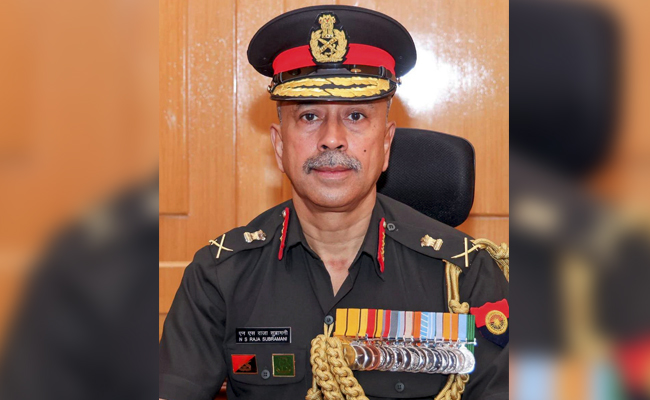
New Delhi (PTI): Lt Gen NS Raja Subramani will be India's new Chief of Defence Staff (CDS) and his key task is set to be to implement the ambitious theaterisation plan that seeks to ensure tri-services synergy.
He will succeed Gen Anil Chauhan whose tenure will come to an end on May 30.
Gen Chauhan, a former Eastern Army Commander, took charge as the country's senior-most military commander in September 2022, over nine months after the first CDS, General Bipin Rawat, died in a helicopter crash in Tamil Nadu.
The government has appointed Lt Gen NS Raja Subramani (Retd) as the Chief of Defence Staff, who will also function as the secretary of the Department of Military Affairs, the defence ministry said on Saturday.
Lt Gen Subramani is currently serving as the military adviser to the National Security Council Secretariat.
Prior to that, he was the Vice Chief of the Army Staff from July 1, 2024 to July 31, 2025, and was General Officer Commanding-in-Chief of the Central Command from March 2023 till June 2024.
As Chief of Defence Staff, Lt Gen Subramani's primary task will be to implement the theaterisation model to bring in tri-services synergy by rolling out integrated military commands.
The officer is a graduate of the National Defence Academy and the Indian Military Academy. He was commissioned into the eighth battalion of the Garhwal Rifles on December 14, 1985.
Lt Gen Subramani is an alumnus of Joint Services Command Staff College, Bracknell (UK), and the National Defence College, New Delhi. He holds a Master of Arts degree from King's College London and an MPhil in defence studies from Madras University.
In his illustrious career spanning over 40 years, Lt Gen Subramani has served across a wide spectrum of conflict and terrain profiles and tenanted a host of Command, Staff and Instructional appointments.
He commanded the 16 Garhwal Rifles in Counter-Insurgency operations in Assam as part of Operation Rhino, the 168 Infantry Brigade in Jammu and Kashmir, and the 17 Mountain Division in the Central Sector, all during a challenging operational environment.
He also has the distinction of commanding two Corps, including the Indian Army's premier strike Corps on the Western Front.