Arianespace to launch 3 more heavy Indian satellites
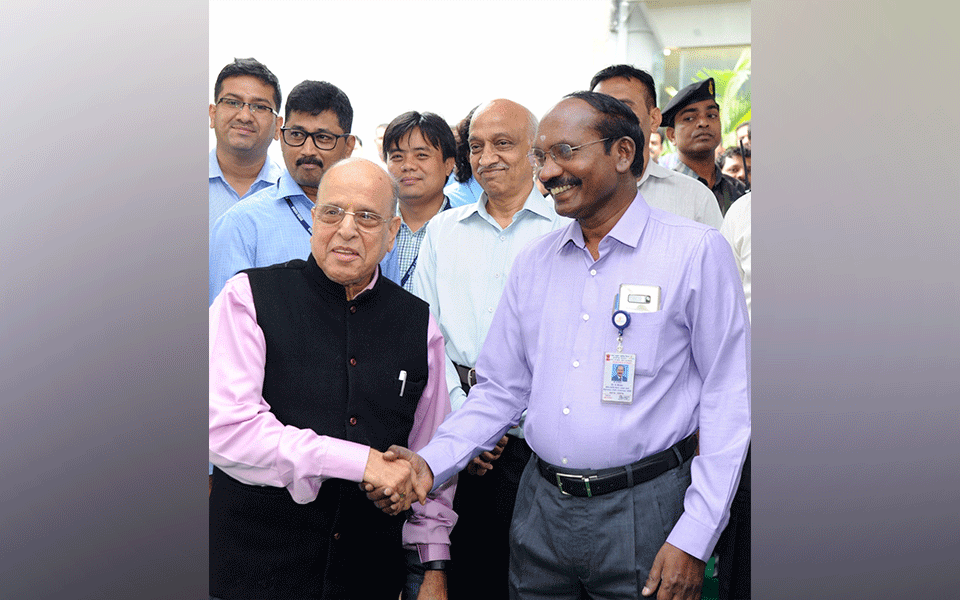
Bengaluru, Aug 12 : Global commercial launch provider Arianespace would launch three more heavy Indian satellites from its rocket port at Kourou in French Guiana over the next 9 months, a top space official said on Sunday.
"Arianespace will launch GSAT-11 on November 30, followed by GSAT-31 in December and GSAT-30 in May 2019," state-run Indian Space Research Organisation (ISRO) Chairman K. Sivan told reporters at an event here.
"GSAT-11 will be sent to Kourou in mid-October for launch on board Arian-5 rocket of Arianespace," said Sivan after the unveiling of the bust of Indian space pioneer Vikram Sarabhai at the space headquarters to mark his 99th birth anniversary.
Contrary to earlier reports, ISRO has decided to launch the two heavier satellites GSAT-31 and GSAT-30 on Ariane-5 to replace INSAT-4CR whose life gets over in January and INSAT-4A, as its life span ends in July 2019.
"Unless we launch the two satellites (GSAT-31 & GSAT-30) before the lifespan of earlier satellites end, we will have no telecast link and direct-to-home (DTH) services in the country," pointed out Sivan.
INSAT-4CR was launched on September 2, 2007 by ISRO on GSLV-F04 from Sriharikota and INSAT-4A was launched from Kourou on December 22, 2005.
Though ISRO planned to launch GSAT-31 and GSAT-30 on its heavy rocket GSLV Mk-2 (Geo-Stationary Launch Vehicle-Mark 2), it gave up the move as the life of the two spacecraft would be for only three years and not 15 years as intended to be.
As the GSLV Mark-3 will be used to launch India's second lunar mission Chandrayaan-2 with a lander and rover on January 3, the space agency is compelled to launch the two replacing heavy satellites on Arian-5.
"As per Arianespace protocol, the launch date must be signed four months prior to lift-off. We need to launch GSAT-31 by December 15 as the satellite (INSAT-4CR) to be replaced has a lifespan till January," added Sivan.
In this context, Sivan admitted that the space agency has limitations in making more heavier rockets (GSLV) than lighter rockets like the Polar Launch Satellite Vehicle (PSLV), which are used for putting spacecraft in the earth's lower orbit for common man's services.
Let the Truth be known. If you read VB and like VB, please be a VB Supporter and Help us deliver the Truth to one and all.
PM arrives at Brigade Parade Grounds for swearing-in ceremony of BJP's first govt in Bengal
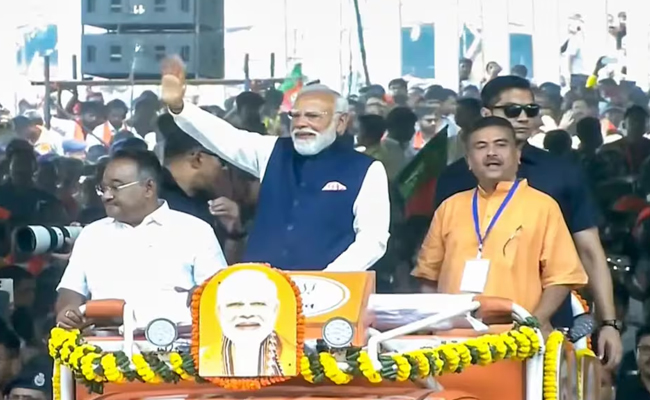
Kolkata (PTI): Prime Minister Narendra Modi arrived at the Brigade Parade Grounds here on Saturday to attend the swearing-in ceremony of the BJP's first government in West Bengal.
Accompanied by state BJP president Samik Bhattacharya and CM-elect Suvendu Adhikari, Modi was accorded a rousing welcome.
Amid the 'Jay Shri Ram' slogan, Modi entered the venue on an open vehicle and was seen waving at the crowd.
The Prime Minister landed at Netaji Subhas Chandra Bose International Airport here a little before 10 am and took a helicopter to reach the Race Course ground before proceeding by road to the venue.
Thousands of BJP supporters gathered at the Brigade Parade Grounds since early morning to witness the oath-taking ceremony.
The BJP secured 207 seats in the 294-member Assembly, ending the Trinamool Congress' 15-year rule in the state.