Astronomers capture most distant star ever seen
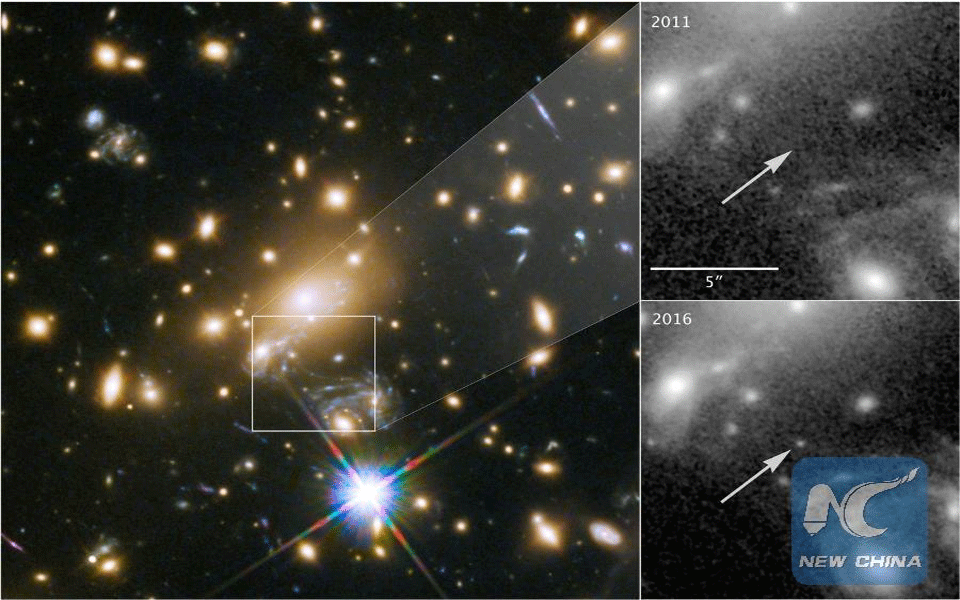
Washington: American astronomers have captured the most distant normal star ever observed, some 9 billion light years from Earth, thanks to a rare cosmic alignment.
The study, published on Monday online in the journal Nature Astronomy, revealed the discovery of a star called Icarus, magnified by gravitational lensing by over 2,000 times, reported Xinhua.
Astronomers routinely study galaxies much farther away, visible because they glow with the brightness of billions of stars. They also managed to study supernova, often brighter than the galaxy in which it sits.
However, for a distance of about 100 million light years, the stars in these galaxies are impossible to make out individually.
But a phenomenon called gravitational lensing, the bending of light by massive galaxy clusters in the line of sight, can magnify the distant universe and make dim, far away objects visible.
The single star was discovered in NASA Hubble Space Telescope images taken in late April of 2016 and as recently as April 2017.
"You can see individual galaxies out there, but this star is at least 100 times farther away than the next individual star we can study, except for supernova explosions," said Patrick Kelly at the University of Minnesota, Twin Cities, the paper's first author.
These observations can provide a rare look at how stars evolve, especially the most luminous ones.
"For the first time ever we're seeing an individual normal star - not a supernova, not a gamma ray burst, but a single stable star - at a distance of nine billion light years," said Alex Filippenko, a professor of astronomy at UC Berkeley and one of many co-authors of the report.
The B-type star Icarus is much larger, more massive, hotter and possibly hundreds of thousands of times intrinsically brighter than our Sun.
According to the researchers, an extended lens, like a galaxy cluster, can only magnify a background object up to 50 times, but smaller objects can magnify much more.
A single star in a foreground lens, if precisely aligned with a background star, can magnify the background star thousands of times.
In this case, a star about the size of our sun briefly passed directly through the line of sight between the distant star Icarus and Hubble, boosting its brightness significantly.
Also, if the alignment was perfect, that single star within the cluster turned the light from the distant star into an "Einstein ring": a halo of light created when light from the distant star bends around all sides of the lensing star.
The ring is too small to discern from this distance, but the effect made the star easily visible by magnifying its apparent brightness.
The astronomers predict that Icarus will be magnified many times over the next decade as cluster stars move around, perhaps increasing its brightness as much as 10,000 times.
Let the Truth be known. If you read VB and like VB, please be a VB Supporter and Help us deliver the Truth to one and all.
Lt Gen NS Raja Subramani to be India's next Chief of Defence Staff

New Delhi (PTI): Lt Gen NS Raja Subramani will be India's new Chief of Defence Staff (CDS) and his key task is set to be to implement the ambitious theaterisation plan that seeks to ensure tri-services synergy.
He will succeed Gen Anil Chauhan whose tenure will come to an end on May 30.
Gen Chauhan, a former Eastern Army Commander, took charge as the country's senior-most military commander in September 2022, over nine months after the first CDS, General Bipin Rawat, died in a helicopter crash in Tamil Nadu.
The government has appointed Lt Gen NS Raja Subramani (Retd) as the Chief of Defence Staff, who will also function as the secretary of the Department of Military Affairs, the defence ministry said on Saturday.
Lt Gen Subramani is currently serving as the military adviser to the National Security Council Secretariat.
Prior to that, he was the Vice Chief of the Army Staff from July 1, 2024 to July 31, 2025, and was General Officer Commanding-in-Chief of the Central Command from March 2023 till June 2024.
As Chief of Defence Staff, Lt Gen Subramani's primary task will be to implement the theaterisation model to bring in tri-services synergy by rolling out integrated military commands.
The officer is a graduate of the National Defence Academy and the Indian Military Academy. He was commissioned into the eighth battalion of the Garhwal Rifles on December 14, 1985.
Lt Gen Subramani is an alumnus of Joint Services Command Staff College, Bracknell (UK), and the National Defence College, New Delhi. He holds a Master of Arts degree from King's College London and an MPhil in defence studies from Madras University.
In his illustrious career spanning over 40 years, Lt Gen Subramani has served across a wide spectrum of conflict and terrain profiles and tenanted a host of Command, Staff and Instructional appointments.
He commanded the 16 Garhwal Rifles in Counter-Insurgency operations in Assam as part of Operation Rhino, the 168 Infantry Brigade in Jammu and Kashmir, and the 17 Mountain Division in the Central Sector, all during a challenging operational environment.
He also has the distinction of commanding two Corps, including the Indian Army's premier strike Corps on the Western Front.