Chandrayaan-3 mission to be launched on July 14, announces ISRO
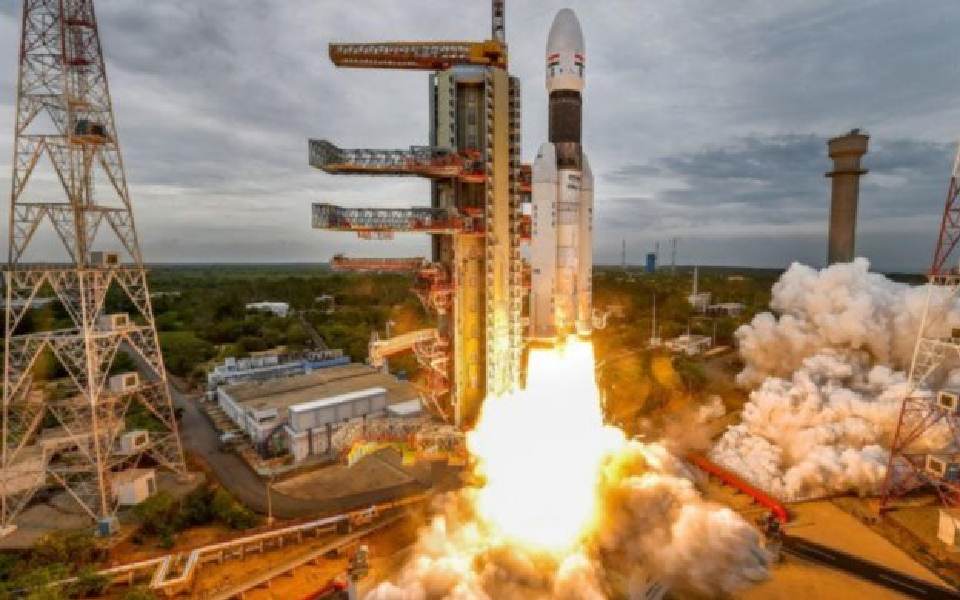
Bengaluru, July 6: The Indian Space Research Organisation (ISRO) on Thursday announced that its lunar mission Chandrayaan-3 will be launched on July 14 from the space port at Sriharikota in Andhra Pradesh.
ISRO's new heavylift launch vehicle LVM-3 will carry out the Moon mission.
"Announcing the launch of Chandrayaan-3: LVM3-M4/Chandrayaan-3 Mission: The launch is now scheduled for July 14, 2023, at 2:35 pm IST from SDSC (Satish Dhawan Space Centre), Sriharikota," ISRO tweeted.
The Chandrayaan-3 mission carries scientific instruments to study the thermophysical properties of the lunar regolith, lunar seismicity, lunar surface plasma environment and elemental composition in the vicinity of the landing site.
While the scope of these scientific instruments on the lander and the rover would fit in the theme of "Science of the Moon", another experimental instrument will study the spectro-polarimetric signatures of the Earth from the lunar orbit, which would fit in the theme of "Science from the Moon", according to ISRO officials.
In March this year, the Chandrayaan-3 spacecraft successfully completed the essential tests that validated its capability to withstand the harsh vibration and acoustic environment that the spacecraft would encounter during its launch.
These tests were particularly challenging, considering the fact that the Chandrayaan-3 spacecraft, which will be launched by LVM3 (Launch Vehicle Mark-III) (earlier referred to as GSLV Mk III), is a composite of three modules -- propulsion, lander and rover.
The propulsion module, which has Spectro-polarimetry of Habitable Planet Earth (SHAPE) payload to study the spectral and polarimetric measurements of Earth from the lunar orbit, will carry the lander and rover configuration till 100 km of the lunar orbit.
The lander payloads are: 'Chandra's Surface Thermophysical Experiment' to measure the thermal conductivity and temperature; 'Instrument for Lunar Seismic Activity' for measuring the seismicity around the landing site; and 'Langmuir Probe' to estimate the plasma density and its variations.
A passive Laser Retroreflector Array from US space agency National Aeronautics and Space Administration (NASA) is also accommodated for lunar laser ranging studies.
The rover payloads are: 'Alpha Particle X-ray Spectrometer' and 'Laser Induced Breakdown Spectroscopy' for deriving the elemental composition in the vicinity of the landing site.
The lander will have the capability to soft land at a specified lunar site and deploy the rover which will carry out in-situ chemical analysis of the lunar surface during the course of its mobility.
The main function of the propulsion module is to carry the lander module from launch vehicle injection till final lunar 100 km circular polar orbit and separate it.
Apart from this, the propulsion module also has one scientific payload as a value addition, which will be operated post separation of the lander module.
Let the Truth be known. If you read VB and like VB, please be a VB Supporter and Help us deliver the Truth to one and all.
Accused gunman at correspondents' dinner was believed to be targeting top officials, Blanche says
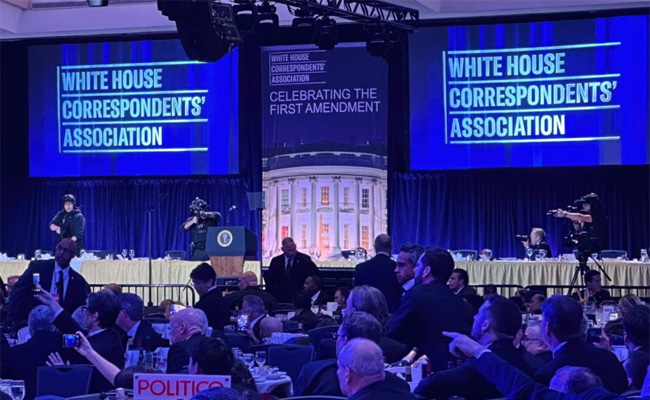
Washington (AP): The accused gunman who tried to storm the ballroom at the White House Correspondents' Association dinner with guns and knives travelled across the country before the event and is believed to have been targeting members of the Trump administration, acting Attorney General Todd Blanche said Sunday.
Blanche also said officials believe the suspect traveled by train from California to Chicago and then on to Washington, where in recent days he checked in as a guest to the hotel where one of Washington's glitziest events was being held Saturday night.
Investigators have not publicly named the suspect, but two law enforcement officials familiar with the matter have identified him to The Associated Press as 31-year-old Cole Tomas Allen of Torrance, California.
Law enforcement officials who have examined the gunman's electronic devices and his writings preliminarily believe he intended to target administration members in attendance at the dinner. He attempted to charge into the cavernous ballroom at the Washington Hilton but was tackled to the ground in a chaotic scene that resulted in shots being fired, President Donald Trump being hurried off the stage and guests ducking for cover beneath their tables.
“It does appear that he did in fact set out to target folks who work in the administration, likely including the president,” Blanche told NBC's “Meet the Press.”
The suspect is believed to have purchased the firearms he carried within the last couple of years, Blanche said. He is not being cooperative and is expected to face multiple charges on Monday.
Video posted by Trump showed the suspect running past security barricades as Secret Service agents ran toward him. One officer was shot in a bullet-resistant vest but was recovering, officials said. The gunman was taken into custody and was not injured, but was being evaluated at a hospital, police said.
“He failed,” Blanche said on CBS's “Face the Nation.” “Law enforcement did their jobs.”
Social media posts that appear to match the suspect show he is a highly educated tutor and amateur video game developer.
A May 2025 profile photo of Allen appears to match the appearance of the man in a photo of the alleged attacker being taken into custody that was posted Saturday night by Trump. The photo, posted to the social networking site LinkedIn, shows him in a cap and gown after graduating with a master's degree in computer science from California State University, Dominguez Hills.
Allen earned a bachelor's degree in 2017 in mechanical engineering from the California Institute of Technology in Pasadena. He listed his involvement there in a Christian student fellowship and a campus group that battled with Nerf guns.
The shooting at the security barricades happened minutes after the event got underway.
The Secret Service and other authorities swarmed the room as guests ducked under tables by the hundreds. Gasps echoed through the ballroom as guests realized something was happening. Hundreds of journalists immediately got on phones to call in information.
“Out of the way, sir!” someone yelled. Others yelled to duck. From one corner, a “God Bless America” chant began as the president was escorted offstage. Outside the hotel, members of the National Guard and other authorities flooded the area as helicopters circled overhead.
After an initial attempt to resume the event, it was scrapped for the night and will be rescheduled.

_vb_69.jpeg)