Don't miss your date with century's longest Lunar Eclipse on July 27
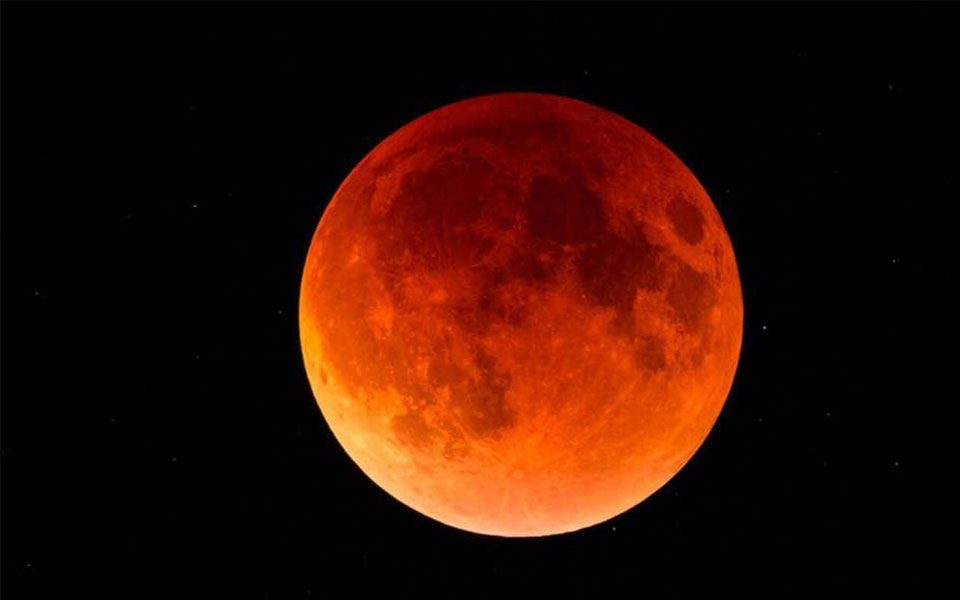
New Delhi, July 26 : If you missed the trilogy of supermoons earlier this year, the Lunar eclipse -- the longest of the 21st century -- set to occur on Friday, will offer you a rare celestial treat.
The celestial spectacle, which would be seen in its entirety from all parts of India, last for 1 hour 43 minutes, making it the longest total lunar eclipse of this century (2001 AD to 2100 AD), the Ministry of Earth Science had said.
The partial eclipse of the Moon will begin at 11.54 p.m. on July 27. The Moon will be gradually covered by the Earth's shadow and the totality phase will begin at 1 a.m. IST on July 28 and the total eclipse will last upto 2.43 a.m.. Then the Moon will start to gradually come out of Earth's shadow and partial eclipse will end at 3.49 a.m., the statement said.
During this eclipse, the Moon will pass through the central part of the Earth's umbral shadow. Furthermore, the Moon will be at apogee -- farthest from the Earth in its orbit, on July 27 and will be moving at a slower speed in its orbit.
This slower moving full Moon will take longer time and greater distance of Earth's umbral shadow cone to travel, making it the longest duration of total eclipse of this century.
Such long duration of total lunar eclipses had earlier occurred on July 16, 2000 for totality duration of 1 hour 46 minutes and another one on June 15, 2011 for totality duration of 1 hour 40 minutes, the statement said.
Moreover, the Sun and Mars will also lie opposite to each other, keeping the Earth in the middle.
This will result in Mars coming close to the Earth, causing it to appear brighter than normal and it will be seen from evening to dawn towards the end of July.
The brighter Mars will remain very close to the eclipsed Moon in the sky on July 27-28 and can be spotted very easily with the naked eye, the statement said.
The eclipse will be visible in parts of South America, much of Africa, the Middle East and Central Asia. For viewers in India, the eclipse, both partial and the total, will be visible in its entirety from all parts of the country.
Let the Truth be known. If you read VB and like VB, please be a VB Supporter and Help us deliver the Truth to one and all.
PM arrives at Brigade Parade Grounds for swearing-in ceremony of BJP's first govt in Bengal
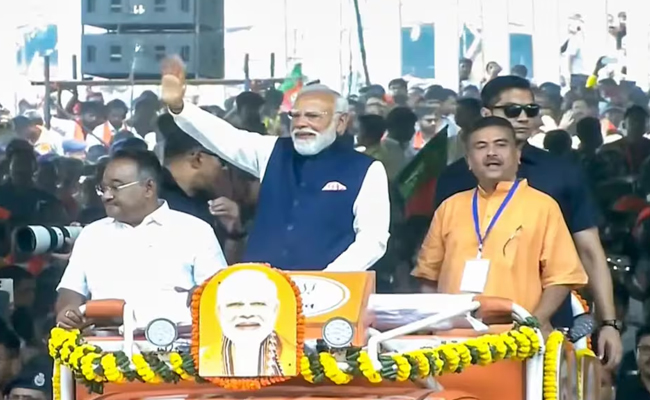
Kolkata (PTI): Prime Minister Narendra Modi arrived at the Brigade Parade Grounds here on Saturday to attend the swearing-in ceremony of the BJP's first government in West Bengal.
Accompanied by state BJP president Samik Bhattacharya and CM-elect Suvendu Adhikari, Modi was accorded a rousing welcome.
Amid the 'Jay Shri Ram' slogan, Modi entered the venue on an open vehicle and was seen waving at the crowd.
The Prime Minister landed at Netaji Subhas Chandra Bose International Airport here a little before 10 am and took a helicopter to reach the Race Course ground before proceeding by road to the venue.
Thousands of BJP supporters gathered at the Brigade Parade Grounds since early morning to witness the oath-taking ceremony.
The BJP secured 207 seats in the 294-member Assembly, ending the Trinamool Congress' 15-year rule in the state.