Gaganyaan mission: Test Vehicle fails to liftoff following anomaly, says ISRO
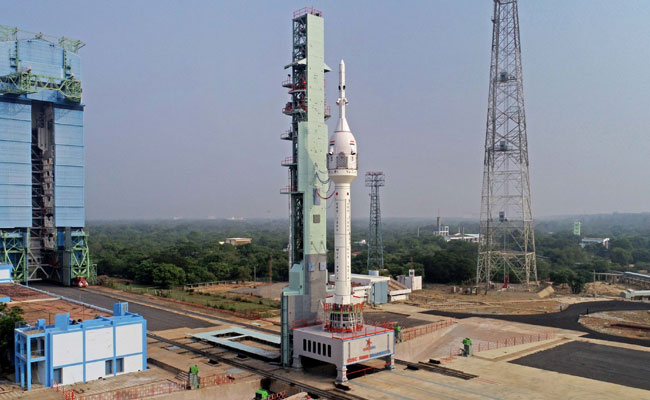
Sriharikota (Andhra Pradesh) (PTI): The liftoff of a test vehicle with crew safety related payloads connected to the ambitious Gaganyaan human space flight mission on Saturday could not happen as planned following an anomaly which will be analysed, ISRO chief S Somanath said.
Engine ignition of the TV-D1 rocket did not happen in the course of time.
After suffering delays twice, totaling 45 minutes, the rocket failed to liftoff from the spaceport here at 8.45 am, even as a "hold" signal flashed across the screens at the Satish Dhawan Space Centre while the final countdown was on.
There was a very smooth air lift and automatic launch sequence leading up to the command to lift off, "but the engine ignition has not happened in the nominal course due to anomaly," Somanath said soon after the mission was put on hold.
"And we have to find out what went wrong with that. The vehicle is safe, the entire vehicle is very safe. We will have to reach the vehicle and then look at what has happened now," he said, adding ISRO will come back soon after analysing what triggered the automatic launch sequence holding the vehicle.
"So what has happened is that the ground support computer doing this function has withheld the launch in view of the anomaly observed. We will come back after understanding the anomaly, correct it and schedule the launch very soon," the space agency's Chairman said from the Mission Control Center.
The revised launch schedule will be announced later after analysing what went wrong today, he added.
Let the Truth be known. If you read VB and like VB, please be a VB Supporter and Help us deliver the Truth to one and all.
Raghuvanshi, spinners fire KKR to seven-wicket win over SRH
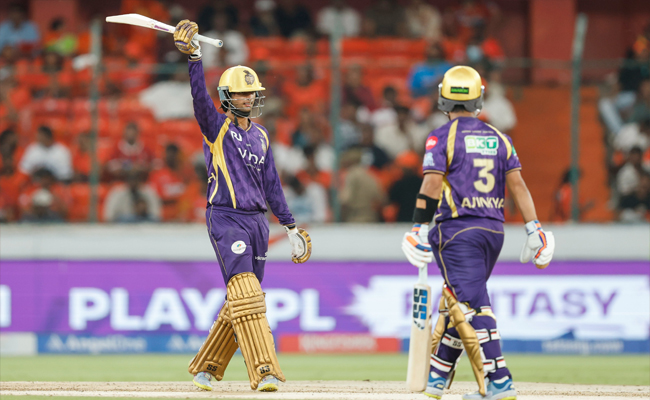
Hyderabad (PTI): The promising Angkrish Raghuvanshi (59) made a well-paced fifty as Kolkata Knight Riders defeated Sunrisers Hyderabad by seven wickets in their IPL match here on Sunday.
Skipper Ajinkya Rahane (43) and Raghuvanshi added 84 runs for the second wicket as KKR overhauled SRH’s under-par 165 all out with ease.
Finn Allen made an aggressive 29 off 13 balls upfront to give KKR a brisk start.
Earlier, Travis Head made a belligerent 61 off 28 balls but KKR's spinners bowled well to restrict SRH to 165.
Mystery spinners Varun Chakravarthy (3/36) and Sunil Narine (2/31) wrecked SRH middle-order with controlled spells.
Along the way of his two-wicket burst in his fourth-over, Narine also completed 200 IPL wickets.
The spinner was the third bowler to achieve the feat after Yuzvendra Chahal and Bhuvneshwar Kumar.
Ishan Kishan made 42 off 29 balls.
Brief Scores:
Sunrisers Hyderabad: 165 all out in 19 overs (Travis Head 61, Ishan Kishan 42; Varun Chakravarthy 3/36, Sunil Narine 2/31).
Kolkata Knight Riders: 169/3 in 18.2 overs (Angkrish Raghuvanshi 59, Ajinkya Rahane 43).