IIT scientists develop material that can harvest water from fog
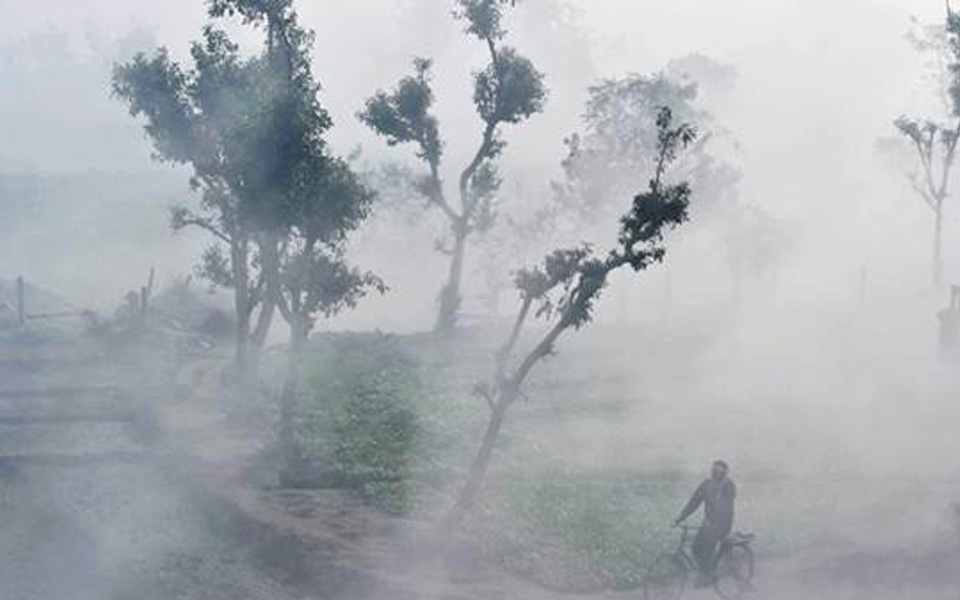
New Delhi, Oct 8 : Taking a leaf from nature's book, a team from IIT Mandi has developed a material that can harvest water from fog.
Researchers worldwide are working towards developing techniques that can harvest water from unexpected sources, such as fog and mist, to meet the burgeoning demand for water.
"There are several plants in arid and semi-arid regions of the world whose leaves can harvest water from dew and fog. If they can do it, so can we," said Venkata Krishnan, an associate professor at Indian Institute of Technology (IIT) Mandi, Himachal Pradesh.
For the study published in the journal ACS Sustainable Chemistry and Engineering, researchers studied the intricate structures on the leaves of an ornamental plant called the Dragon's lily head (Gladiolus dalenii).
The surface patterns on the leaf in micrometre and nanometre scales were evaluated in relation to the water harvesting properties, and the patterns were replicated onto a polymer material.
The team found a 230 per cent enhancement on the fog harvesting performance of the patterned samples, compared to an unpatterned control sample.
Solutions to provide drinking water to India's growing population must not only span policy and behavioural changes but also incorporate scientific and technological innovations inspired by nature, researchers said.
Let the Truth be known. If you read VB and like VB, please be a VB Supporter and Help us deliver the Truth to one and all.
No 'bacterial infection' found in bodies of 4 Mumbai family members who died after eating watermelon
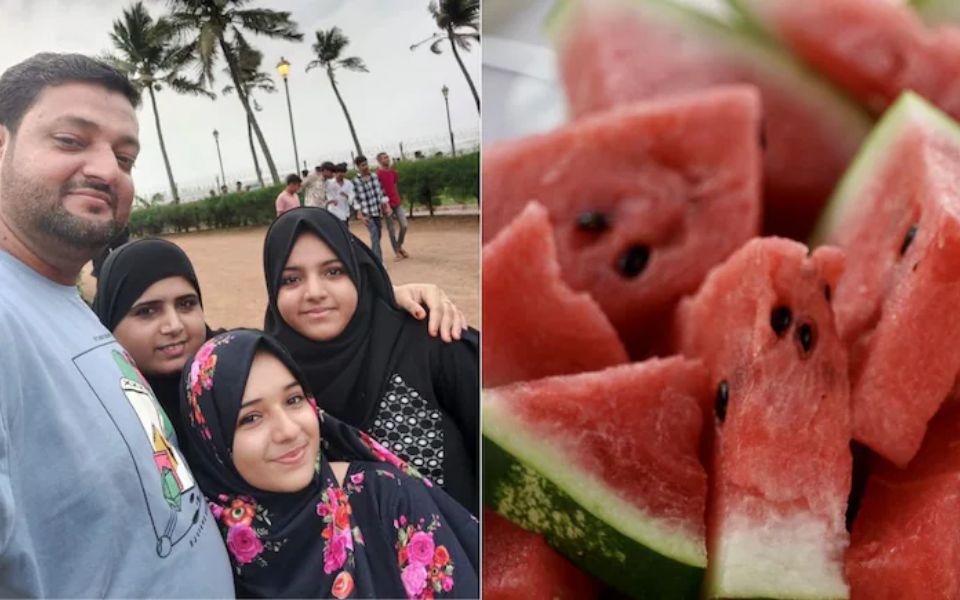
Mumbai (PTI): The initial report submitted by the microbiology department of a Mumbai-based state-run hospital has said no "bacterial infection" was detected in the bodies of four family members, who died after consuming watermelon recently, officials said on Wednesday.
The Dokadia family, residents of Ghari Mohalla on Ismail Kurte Road, had hosted a get-together of relatives on the night of April 25. At around 1 am (on April 26), hours after the guests had left, Abdullah Dokadia (40), his wife Nasreen (35), and daughters Ayesha (16) and Zaineb (13) ate pieces of a watermelon.
They suffered severe bouts of vomiting and diarrhoea in the early hours of April 26 and were rushed to a local hospital before being referred to the government-run J J Hospital where all four died during treatment.
After the incident, Mumbai police, forensic experts and Food and Drug Administration (FDA) officials visited the house and had collected samples of every food item that constituted the family's last meal, including 'chicken pulav', watermelon, water, and other foodstuffs, and sent them to the Forensic Science Laboratory for analysis.
After the post-mortem of the deceased, their viscera was preserved for chemical analysis.
As the probe is underway, the microbiology department of the state-run J J Hospital has submitted its initial report to the police.
"As per the report, no bacterial infection has been detected so far in the bodies of the victims. No bacteria was found in their blood," the official said.
The exact cause of the death will be known once the forensic science lab submits its report, he said.
"The report will also clarify whether any food items consumed by the family members during the day contained anything poisonous," the official said.