India's solar mission spacecraft Aditya-L1 gets send off from Earth as ISRO performs key manoeuvre
Bengaluru (PTI): Aditya L1 spacecraft, India's first space-based mission to study the Sun, got a "send-off" from the Earth after orbiting it since its September 2 launch as it underwent a key manoeuvre in the early hours of Tuesday, ISRO said.
The Trans-Lagrangian Point 1 Insertion manoeuvre marks the beginning of the spacecraft's about 110-day trajectory to the destination around the L1 Lagrange point, a balanced gravitational location between the Earth and the Sun.
"Off to Sun-Earth L1 point! The Trans-Lagrangian Point 1 Insertion (TL1I) manoeuvre is performed successfully. The spacecraft is now on a trajectory that will take it to the Sun-Earth L1 point. It will be injected into an orbit around L1 through a maneuver after about 110 days," ISRO said in a post on X (formerly Twitter).
This is the fifth consecutive time the Indian Space Research Organisation (ISRO) has successfully transferred an object on a trajectory toward another celestial body or location in space, the country's space agency said.
Aditya-L1 is the first Indian space-based observatory to study the Sun from a halo orbit around first Sun-Earth Lagrangian point (L1), located roughly 1.5 million km from earth, which is about one per cent of the Earth-Sun distance.
The Sun is a giant sphere of gas, and Aditya-L1 would study the outer atmosphere of the Sun. It will neither land on the Sun nor approach the Sun any closer.
Since its launch, Aditya-L1, during its journey around the Earth, underwent four Earth-bound manoeuvres on September 3, 5 ,10 and 15 respectively, during which it gained the necessary velocity for its further journey to L1.
Upon arrival at the L1 point, another manoeuvre binds Aditya-L1 to an orbit around L1.
The satellite spends its whole mission life orbiting around L1 in an irregularly shaped orbit in a plane roughly perpendicular to the line joining the Earth and the Sun.
Aditya-L1 is expected to arrive at the intended orbit at the L1 point after about 127 days, ISRO had said soon after the launch.
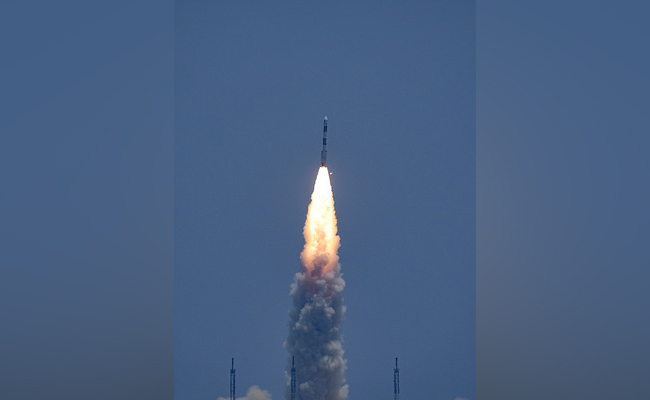
ISRO's Polar Satellite Launch Vehicle (PSLV-C57) on September 2 successfully launched the Aditya-L1 spacecraft, from the Second Launch Pad of Satish Dhawan Space Centre (SDSC), Sriharikota.
After a flight duration of 63 minutes and 20 seconds that day, Aditya-L1 spacecraft was successfully injected into an elliptical orbit of 235x19500 km around the earth.
According to ISRO, a spacecraft placed in the halo orbit around the L1 point has the major advantage of continuously viewing the Sun without any occultation /eclipses. This will provide a greater advantage of observing the solar activities and its effect on space weather in real time.
Aditya-L1 carries seven scientific payloads indigenously developed by ISRO and national research laboratories including Indian Institute of Astrophysics (IIA), Bengaluru, and Inter University Centre for Astronomy and Astrophysics (IUCAA), Pune.
The payloads are to observe the photosphere, chromosphere and the outermost layers of the Sun (the corona) using electromagnetic and particle and magnetic field detectors.
Using the special vantage point L1, four payloads directly view the Sun and the remaining three payloads carry out in-situ studies of particles and fields at the Lagrange point L1, thus providing important scientific studies of the propagatory effect of solar dynamics in the interplanetary medium.
The suits of Aditya L1 payloads are expected to provide the most crucial information to understand the problem of coronal heating, coronal mass ejection, pre-flare and flare activities and their characteristics, dynamics of space weather, propagation of particles and fields.
According to scientists, there are five Lagrangian points (or parking areas) between the Earth and the Sun where a small object tends to stay if put there. The Lagrange Points are named after Italian-French mathematician Joseph-Louis Lagrange for his prize-winning paper -- "Essai sur le Probl me des Trois Corps, 1772."
These points in space can be used by spacecraft to remain there with reduced fuel consumption.
At a Lagrange point, the gravitational pull of the two large bodies (the sun and the earth) equals the necessary centripetal force required for a small object to move with them.
Let the Truth be known. If you read VB and like VB, please be a VB Supporter and Help us deliver the Truth to one and all.
T'gana RTC strike: Talks between govt, employees successful

Hyderabad (PTI): Talks between employees of Telangana State Road Transport Corporation (RTC) who were on strike and the state government concluded successfully on Friday as the government agreed to the key demands of the workmen.
Following a day-long marathon of talks between the leaders of the employees' Joint Action Committee (JAC) and the cabinet sub-committee, the government announced after midnight that it acceded to the demands, including a merger of RTC with the government, 11 per cent pay revision and elections to the employees' unions.
A committee comprising officials and employee leaders would be appointed over the merger of RTC with the government, it said.
The RTC management has also agreed to address the remaining issues as well, an official release said.
The employees would call off their strike and the RTC buses would hit the roads shortly, it said.
The employees had been on an indefinite strike since April 22 over a series of demands, including the merger of RTC with the government.
Earlier in the day, a driver of the RTC, who attempted suicide on April 23 during the strike, died at a hospital here in the early hours of Friday.
Shankar Goud, a 55-year-old driver, set himself ablaze by pouring petrol at Narsampet in Warangal district when the employees were staging a protest on Thursday in support of their demands.
Goud suffered serious burns, was initially admitted to a state-run hospital in Warangal, and later shifted to a super-speciality hospital in Hyderabad for advanced treatment.
"He succumbed (to injuries) at about 1.30 am on Friday," a senior official said.
The driver’s body was taken to his relative’s village, Muttojipet in Warangal district, for funeral rites.
Tension prevailed in Muttojipet as his family members and RTC employees attempted to take the body to the Narsampet bus station, where he worked, to enable his colleagues to pay their last respects. However, police did not permit this, citing law-and-order concerns.
This led to a deadlock before the funeral could proceed.
Union Minister Bandi Sanjay Kumar criticised the Telangana government for not allowing the body to be taken to the Narsampet bus station.
Kumar, Minister of State (Home), visited Muttojipet village in Warangal district, where the funeral was held, and paid homage to Goud.
“They (family members) want to take the body to the bus depot for five minutes. Is the RTC bus depot in Pakistan or Bangladesh? They are emotionally attached to taking the body there. The government is hurting sentiments and creating fear among RTC employees,” Kumar told reporters.
He also expressed anger at the police for not allowing the body to be taken to the bus station and staged a protest, according to a release from his office.
RTC employees and BJP workers attempted to take the mortal remains in an ambulance to Narsampet, but were stopped by the police.
Later, after discussions with the police, the family members and RTC employees agreed to conduct the funeral in the village.
Sanjay Kumar, stating he would abide by the family’s decision, left the village after the funeral was conducted there.
Transport Minister Ponnam Prabhakar said an ex gratia of Rs 10 lakh, a house, and a government job would be provided to the kin of Goud.
Chief Minister A Revanth Reddy expressed shock over the employee’s death and conveyed deep condolences to the grieving family, according to the release.
The RTC employees’ JAC had earlier announced an agitation programme from April 24 to 29, including silent marches and submission of memorandums to MLAs and other leaders.