ISRO all set for launch of heaviest communication satellite from Indian soil onboard LVM3-M5
Sriharikota (PTI): ISRO's over 4,000 kg communication satellite CMS-03 is all set to be launched from this space port on Sunday.
The satellite, weighing about 4,410 kg will be the heaviest to be launched from the Indian soil and into a Geosynchronous Transfer Orbit (GTO), the space agency said. The satellite will travel onboard a LVM3-M5 rocket, dubbed as 'Bahubali' for its heavylift capability.
The launch vehicle has been fully assembled and integrated with the spacecraft and it has been moved to the second launch pad here for taking up pre-launch operations, the Bengaluru-headquartered space agency said on Saturday.
The 43.5 metre tall rocket, dubbed as 'Bahubali' for its ability to carry heavier payloads weighing up to 4,000 kg, is scheduled for a 5.26 pm liftoff on November 2.
LVM3- (Launch Vehicle Mark-3) is the new heavy lift launch vehicle of ISRO and is used for placing 4,000 kg spacecraft in GTO in a cost-effective manner, ISRO said.
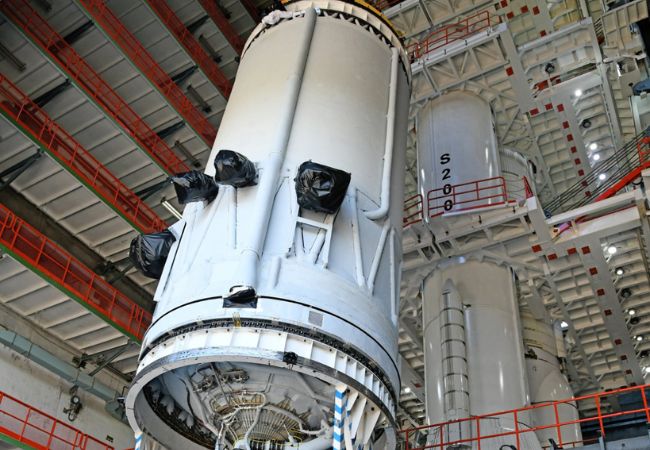
This three stage launch vehicle with two solid motor strap-ons (S200), a liquid propellant core stage (L110) and a cryogenic stage (C25) gives ISRO full self-reliance in launching heavier communication satellites that weigh up to 4,000 kg in GTO.
LVM3- is also termed by ISRO scientists as Geosynchronous Satellite Launch Vehicle (GSLV) MkIII.
The LVM3-M5 is the fifth operational flight, ISRO said.
The space agency had previously launched its heaviest communication satellite GSAT-11 on December 5, 2018 from Kourou launch base, French Guiana by Ariane-5 VA-246 rocket. Weighing about 5,854 kg, GSAT-11 is the heaviest satellite built by ISRO.
Sunday's mission objective is that the CMS-03, a multi-band communication satellite, will provide services over a wide oceanic region including the Indian landmass, ISRO said.
The previous mission of LVM-3 rocket was the successful launch of Chandrayaan-3 mission, wherein, India became the first country to land successfully near the lunar South pole in 2023.
The LVM3- rocket is capable to carry payload to GTO weighing 4,000 kg and for Low Earth Orbit payloads of 8,000 kg with its powerful cryogenic stage.
The two S200 solid rocket boosters located on the sides of the rocket provide the thrust required for lift off. The S200 boosters are developed at Vikram Sarabhai Space Centre, Thiruvananthapuram. The third stage is L110 Liquid Stage and is powered by two Vikas engines designed and developed at the Liquid Propulsion Systems Centre.
Let the Truth be known. If you read VB and like VB, please be a VB Supporter and Help us deliver the Truth to one and all.
Lt Gen NS Raja Subramani to be India's next Chief of Defence Staff
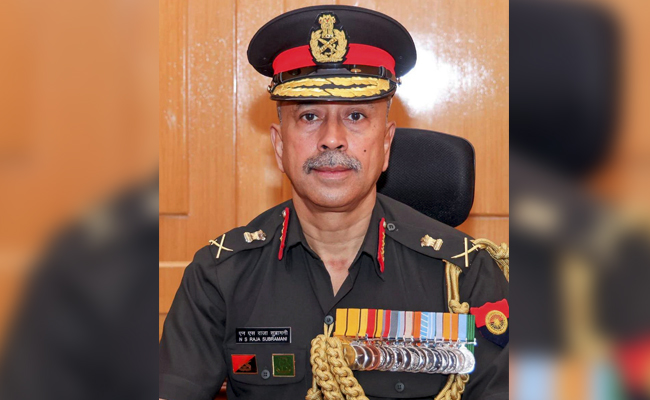
New Delhi (PTI): Lt Gen NS Raja Subramani will be India's new Chief of Defence Staff (CDS) and his key task is set to be to implement the ambitious theaterisation plan that seeks to ensure tri-services synergy.
He will succeed Gen Anil Chauhan whose tenure will come to an end on May 30.
Gen Chauhan, a former Eastern Army Commander, took charge as the country's senior-most military commander in September 2022, over nine months after the first CDS, General Bipin Rawat, died in a helicopter crash in Tamil Nadu.
The government has appointed Lt Gen NS Raja Subramani (Retd) as the Chief of Defence Staff, who will also function as the secretary of the Department of Military Affairs, the defence ministry said on Saturday.
Lt Gen Subramani is currently serving as the military adviser to the National Security Council Secretariat.
Prior to that, he was the Vice Chief of the Army Staff from July 1, 2024 to July 31, 2025, and was General Officer Commanding-in-Chief of the Central Command from March 2023 till June 2024.
As Chief of Defence Staff, Lt Gen Subramani's primary task will be to implement the theaterisation model to bring in tri-services synergy by rolling out integrated military commands.
The officer is a graduate of the National Defence Academy and the Indian Military Academy. He was commissioned into the eighth battalion of the Garhwal Rifles on December 14, 1985.
Lt Gen Subramani is an alumnus of Joint Services Command Staff College, Bracknell (UK), and the National Defence College, New Delhi. He holds a Master of Arts degree from King's College London and an MPhil in defence studies from Madras University.
In his illustrious career spanning over 40 years, Lt Gen Subramani has served across a wide spectrum of conflict and terrain profiles and tenanted a host of Command, Staff and Instructional appointments.
He commanded the 16 Garhwal Rifles in Counter-Insurgency operations in Assam as part of Operation Rhino, the 168 Infantry Brigade in Jammu and Kashmir, and the 17 Mountain Division in the Central Sector, all during a challenging operational environment.
He also has the distinction of commanding two Corps, including the Indian Army's premier strike Corps on the Western Front.