ISRO forays into small satellite launch market with SSLV success
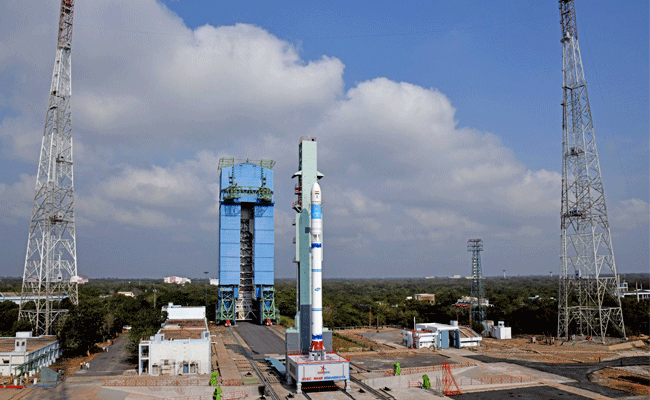
Sriharikota (AP) (PTI): ISRO on Friday tasted maiden success in the small satellite launch vehicle segment, with its SSLV D2 rocket injecting three satellites into an intended circular orbit, months after the maiden mission failed to bring in the desired results.
The satellites included ISRO's earth observation satellite EOS-07.
ISRO's first mission in 2023 and SSLV's sequel saw a strange coincidence--it was launched at 9.18 AM, the same time its predecessor lifted off from the Satish Dhawan Space Centre here on August 7, 2022 but could not deliver due to orbit anomaly and flight path deviation.
With the earlier SSLV not living up to the expectations, 'corrective measures' were put in its successor.
A visibly relieved Chairman of the Indian Space Research Oragnisation (ISRO), S Somanath said SSLV in its second flight put the three satellites in the intended orbit with precision.
"Congratulations to the space community of India...we have a new launch vehicle, the small satellite SSLV. In its second attempt, SSLV D2 has placed the satellites in the intended orbit precisely. Congrats to all three satellite teams," he said from the Mission Control Centre (MCC) soon after the successful launch that brought all round smiles.
All the problems related to the previous SSLV launch have been identified, corrective action taken and implemented in good time, Somanath added.
Mission Director S Vinod said the ISRO team made a "comeback" is short time soon after the August 7, 2022 failure.
ISRO now has a "new launch vehicle" on offer for the launch vehicle community, he added.
Earlier, the 34-metre tall SSLV soared into majestically into clear skies at 9.18 AM, after a six and a half hour countdown, carrying with it the EOS-07, besides Janus-1 and AzaadiSAT-2 satellites. The rocket placed the satellites into the intended 450-km circular orbit after a 15-odd minute flight.
EOS-07 is a 156.3 kg satellite which has been designed, developed and realised by ISRO. New experiments include mm-Wave Humidity Sounder and Spectrum Monitoring Payload.
Janus-1, a 10.2 kg satellite, built by Antaris, USA is a technology demonstrator, smart satellite mission, ISRO said.
AzaadiSAT-2, weighing about 8.2 kg is a combined effort of about 750 girl students across India guided by Space Kidz India, Chennai. It aims to demonstrate amateur radio communication capabilities, measure radiation, among others, the space agency added.
According to ISRO, SSLV is capable of launching mini, micro or nano satellites in the 10-500 kg segment into the 500 km planar orbit. It caters to the launch of satellites to Low Earth Orbits (LEO) on "launch-on-demand" basis. It provides low-cost access to Space, offers low turn-around time and flexibility in accommodating multiple satellites, and demands minimal launch infrastructure, ISRO added.
It is configured with three solid propulsion stages and a velocity terminal module.
Let the Truth be known. If you read VB and like VB, please be a VB Supporter and Help us deliver the Truth to one and all.
NIA registers case to probe recovery of 79 crude bombs in poll-bound West Bengal
New Delhi (PTI): The National Investigation Agency (NIA) on Sunday registered a case to probe recovery of 79 crude bombs in poll-bound West Bengal, officials said.
The move came following a directive by the Union Home Ministry in this regard, they said.
In pursuance to the home ministry's order, the anti-terror agency on Sunday registered a case, which was originally filed at Uttar Kashi police station, Bhangar division, Kolkata on Saturday, and took up the investigation, an NIA spokesperson said in a late night statement.
"The case pertains to recovery of 79 crude bombs and other incriminating materials by Kolkata police, which were being stored at a spot, thereby endangering human life and property," the spokesperson said.
Earlier in the day, the Election Commission had directed the West Bengal Police to launch a special drive to arrest those involved in illegal manufacturing of crude bombs in the poll-bound state, an official said.
It asserted that all cases related to the making of any such explosive would be probed by the National Investigation Agency, the official said.
The directive came after the police recovered a large number of crude bombs from the house of a person, allegedly a TMC worker, at Bhangar in South 24 Parganas district, days ahead of the second and final phase of the assembly polls in the state.
The explosives were recovered during a search at the residence of Rafikul Islam following specific inputs, the official said.
The poll panel also issued a warning to senior police officers across the state over any lapse in maintaining law and order before the April 29 polling.
The first phase of the assembly elections in West Bengal was held on April 23, while the second phase will take place on April 29. Votes will be counted on May 4.
A record 93.19 per cent turnout has been recorded in the first round of polling. Bhangar will vote in the second phase.