ISRO successfully brings down Cartosat-2 to Earth's atmosphere 17 years after its launch
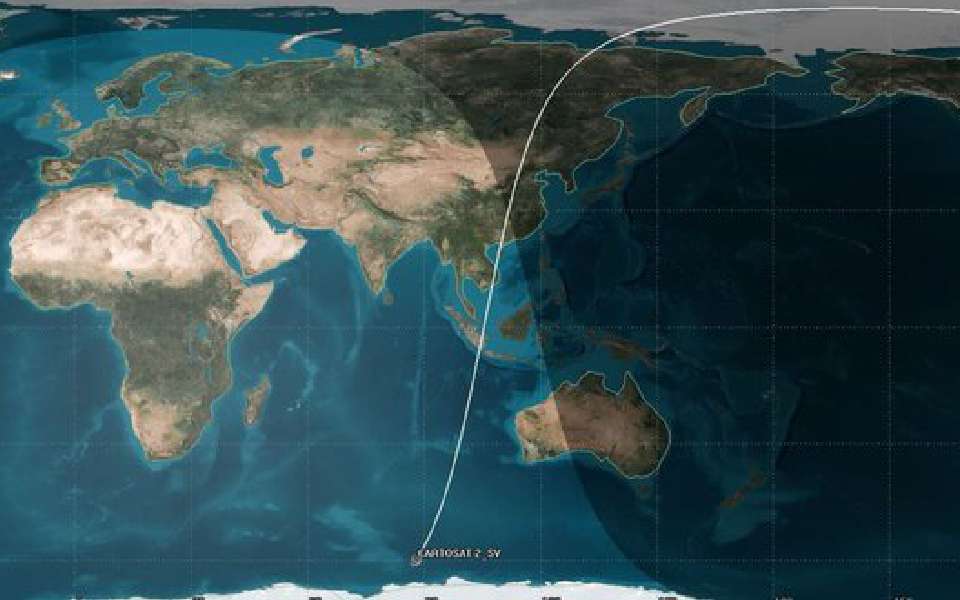
Bengaluru, Feb 16: Cartosat-2, ISRO's first satellite in the second generation of high-resolution imaging satellites launched 17 years ago, has been brought down from space to the earth's atmosphere, an official of the space agency said on Friday.
"The satellite entered the earth's atmosphere at 3.48 pm IST on February 14 over the Indian ocean. Either it would have burnt out or its leftovers might have fallen in the sea, which we may not be able to find," the official said.
According to ISRO, the satellite was launched on January 10, 2007. It weighed 680 kg at launch and operated in a sun-synchronous polar orbit at an altitude of 635 km.
Until 2019, it provided high-resolution imagery for urban planning, ISRO said in a statement.
"Initially, Cartosat-2 was expected to take about 30 years to naturally de-orbit. However, ISRO opted to lower its perigee using leftover fuel to comply with international guidelines on space debris mitigation," it said.
"This exercise involved reducing collision risks and ensuring safe end-of-life disposal, following recommendations from organisations like the United Nations Committee on the Peaceful Uses of Outer Space (UN-COPOUS) and the Inter-Agency Space Debris Coordination Committee (IADC)," ISRO said.
ISRO said its System for Safe and Sustainable Space Operations (IS4OM) team at ISRO Telemetry Tracking and Command Network (ISTRAC) predicted Cartosat-2's atmospheric re-entry for February 14.
"Electrical passivation was completed on February 14th, and tracking continued until re-entry. The final telemetry frames confirmed successful passivation, with the satellite reaching about 130 km altitude," ISRO said.
This exercise provided an opportunity to assess indigenous tracking capabilities, with the multi-object tracking radar at the spaceport of Sriharikota utilised for tracking.
"The final prediction placed Cartosat-2's re-entry over the Indian Ocean at 10:18 UTC / 3:48 pm IST on February 14, 2024. Analysis indicated that all major spacecraft components would demise (sic) during atmospheric re-entry," ISRO said.
According to the space agency, Cartosat-2's successful de-orbiting at its end-of-life represents a significant step for ISRO in ensuring the long-term sustainability of outer space activities.
Cartosat-2: Atmospheric re-entry
— ISRO (@isro) February 16, 2024
🛰️ Cartosat-2, ISRO's high-resolution imaging satellite, bid adieu with a descent into Earth's atmosphere on February 14, 2024, as predicted.
ISRO had lowered its orbit from 635 km to 380 km by early 2020.
This strategic move minimized space… pic.twitter.com/HJCWONymS9
Let the Truth be known. If you read VB and like VB, please be a VB Supporter and Help us deliver the Truth to one and all.
China confirms its support to Pakistan during four-day conflict with India

Beijing (PTI): China, for the first time, has confirmed that it provided on-site technical support to Pakistan during the four-day conflict with India last year, official media reports here said.
China's state broadcaster CCTV on Thursday aired an interview with Zhang Heng, an engineer from the Aviation Industry Corporation of China's (AVIC) Chengdu Aircraft Design and Research Institute, a key developer of China’s advanced fighter aircraft and unmanned aerial vehicle design.
Zhang had provided technical support to Pakistan during the four-day war last May, Hong Kong-based South China Morning Post reported, quoting CCTV.
Pakistan's air force operates a fleet of Chinese-made J-10CE jets, produced by an AVIC subsidiary.
"At the support base, we frequently heard the roar of fighter jets taking off and the constant wail of air-raid sirens. By late morning, in May, the temperature was already approaching 50 degrees Celsius (122 degrees Fahrenheit). It was a real ordeal for us, both mentally and physically,” Zhang said.
What drove his team was the "desire to do an even better job with on site support” and to ensure their equipment could “truly perform at its full combat potential”, Zhang told CCTV.
“That wasn’t just a recognition of the J10CE; it was also a testament to the deep bond we formed through working side by side, day in and day out,” he said.