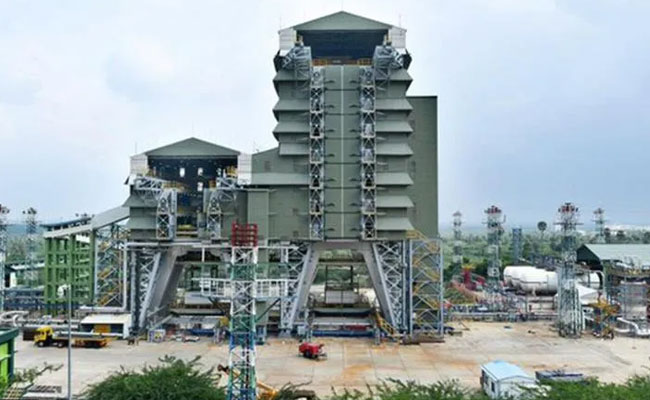
Bengaluru (PTI): The Indian Space Research Organisation has sucessfully commenced testing of its semi-cryogenic engines that would power future launch vehicles.
The very first integrated test on an intermediate configuration of the 2000 kN (Kilonewton)
semi-cryogenic engine carried out at the newly-commissioned Semicryogenic Integrated Engine & Stage Test facility at ISRO Propulsion Complex (IPRC) at Mahendragiri in Tamil Nadu on Wednesday was successful, the Bengaluru-headquartered national space agency said.
The test is a step towards developing a 2000 kN thrust engine, which works on Liquid Oxygen (LOX)-Kerosene propellant combination, for future launch vehicles, an ISRO statement said.
The intermediate configuration, designated as Power Head Test Article (PHTA), comprises all the engine systems except the thrust chamber.
It was the first of a series of tests planned to validate the design of the propellant feed system, including the low-pressure and high-pressure turbo-pumps, the gas generator, and control components.
The Liquid Propulsion Systems Centre (LPSC) of ISRO has undertaken the design & development of a semi-cryogenic engine with 2000 kN thrust with Indian industry participation, and it will power the booster stages of future launch vehicles.
Wednesday's test is a major milestone before integrating the complete engine and its qualification, ISRO said.
"This test demonstrated the complex chill-down operations spanning about 15 hours duration that was conducted successfully, meeting all the required conditions for engine start. After the chill down of the LOX circuit, the feed circuit of kerosene was filled, and LOX was admitted into the gas generator by opening the injection valve. Successful performance of the test article helps derive the sequence of operations for further tests," it said.
The new facility at IPRC with a state-of-the-art Programmable Logic Controllers-based control system and data acquisition system, is capable of testing semi-cryogenic engines up to 2600 kN thrust and will support the subsequent testing and qualification of the fully integrated semi-cryogenic engine and stage, ISRO said.
This test, the space agency said, has demonstrated the successful performance of the test facility and PHTA in the first attempt itself.
According to ISRO, the Semi Cryogenic Propulsion System Project envisages the design and development of a 2000 kN semi-cryogenic engine and 'SC120 stage' that will enable the development of a heavy-lift capability for future Indian space transportation systems.
Let the Truth be known. If you read VB and like VB, please be a VB Supporter and Help us deliver the Truth to one and all.
New Delhi: In a striking turn that surprised even his regular viewers, Arnab Goswami spent the evening of December 4 taking direct aim at the central government over the ongoing crisis in the domestic aviation sector. The debate, aired on Republic, focused entirely on the severe disruption caused by IndiGo flight cancellations and the state of air travel in the country. The tone was sharp, emotional, and openly critical, raising the larger question of whether this marks a homecoming of sorts for the anchor long accused by critics of being soft on the government.
Goswami began the show by saying the central government had “completely let down” air passengers. He pointed to chaotic visuals from airports in Pune, Ahmedabad and Mumbai, describing passengers packed into crowded spaces, long queues, and travellers lying on the floor with little access to basic facilities. He said anyone travelling with children or elderly parents would understand the distress such situations cause.
According to him, the government often claims to have improved the aviation sector, but the day-to-day experience of passengers tells a different story. He argued that whatever help the government may have extended has benefited individuals and individual companies, not the sector as a whole.
Goswami highlighted data from the last three days, saying IndiGo had canceled 1,232 flights in November. He broke down the reasons for the cancellations: 755 linked to crew and FDTL constraints, 258 due to airspace and airport restrictions, 92 because of failures in air traffic control systems, 127 for other reasons.
He said passengers in India are often “taken for granted” and that only in this country can such large-scale cancellations take place without consequences.
Throughout the debate, Goswami repeatedly returned to the theme of duopoly. He said Air India and IndiGo together control 91.5 percent of the aviation market, leaving only a small share for others like Akasa and SpiceJet. This, he said, gives the two big players the power to decide prices and escape accountability.
“They can set the prices. They can torture passengers. They can be not answerable for air crashes.” He added.
Goswami also questioned why such a structure is allowed to exist if the government claims it opposes monopolies. He asked whether the government has made Air India accountable after the recent air crash, and said he did not believe so.
“We are told that the Modi government does not like monopolies. First of all, I don't agree with that. There are too many monopolies happening.” He said.
The anchor accused Air India of operating aircraft that were not airworthy and said no serious action followed. According to him, any other minister in charge of civil aviation would have been removed after such incidents, but nothing happened.
“He is not answerable. And why is the central government not bothered about it? Because he comes from the TDP, an alliance party. So let him do,” he said.
He added that Air India continues to seek government support, including compensation for losses after the Sindhur episode. Goswami questioned why public money should be used to support the airline, drawing a comparison with the earlier controversy involving Vijay Mallya seeking help from the Manmohan Singh government a move that was labelled as scam.
Goswami said passengers are suffering because of delayed flights, sudden cancellations, and lack of compensation. He criticised the DGCA, saying it was not enforcing safety and operational norms. He also questioned why the Prime Minister’s Office had not intervened.
He noted that Republic had carried multiple exposés on these issues and claimed that Air India chooses to give interviews and advertisements only to other channels.
He also called for Parliament to debate the aviation mess and examine whether monopolies or duopolies should be allowed in a nation of India’s size.
“I'm sure the government's not going to be happy with us saying this, but someone's got to speak up for the people of this country.” He added.
Known by his critics as the “Godi Media Chief”, Goswami’s direct attack on the Modi government over civil aviation raised eyebrows across media circles.
Whether this is a one-off outburst or a sign of a new editorial direction is something viewers will be watching closely.
#AviationCollapse | India’s aviation sector is in turmoil as IndiGo’s mass cancellations and Air India’s alleged safety lapses leave passengers stranded. The disruption raises serious questions about airline management, regulatory oversight, and who is ultimately responsible for… pic.twitter.com/Dqt6pcoW8w
— Republic (@republic) December 4, 2025