ISRO successfully deploys magnetometer boom on board Aditya-L1 spacecraft
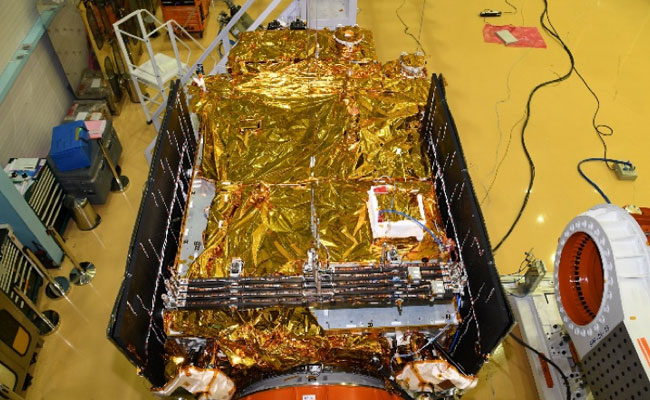
Bengaluru (PTI): ISRO has successfully deployed the magnetometer boom on board the Aditya-L1 satellite to measure the low intensity interplanetary magnetic field in space.
The six metre-long magnetometer boom is deployed in the Halo orbit at the Lagrange point L-1, on January 11, the space agency said, noting that the boom had been in stowed condition for 132 days since the Aditya-L1 launch.
According to ISRO, the boom carries two state-of-the-art, high-accuracy fluxgate magnetometer sensors that measure the low intensity interplanetary magnetic field in space.
"The sensors are deployed at distances of 3 and 6 metres from the spacecraft body. Mounting them at these distances minimises the impact of the spacecraft generated magnetic field on measurements, and using two of them assists precise estimation of this influence. The dual sensor system facilitates cancelling out the spacecraft's magnetic influence," it said.
The boom segments are constructed from carbon fibre reinforced polymer and serve as interfaces for the sensor mounting and mechanism elements, ISRO said.
The articulated boom mechanism comprises five segments interconnected through spring-driven hinge mechanisms, allowing for folding and deploying actions, it was noted.
India's maiden solar mission Aditya-L1 reached the L1 point, located roughly 1.5 million km from earth enabling the spacecraft to view the sun continuously, on January six, 127 days after it was launched on September 2, 2023.
The solar observatory at L1 is aimed at "Observing and understanding the chromospheric and coronal dynamics of the Sun" in a continuous manner.
Let the Truth be known. If you read VB and like VB, please be a VB Supporter and Help us deliver the Truth to one and all.
Bihar: Over 150 children fall ill after consuming 'mid-day meal' in Saharsa

Saharsa (PTI): More than 150 children were taken ill after allegedly consuming food that was part of the mid-day meal in a school in Bihar’s Saharsa district, a senior official said on Thursday.
The incident occurred at a middle school in Baluaha village of the district.
The official said that 115 children were undergoing treatment at the Sadar Hospital, while around 50 students were admitted to Mahishi Public Health Centre.
“We received information that several children fell ill after consuming the mid-day meal in Baluaha. The children were initially treated at the primary health centre, but later, many were referred to the Sadar Hospital,” Saharsa District Magistrate Deepesh Kumar told reporters.
“According to doctors, the health condition of the children has improved, but they will be kept under observation for some time. There is no need to panic. Some kids are having mild fever. They are being treated accordingly,” Kumar said.
Meanwhile, family members of some children claimed that a snake was found in the container in which cooked pulses was stored at the school.
Of the 545 students present in the school, 200 had already eaten their meals by the time the snake was spotted, and later complained of stomach ache and vomiting, they said.
Regarding the claims, the DM said food samples have been collected from the school.
“We will be able to comment on this only after the results of the tested samples arrive,” he said.