ISRO successfully places seven Singaporean satellites into intended orbit
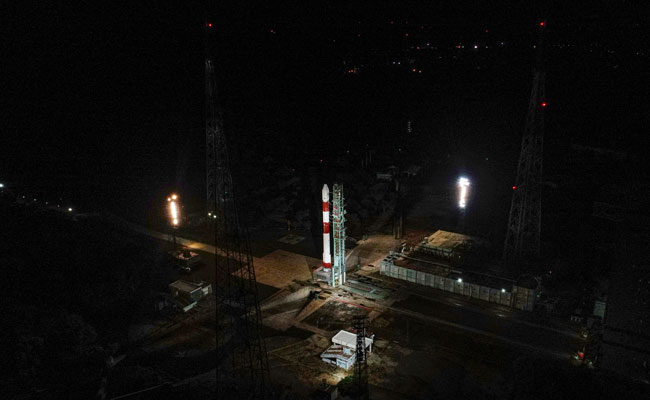
Sriharikota, (AP) (PTI): ISRO on Sunday successfully launched its proven PSLV rocket carrying seven Singaporean satellites from Satish Dhawan Space Centre here and placed them into intended orbits.
Around 23 minutes after lift-off, the primary satellite got separated and it was followed by six other co-passenger satellites, which were deployed into the intended orbits sequentially, ISRO said.
This ISRO mission, which comes after the much-awaited Chandrayaan-3 launch earlier this month, is being undertaken by its commercial arm NewSpace India Limited (NSIL).
ISRO Chairman S Somanath said, "The PSLV-C56 carrying seven satellites including primary satellite DS-SAR and six co-passenger satellites have been successfully placed in the right orbits."
After the 25 hour countdown that commenced on Saturday concluded, the 44.4 metre tall rocket lifted off majestically from the first launch pad at this spaceport, one minute after the prefixed time of 6.30 am, emanating thick fumes on its tail.
The lift-off time which was scheduled for 6.30 am today was later revised to 6.31 am as space debris was expected on the path of the rocket during its journey to the orbit. "Change of lift-off time occurs when space debris come in the path of rocket. That is what happened today," an ISRO official told PTI.
"This is the mission of the PSLV for NSIL and I want to congratulate the customers sponsored by Government of Singapore for having this mission on board PSLV and their continued faith in our PSLV for deploying the spacecrafts (satellites) from Singapore," Somanath said at the Mission Control Centre.
"Congratulations once again to NSIL for the Singapore satellites which have been onboard this mission and the very perfect orbit that this time we have got. But at this moment I thank all of you for watching this mission early morning this day and supporting us and congratulating us and we want to specifically tell you that we are going to come back with another PSLV mission soon in the month of August or early September" he said.
On the successful launch and separation of the satellites, ISRO posted on Twitter, "PSLV-C56/DS-SAR Mission: The mission is successfully accomplished. PSLV-C56 vehicle launched all seven satellites precisely into their intended orbits. Thanks to @NSIL_India and Singapore, for the contract."
NewSpace India Ltd Chairman and Managing Director D Radhakrishnan said, "My heartiest congratulations to team ISRO for the PSLV project across various centres for giving us such a marvelous and precise mission and I don't think the customer would have asked for anything better than what we have just seen in today's mission.
"I would say in the history of our PSLV launches, commercial launches for international customers, a single customer (Singapore government) coming to PSLV continuously four times for a dedicated launch has been a real record and that shows the kind of trust the customer has laid on the teams here. I am aware Singapore is planning many more missions in the future and they will continue to have trust on our services and the most reliable launcher, the PSLV that we have offered the service, and I am sure they will offer us many more opportunities for us to give them the best launch in the international community." he said.
In today's dedicated commercial mission, the primary payload carried by ISRO's trusted workhorse Polar Satellite Launch Vehicle is the DS-SAR Radar Imaging Earth Observation satellite, which has been developed under a partnership between DSTA (representing the Government of Singapore) and ST Engineering, Singapore.
The 360-kg satellite, upon deployment at an altitude of 535 km into a Near-equatorial Orbit (NEO), would be used to support the satellite imagery requirements of various agencies within the Government of Singapore.
ST Engineering would use the satellite for multi-modal and higher responsiveness imagery and geospatial services for their commercial customers.
The satellite carries a Synthetic Aperture Radar (SAR) payload developed by Israel Aerospace Industries. The payload allows DS-SAR to provide for all-weather day-and-night coverage and it is capable of imaging at 1-metre resolution.
The co-passenger satellites are 1. VELOX-AM,a 23 kg technology demonstration microsatellite, 2. ARCADE Atmospheric Coupling and Dynamics Explorer (ARCADE), an experimental satellite, 3. SCOOB-II, a 3U nanosatellite flying a technology demonstrator payload, 4.
NULloN by NuSpace, an advanced 3U nanosatellite enabling seamless Internet of Things connectivity in both urban and remote locations, 5. Galassia-2, a 3U nanosatellite that would be orbiting at low earth orbit and 6. ORB-12 STRIDER, a satellite developed under an international collaboration, the Bengaluru-headquartered space agency said.
Today's mission is the 58th flight of PSLV and using the 17th vehicle with Core Alone Configuration.
According to the space agency, a Core Alone version of the rocket means the vehicle does not use solid strap-on motors on its sides in the first stage as compared to other variants like PSLV-XL, QL, and DL which use six, four or two boosters, respectively.
PSLV has earned its title as the 'Workhorse of ISRO' through consistently delivering various satellites into low earth orbits, ISRO said.
This is the second campaign to be undertaken by ISRO after the much awaited Chandrayaan-3 mission which was launched on July 14 from the second launch pad at Satish Dhawan Space Centre, here. Sriharikota is located about 135 km from Chennai on the eastern coast.
Currently, the Chandrayaan-3 spacecraft is undergoing orbit raising manoeuvres. On July 25, ISRO scientists successfully performed the fifth orbit-raising manoeuvre of the Chandrayaan-3 spacecraft setting the stage for the planned August 1 journey towards the Moon after leaving the orbit of the Earth.
Today's mission follows PSLV-C55/TeLEOS-2 mission, which was successfully launched in April to serve the customers in Singapore.
Let the Truth be known. If you read VB and like VB, please be a VB Supporter and Help us deliver the Truth to one and all.
Putin meets Iran's FM Araghchi, says Russia ready to do its best to help bring peace to West Asia
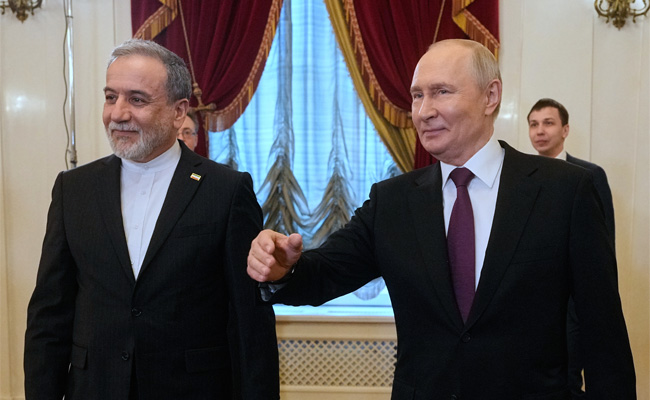
Moscow (PTI): Iran's Foreign Minister Abbas Araghchi on Monday met Russian President Vladimir Putin, who hailed the Iranian people for fighting bravely and heroically for their sovereignty and said Moscow is ready to do its best to help bring peace to West Asia as soon as possible.
Araghchi, who held talks with Omani and Pakistani leadership before arriving in Russia, met Putin in St. Petersburg and thanked him for supporting Iran, state-owned TASS news agency reported.
"Russia is ready to do everything in its power to ensure that peace in the Middle East is achieved as soon as possible," Putin said during his meeting with Araghchi, which was also attended by Russian Foreign Minister Sergey Lavrov.
Revealing that he received a message from Iranian Supreme Leader Mojtaba Khamenei last week, Putin asked Araghchi to convey his "gratitude for this message and best wishes for his health and well-being."
He praised the Iranian people for fighting "bravely and heroically" for their sovereignty, Iran's state-run PRESS TV reported.
"We really hope that, based on the courage and desire for independence, the Iranian people, under the guidance of the new leader, will weather this difficult period of trials and peace will come,” Putin said.
He also stressed that Russia “intends to maintain” its strategic relations with Iran.
Araghchi said that the world witnessed Iran’s strength in countering the US during the recent war, and that the Islamic Republic is a "stable and powerful establishment."
"With their courage, the Iranian people succeeded in resisting the US aggression and will be able to endure it,” he said.
He said that it became clear that Iran has “great friends and allies” like Russia, and conveyed “warmest greetings” from Supreme Leader Mojtaba Khamenei and President Masoud Pezeshkian to the Russian leader.
Araghchi said relations between Moscow and Tehran represent a “strategic partnership at the highest level” and will continue to develop "regardless of circumstances."
"We are grateful to you for the solid and strong positions in support of the Islamic Republic of Iran," he said.
Foreign Minister Lavrov said that the talks between President Putin and the Iranian Foreign Minister were "useful and constructive."
Kremlin Spokesman Dmitry Peskov later said that Russia is "ready to provide any good offices, any mediation services that are acceptable to the parties."
"We will be ready to do everything so that ultimately peace ensues, guaranteed peace, and that there is no return to hostilities," Peskov was quoted as saying by TASS.
He was asked how Moscow can assist in future negotiations on the Iranian settlement.
Araghchi arrived in Russia after his whirlwind trip to Islamabad, which, according to him, was “very productive” and involved “good consultations" with Pakistan's Army Chief Field Marshal Asim Munir, amid uncertainty over the second round of peace talks to resolve the war in West Asia.
"We held good consultations with our friends in Pakistan. The trip was successful. We assessed the outcome of our recent (meetings) and discussed in what direction and under what conditions talks can move on,” Araghchi said in a video posted on his Telegram channel upon his arrival in St Petersburg.
Referring to the second round of talks between the US and Iran to resolve the conflict in West Asia, Araghchi said: "Developments have taken place in the negotiations."
"Despite some progress in earlier rounds, the talks failed to reach their objectives due to the Americans' approach, the excessive demands they made, and the wrong approaches they adopted. Therefore, it was necessary to consult with our friends in Pakistan to review the latest situation,” Iran's official news agency IRNA quoted him as saying.
He said that the trip to Pakistan was a good opportunity to review developments related to the US-Israeli war against Iran, expressing confidence that “these consultations and coordination between the two countries will be highly significant.”
Araghchi arrived at St. Petersburg's Pulkovo Airport early Monday, where he was welcomed by Russian officials and Iran’s ambassador to Russia, Kazem Jalali, the report said.
The first round of peace talks between Iran and the US, held on April 11 and 12, failed to bring the desired result for the parties to the conflict.
The Iranian minister arrived in Islamabad for the second time on Sunday after a short visit to Oman, where he held talks with Sultan Haitham bin Tariq al-Said on security in the Strait of Hormuz and diplomatic efforts to end the Iran-US conflict.
After Araghchi left Pakistan for Oman on Saturday, President Donald Trump announced that US negotiators Steve Witkoff and Jared Kushner would no longer be going to Islamabad for talks with Iran, contending that Washington held all the cards on the matter.
Trump on Sunday reiterated that the US and Iranian officials can talk by phone for a peace solution to the conflict.
On Tuesday, Trump extended the two-week ceasefire with Iran indefinitely to give Tehran more time to prepare a unified proposal to end the war, just hours before the truce was set to expire.
The war began when the US and Israel jointly attacked Iran on February 28, killing Iranian Supreme Leader Ayatollah Ali Khamenei and several top commanders. The retaliation by the Islamic Republic extended the war to the entire Gulf region.