'NASA analysing images of Chandrayaan-2's landing site'
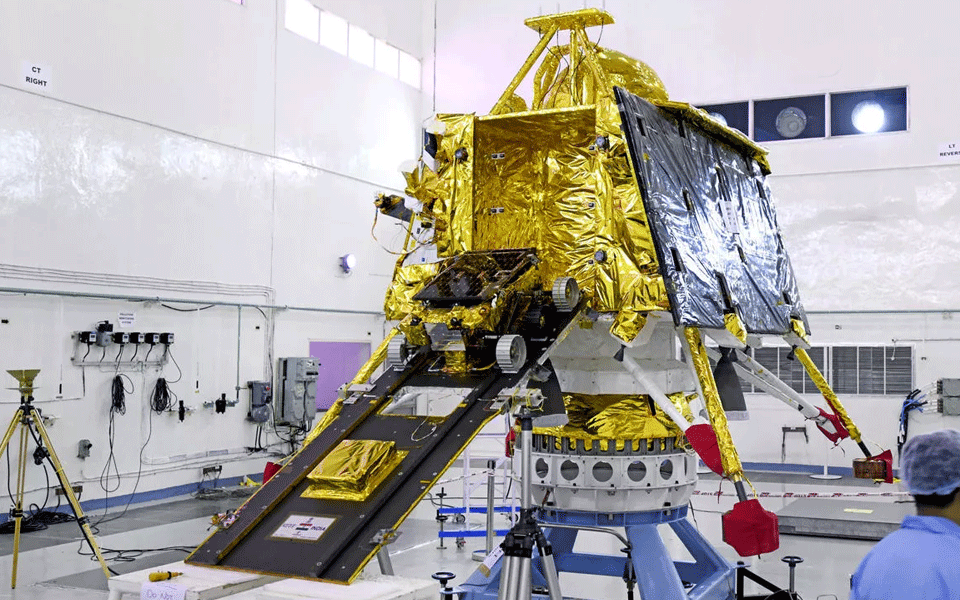
Houston: NASA is analysing, validating and reviewing the images clicked by its lunar orbiter of the area on the Moon where India's Chandrayaan-2 mission made an unsuccessful attempt to soft land its Vikram module, according to a media report that quoted a project scientist of the US space agency.
NASA's Lunar Reconnaissance Orbiter (LRO) spacecraft has snapped a series of images during its flyby on September 17 of Vikram's attempted landing sight near the Moon's uncharted south pole.
LRO deputy project scientist John Keller shared a NASA statement confirming that the orbiter's camera captured the images.
"The LROC team will analyse these new images and compare them to previous images to see if the lander is visible (it may be in shadow or outside the imaged area)," Keller was quoted as saying in the statement by cnet.com.
NASA is validating, analysing and reviewing the images. It was near lunar dusk when the orbiter passed over, meaning large parts of the area were in shadow, the report said.
In the early hours of September 7, Indian Space Research Organization's (ISRO) plan to soft land Chandrayaan-2's Vikram module on the lunar surface did not go as per script.
The lander lost communication with ground stations during its final descent. ISRO officials said, adding that the orbiter of Chandrayaan-2 -- second lunar mission -- remained healthy and safe.
A NASA spokesperson had earlier said that the space agency will share any before and after flyover imagery of the area around the targeted Chandrayaan-2 Vikram Lander landing site to support analysis by ISRO.
Let the Truth be known. If you read VB and like VB, please be a VB Supporter and Help us deliver the Truth to one and all.
AIITA welcomes Karnataka’s ban on obscene songs in school events

Bhatkal: The Karnataka unit of the All India Ideal Teachers Association (AIITA) has welcomed the Karnataka government’s decision to strictly ban school children from dancing to obscene songs during educational and cultural programmes in government, aided, and private schools across the state.
AIITA Karnataka State President M. R. Manvi congratulated the government for taking what he termed an important step to preserve the sanctity of education.
“Such decisions to safeguard the dignity of school children and uphold the values of education are the need of the hour. This rule should not be limited to government schools alone but must be strictly implemented in all private educational institutions as well,” he said.
He further urged the government to address other concerns within school programmes.
“The government should not only prohibit obscene dances in the name of school anniversaries, but also ensure that plays and dialogues that incite religious hatred are avoided. Schools should be centres of harmony, not platforms for spreading hatred,” he added.
According to a recent circular issued by the Department of School Education and Literacy, obscene dances are adversely affecting the mental health and moral values of students.
In this regard, schools have been advised to use songs that promote nationalism, positive thinking, the greatness of Kannada culture, and value-based traditions instead of inappropriate content during programmes.
The circular also emphasises that students should be dressed in decent attire.
AIITA also backed the department’s warning that disciplinary action would be taken against head teachers if such guidelines are violated. The association has further demanded that district Deputy Directors of Public Instruction strictly monitor the implementation of these rules.