NASA discovers giant planet ‘Super Earth’ sending mysterious signal 154 light years away: Report
Washington, D.C.: In a fascinating development, NASA has reportedly discovered a new planet, described as a "Super Earth," just 154 light-years away that is sending out a strange, repeating signal that has caught the attention of scientists.
According to a report by The Sun, cited by Hindustan Times, the planet, named TOI‑1846 b, was spotted earlier this year when NASA’s Transiting Exoplanet Survey Satellite (TESS) detected a recurring flicker of light from a star in the Lyra constellation, located in the northern sky.
Interestingly, TOI‑1846 b is about twice the size of Earth and nearly four times as heavy. Its size and weight place it in a rare category known as the “radius gap”—a zone between small rocky planets like Earth and large gas giants such as Neptune.
Because of this, scientists believe the planet could have unusual features, such as a thin atmosphere, a layer of thick ice, or perhaps even a shallow ocean. Despite its high surface temperature—around 300°C (about 600°F)—researchers say water might still exist.
However, due to the extreme temperatures, scientists think the chances of life on the planet are very low.
The planet's discovery was confirmed by Abderahmane Soubkiou and his team at the Oukaimeden Observatory in Morocco, who worked alongside observers from four continents.
“We have validated TOI‑1846 b using TESS and multicolor ground‑based photometric data, high‑resolution imaging, and spectroscopic observations,” the team explained.
Furthermore, the team found the planet circles its star in just under four days.
To better understand this mysterious Super Earth, scientists say more advanced tools will be needed. One such instrument, MAROON-X, located on the Gemini North telescope in Hawai‘i, could help confirm the planet’s exact mass and detect any nearby planets.
Let the Truth be known. If you read VB and like VB, please be a VB Supporter and Help us deliver the Truth to one and all.
Lt Gen NS Raja Subramani to be India's next Chief of Defence Staff
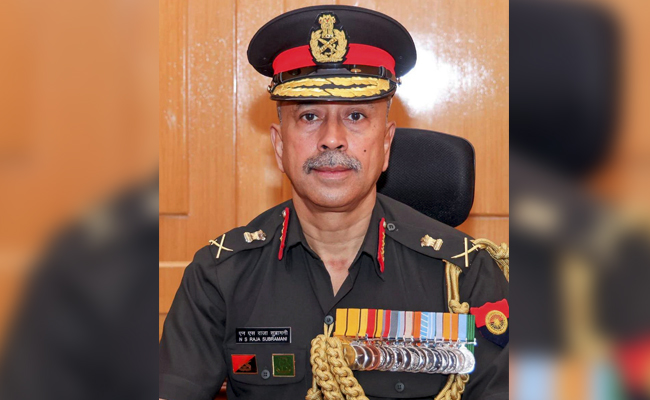
New Delhi (PTI): Lt Gen NS Raja Subramani will be India's new Chief of Defence Staff (CDS) and his key task is set to be to implement the ambitious theaterisation plan that seeks to ensure tri-services synergy.
He will succeed Gen Anil Chauhan whose tenure will come to an end on May 30.
Gen Chauhan, a former Eastern Army Commander, took charge as the country's senior-most military commander in September 2022, over nine months after the first CDS, General Bipin Rawat, died in a helicopter crash in Tamil Nadu.
The government has appointed Lt Gen NS Raja Subramani (Retd) as the Chief of Defence Staff, who will also function as the secretary of the Department of Military Affairs, the defence ministry said on Saturday.
Lt Gen Subramani is currently serving as the military adviser to the National Security Council Secretariat.
Prior to that, he was the Vice Chief of the Army Staff from July 1, 2024 to July 31, 2025, and was General Officer Commanding-in-Chief of the Central Command from March 2023 till June 2024.
As Chief of Defence Staff, Lt Gen Subramani's primary task will be to implement the theaterisation model to bring in tri-services synergy by rolling out integrated military commands.
The officer is a graduate of the National Defence Academy and the Indian Military Academy. He was commissioned into the eighth battalion of the Garhwal Rifles on December 14, 1985.
Lt Gen Subramani is an alumnus of Joint Services Command Staff College, Bracknell (UK), and the National Defence College, New Delhi. He holds a Master of Arts degree from King's College London and an MPhil in defence studies from Madras University.
In his illustrious career spanning over 40 years, Lt Gen Subramani has served across a wide spectrum of conflict and terrain profiles and tenanted a host of Command, Staff and Instructional appointments.
He commanded the 16 Garhwal Rifles in Counter-Insurgency operations in Assam as part of Operation Rhino, the 168 Infantry Brigade in Jammu and Kashmir, and the 17 Mountain Division in the Central Sector, all during a challenging operational environment.
He also has the distinction of commanding two Corps, including the Indian Army's premier strike Corps on the Western Front.