NASA finds 3 bn years old organic molecules in rocks on Mars
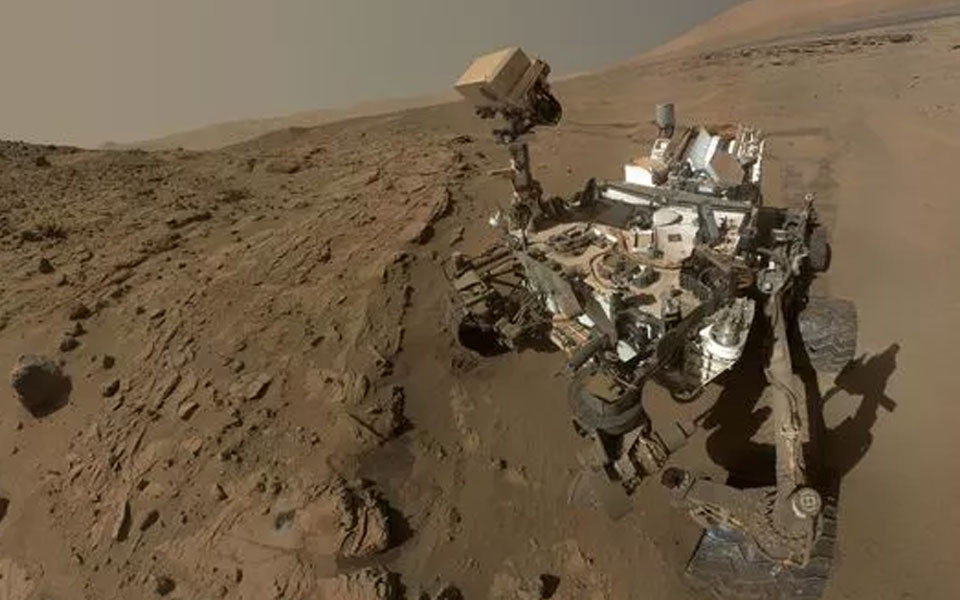
Washington, June 8 : NASA announced on Thursday that its robot explorer Curiosity, which landed on Mars in 2012 and has been exploring there ever since, found organic molecules in rocks formed three billion years ago, a discovery that could indicate that there was life on the Red Planet at that time.
Paul Mahaffy, Director of NASA's Solar System exploration division, said that although this is an exciting discover scientists still cannot confirm how the molecules originated.
They could be evidence for the development of ancient life on Mars but they could also have come from a meteorite or other sources, Efe reported.
Despite the fact that it is still not clear how these molecules were created, NASA emphasized that these kinds of particles could have been the food source for hypothetical microbial life on Mars.
Jennifer Eigenbrode, with the NASA's Goddard Space Center in Maryland, said that the organic molecules found on Mars do not provide specific evidence of life since "they could have come from things that are non-biological".
In any case, however, the molecules may provide key information to scientists in their continuing search for life on Mars, since "All life that we know of is based on organic molecules," Eigenbrode explained.
She said that although the surface of Mars is presently "inhospitable", indications are that in the distant past the Martian climate allowed liquid water to exist on the planet's surface.
The data gathered by Curiosity reveal that billions of years ago there was a shallow lake of water inside the Gale Crater on Mars that contained all the ingredients necessary for life as we know it, including chemical building blocks and energy sources.
Eigenbrode said that -- now that potential signs of ancient life have been found -- future missions to Mars will delve deeper into the issue of organic molecules and other possible markers for life.
Curiosity found the first indications of water on Mars in 2013 and it also determined that the concentration of methane in the planet's thin atmosphere fluctuates regularly with the Martian seasons.
Although the origin of the gas is unknown, scientists say it could have been trapped underground as a byproduct of organic processes in the distant past and is now slowly seeping out.
Let the Truth be known. If you read VB and like VB, please be a VB Supporter and Help us deliver the Truth to one and all.
Ordinance issued to increase number of Supreme Court judges from 34 to 38
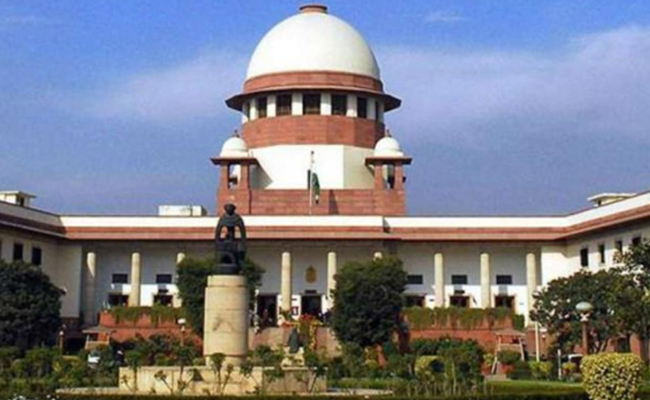
New Delhi (PTI): The government has promulgated an ordinance to increase the strength of the Supreme Court from the present 34 judges to 38, including the Chief Justice of India.
The law ministry notified the ordinance on Saturday, which amended the Supreme Court (Number of Judges) Act, 1956, to increase the sanctioned strength of the top court.
So far, the sanctioned strength of the top court was 34, including the Chief Justice of India (CJI). Now, the number of judges has been increased by four, taking the sanctioned strength to 38.
The top court will now have 37 judges, other than the CJI.
With the apex court having two vacancies at present, and the ordinance coming into force immediately, the Supreme Court Collegium will now have to recommend six names for appointment as judges in the top court.
A bill will be brought in the Monsoon Session of Parliament to convert the ordinance – an executive order – into a law passed by Parliament.
The Union Cabinet had cleared a draft bill on May 5 to increase the number of apex court judges.
The strength of the Supreme Court was last increased from 30 to 33 (excluding the CJI) in 2019.
The Supreme Court (Number of Judges) Act, as originally enacted in 1956, put the maximum number of judges (excluding the CJI) at 10.
This number was increased to 13 by the Supreme Court (Number of Judges), Amendment Act, 1960, and to 17 by another amendment to the law.
The Supreme Court (Number of Judges) Amendment Act, 1986, augmented the strength of judges from 17 to 25, excluding the CJI.
A fresh amendment in 2009 further increased the strength from 25 to 30.
Article 124(3) of the Constitution lists the qualifications required to become a Supreme Court judge.
An Indian citizen who has either served as a high court judge for at least five years, or as an advocate for 10 years, or is a distinguished jurist, can be appointed to the top court.
The strength of the Supreme Court is increased based on the recommendations of the CJI, who writes to the Union law minister. After consulting the finance ministry, the Department of Justice under the law ministry moves the Cabinet with a draft bill.