NASA pushes back astronaut flights to moon again
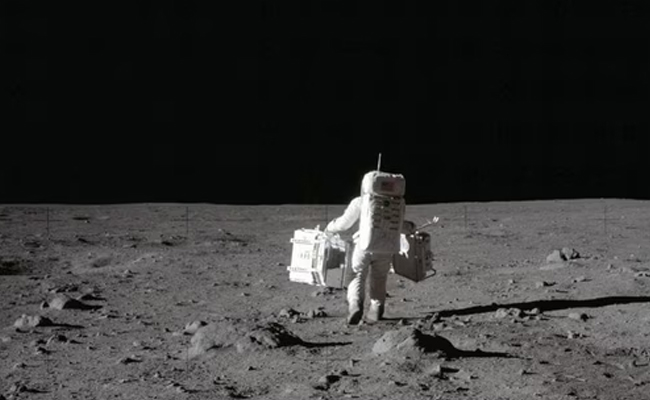
Cape Canaveral (AP): NASA announced more delays Thursday in sending astronauts back to the moon more than 50 years after Apollo.
Administrator Bill Nelson said the next mission in the Artemis program -- flying four astronauts around the moon and back – is now targeted for April 2026. It had been on the books for September 2025, after slipping from this year.
The investigation into heat shield damage from the capsule's initial test flight two years ago took time, officials said, and other spacecraft improvements are still needed.
This bumps the third Artemis mission — a moon landing by two other astronauts — to at least 2027. NASA had been aiming for 2026.
NASA's Artemis program, a follow-up to the Apollo moonshots of the late 1960s and early 1970s, has completed only one mission. An empty Orion capsule circled the moon in 2022 after blasting off on NASA's new Space Launch System rocket.
Although the launch and lunar laps went well, the capsule returned with an excessively charred and eroded bottom heat shield, damaged from the heat of reentry. It took until recently for engineers to pinpoint the cause and come up with a plan.
NASA will use the Orion capsule with its original heat shield for the next flight with four astronauts, according to Nelson, but make changes to the reentry path at flight's end. To rip off and replace the heat shield would have meant at least a full year's delay and stalled the moon landing even further, officials said.
During the flight test, NASA had the capsule dip in and out of the atmosphere during reentry, and gases built up in the heat shield's outer layer, officials said. That resulted in cracking and uneven shedding of the outer material.
The commander of the lunar fly-around, astronaut Reid Wiseman, took part in Thursday's news conference at NASA headquarters in Washington. His crew includes NASA astronauts Victor Glover and Christina Koch and Canadian astronaut Jeremy Hansen.
“Delays are agonizing and slowing down is agonizing and it's not what we like to do,” Wiseman said. But he said he and his crew wanted the heat shield damage from the first flight to be fully understood, regardless of how long it took. Now they can focus with this “large decision behind us."
Twenty-four astronauts flew to the moon during NASA's vaulted Apollo program, with 12 landing on it. The final bootprints in the lunar dust were made during Apollo 17 in December 1972.
Nelson said the revised schedule should still have the United States getting astronauts back on the lunar surface before China, which has indicated 2030 for a crew moon landing.
The space agency has put all the Artemis contractors, including Elon Musk's SpaceX, on notice to “double-down” to meet the schedule deadlines, according to Nelson. SpaceX's mega rocket Starship — making test flights from Texas with increasing frequency — is how astronauts will get from the Orion capsule in lunar orbit down to the surface on the first two Artemis moon landings.
Nelson said he's already called Jared Isaacman, the SpaceX-flying billionaire nominated this week by Trump to lead NASA, and invited him to NASA headquarters in Washington.
Let the Truth be known. If you read VB and like VB, please be a VB Supporter and Help us deliver the Truth to one and all.
Lt Gen NS Raja Subramani to be India's next Chief of Defence Staff
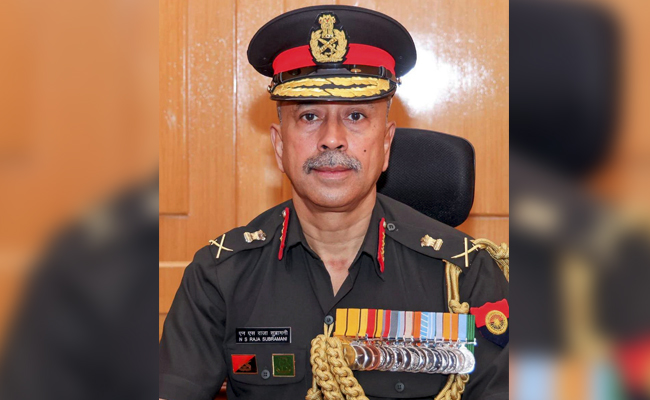
New Delhi (PTI): Lt Gen NS Raja Subramani will be India's new Chief of Defence Staff (CDS) and his key task is set to be to implement the ambitious theaterisation plan that seeks to ensure tri-services synergy.
He will succeed Gen Anil Chauhan whose tenure will come to an end on May 30.
Gen Chauhan, a former Eastern Army Commander, took charge as the country's senior-most military commander in September 2022, over nine months after the first CDS, General Bipin Rawat, died in a helicopter crash in Tamil Nadu.
The government has appointed Lt Gen NS Raja Subramani (Retd) as the Chief of Defence Staff, who will also function as the secretary of the Department of Military Affairs, the defence ministry said on Saturday.
Lt Gen Subramani is currently serving as the military adviser to the National Security Council Secretariat.
Prior to that, he was the Vice Chief of the Army Staff from July 1, 2024 to July 31, 2025, and was General Officer Commanding-in-Chief of the Central Command from March 2023 till June 2024.
As Chief of Defence Staff, Lt Gen Subramani's primary task will be to implement the theaterisation model to bring in tri-services synergy by rolling out integrated military commands.
The officer is a graduate of the National Defence Academy and the Indian Military Academy. He was commissioned into the eighth battalion of the Garhwal Rifles on December 14, 1985.
Lt Gen Subramani is an alumnus of Joint Services Command Staff College, Bracknell (UK), and the National Defence College, New Delhi. He holds a Master of Arts degree from King's College London and an MPhil in defence studies from Madras University.
In his illustrious career spanning over 40 years, Lt Gen Subramani has served across a wide spectrum of conflict and terrain profiles and tenanted a host of Command, Staff and Instructional appointments.
He commanded the 16 Garhwal Rifles in Counter-Insurgency operations in Assam as part of Operation Rhino, the 168 Infantry Brigade in Jammu and Kashmir, and the 17 Mountain Division in the Central Sector, all during a challenging operational environment.
He also has the distinction of commanding two Corps, including the Indian Army's premier strike Corps on the Western Front.