New algorithm may help reveal fake Facebook, Twitter accounts

New York, April 18: Scientists have developed a new generic algorithm based on machine-learning to detect fake accounts on social network platforms including Facebook and Twitter, an advance with considerable potential for applications in the cyber-security arena.
"With recent disturbing news about failures to safeguard user privacy, and targeted use of social media to influence elections, rooting out fake users has never been of greater importance," said lead researcher Dima Kagan from the Ben-Gurion University (BGU) in Israel.
The study showed that the algorithm is generic, and efficient both in revealing fake users and in disclosing the influential people in social networks.
"Overall, the results demonstrated that in a real-life friendship scenario we can detect people who have the strongest friendship ties as well as malicious users, even on Twitter," the researchers said.
Based on machine-learning algorithms, the new method, detailed in the journal Social Network Analysis and Mining, works on the assumption that fake accounts tend to establish improbable links to other users in the networks.
It constructs a link prediction classifier that can estimate, with high accuracy, the probability of a link existing between two users.
It also generates a new set of meta-features based on the features created by the link prediction classifier.
Using the meta-features, the researchers, constructed a generic classifier that can detect fake profiles in a variety of online social networks.
"We tested our algorithm on simulated and real-world data sets on 10 different social networks and it performed well on both," Kagan said.
Previously, researchers from the BGU had developed the Social Privacy Protector (SPP) to help users evaluate their friends list in seconds to identify which have few or no mutual links and might be "fake" profiles.
Let the Truth be known. If you read VB and like VB, please be a VB Supporter and Help us deliver the Truth to one and all.
Lt Gen NS Raja Subramani to be India's next Chief of Defence Staff
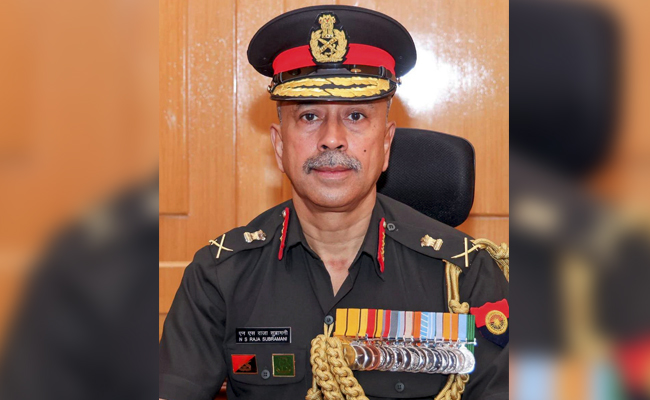
New Delhi (PTI): Lt Gen NS Raja Subramani will be India's new Chief of Defence Staff (CDS) and his key task is set to be to implement the ambitious theaterisation plan that seeks to ensure tri-services synergy.
He will succeed Gen Anil Chauhan whose tenure will come to an end on May 30.
Gen Chauhan, a former Eastern Army Commander, took charge as the country's senior-most military commander in September 2022, over nine months after the first CDS, General Bipin Rawat, died in a helicopter crash in Tamil Nadu.
The government has appointed Lt Gen NS Raja Subramani (Retd) as the Chief of Defence Staff, who will also function as the secretary of the Department of Military Affairs, the defence ministry said on Saturday.
Lt Gen Subramani is currently serving as the military adviser to the National Security Council Secretariat.
Prior to that, he was the Vice Chief of the Army Staff from July 1, 2024 to July 31, 2025, and was General Officer Commanding-in-Chief of the Central Command from March 2023 till June 2024.
As Chief of Defence Staff, Lt Gen Subramani's primary task will be to implement the theaterisation model to bring in tri-services synergy by rolling out integrated military commands.
The officer is a graduate of the National Defence Academy and the Indian Military Academy. He was commissioned into the eighth battalion of the Garhwal Rifles on December 14, 1985.
Lt Gen Subramani is an alumnus of Joint Services Command Staff College, Bracknell (UK), and the National Defence College, New Delhi. He holds a Master of Arts degree from King's College London and an MPhil in defence studies from Madras University.
In his illustrious career spanning over 40 years, Lt Gen Subramani has served across a wide spectrum of conflict and terrain profiles and tenanted a host of Command, Staff and Instructional appointments.
He commanded the 16 Garhwal Rifles in Counter-Insurgency operations in Assam as part of Operation Rhino, the 168 Infantry Brigade in Jammu and Kashmir, and the 17 Mountain Division in the Central Sector, all during a challenging operational environment.
He also has the distinction of commanding two Corps, including the Indian Army's premier strike Corps on the Western Front.