Nuclear-capable missile Prithvi II successfully test-fired
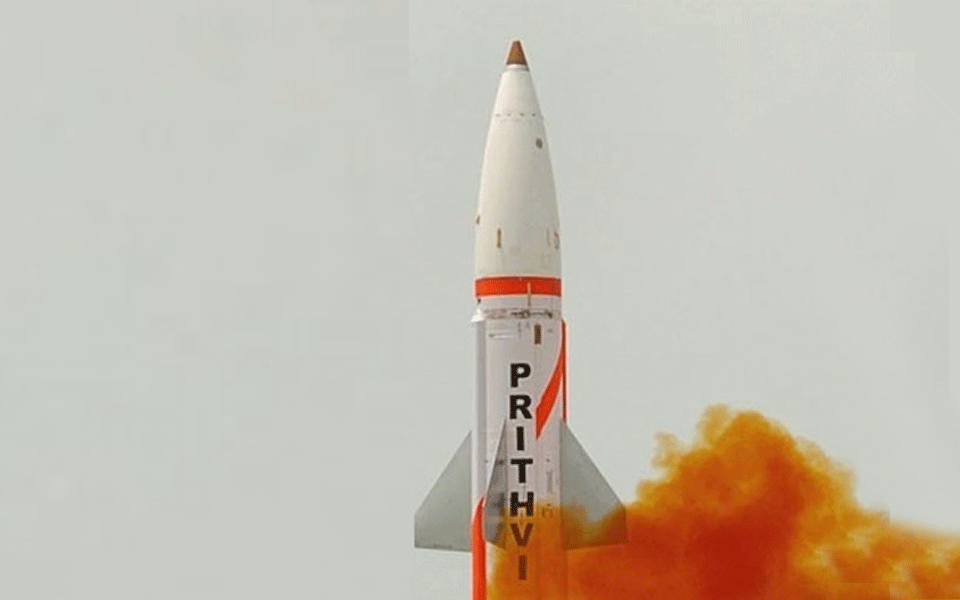
Balasore (Odisha), Jun 27: India successfully test-fired indigenously developed nuclear-capable missile Prithvi-II on Thursday night as part of a user trial by the Army from a test range off the Odisha coast.
The trial of the surface-to-surface missile, which has a strike range of 350 km, was carried out from a mobile launcher from Launch Complex-III of the Integrated Test Range (ITR) at Chandipur, near here, at around 8.30 pm, sources said.
"It was a routine trial," a source said.
Prithvi-II was also successfully test-fired at night on February 21, 2018 from the ITR at Chandipur.
The missile is capable of carrying 500/100 kg of warheads and is powered by liquid propulsion twin engines. The state-of-the-art missile uses an advanced inertial guidance system with a maneuvering trajectory to hit its target, the sources said.
The missile was randomly chosen from the production stock and the entire launch activity was carried out by the Strategic Forces Command (SFC) of the Army and monitored by the scientists of the Defence Research Development Organisation (DRDO) as part of a training exercise, they added.
"The missile trajectory was tracked with the help of radars, electro-optical tracking systems and telemetry stations by the DRDO along the coast of Odisha," a source said.
The down range teams on board a ship deployed near the designated impact point in the Bay of Bengal monitored the terminal events and splashed down, he added.
On November 21, 2016, two missiles were successfully test-fired in the salvo mode from the same base.
Inducted into the armory of the Indian defence forces in 2003, the nine-metre-tall, single-stage liquid-fuelled Prithvi is the first missile to have been developed by the DRDO under the Integrated Guided Missile Development Programme.
Let the Truth be known. If you read VB and like VB, please be a VB Supporter and Help us deliver the Truth to one and all.
Ranchi: Death toll in Giridih accident rises to five

Giridih (PTI): The death toll in the accident in Jharkhand's Giridih, wherein a truck rammed into parked vehicles a day ago, rose to five with another person succumbing to injuries during treatment at a hospital in Dhanbad, police said on Saturday.
The incident occurred on Friday evening at the main market within the Nimiyaghat police station limits, killing four people on the spot. Officials claimed the truck was being driven at a high speed, and the person at the wheel was in an inebriated state.
"One more person died during treatment at a hospital in Dhanbad late on Friday night. The deceased is yet to be identified," said Suman Kumar, the officer in charge of Naimyaghat police station.
The four who died on the spot were identified as Md Irshad (45), Sujeet Kumar (37), Ranjeet Kumar (33), and Santosh Kumar Mahto (27), all natives of Giridi. Seven people sustained injuries.
The truck was seized, and its driver has been held, the officer in charge of the Naimyaghat police station said.
Enraged locals put up a blockade on the Dumri-GT Road for two hours and demanded compensation for the kin of the victim. They also demanded no entry for heavy vehicles in the market at night.
Giridih's Deputy Commissioner Ramniwas Yadav inspected the accident spot and met those who were injured in the accident.
"The injured are undergoing treatment at different hospitals. I have directed the department concerned to prepare a detailed report on what led to the accident," he said.