Origin of 'ghost particle' traced to distant black hole
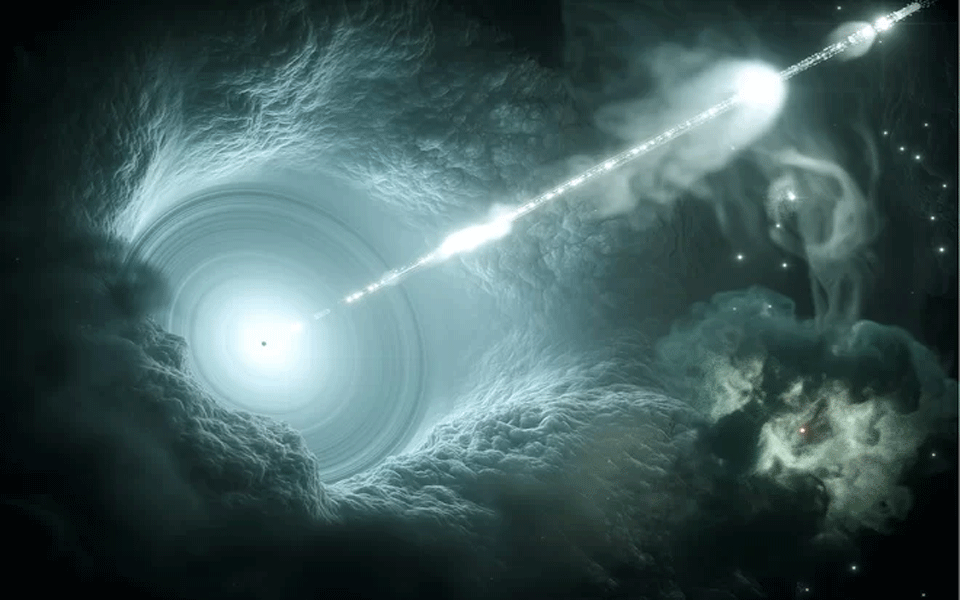
Washington, July 13 : For the first time, scientists have found the source of a high-energy ghostly particle, known as neutrino, that travelled 3.7 billion years at almost the speed of light to reach Earth.
Using NASA's Fermi Gamma-ray space telescope, scientists traced the path of this hard-to-catch particle to a blast of gamma-ray light from a distant supermassive black hole in the constellation Orion.
Scientists believe that high-energy neutrinos are created by the most powerful events in the cosmos, such as galaxy mergers and material falling onto supermassive black holes.
They travel at speeds just shy of the speed of light and rarely interact with other matter, allowing them to travel unimpeded across distances of billions of light-years.
The findings detailed in the journal Science marked the detection of the source of such a particle for the first time.
"Again, Fermi has helped make another giant leap in a growing field we call multimessenger astronomy," said Paul Hertz, Director of the Astrophysics Division at NASA Headquarters in Washington.
"Neutrinos and gravitational waves deliver new kinds of information about the most extreme environments in the universe. But to best understand what they're telling us, we need to connect them to the 'messenger' astronomers know best - light," Hertz added.
The neutrino was discovered last year in Antarctica by an international team of scientists using the US National Science Foundation's IceCube Neutrino Observatory.
It hit the Antarctic ice with the energy of about 300 trillion electron volts -- more than 45 times the energy achievable in the most powerful particle accelerator on Earth.
This high energy strongly suggested that the neutrino had to be from beyond our solar system.
Backtracking the path through IceCube indicated where in the sky the neutrino came from, and automated alerts notified astronomers around the globe to search this region for flares or outbursts that could be associated with the event.
Data from Fermi revealed enhanced gamma-ray emission from a well-known active galaxy at the time the neutrino arrived.
This is a type of active galaxy called a blazar, with a supermassive black hole with millions to billions of times the Sun's mass that blasts jets of particles outward in opposite directions at nearly the speed of light.
Blazars are especially bright and active because one of these jets happens to point almost directly toward Earth.
Fermi scientist Yasuyuki Tanaka at Hiroshima University in Japan was the first to associate the neutrino event with the blazar designated TXS 0506+056 (TXS 0506 for short), NASA said.
"The most extreme cosmic explosions produce gravitational waves, and the most extreme cosmic accelerators produce high-energy neutrinos and cosmic rays," said Regina Caputo of NASA's Goddard Space Flight Center in Greenbelt, Maryland.
"Through Fermi, gamma rays are providing a bridge to each of these new cosmic signals," Caputo said.
Let the Truth be known. If you read VB and like VB, please be a VB Supporter and Help us deliver the Truth to one and all.
PM arrives at Brigade Parade Grounds for swearing-in ceremony of BJP's first govt in Bengal

Kolkata (PTI): Prime Minister Narendra Modi arrived at the Brigade Parade Grounds here on Saturday to attend the swearing-in ceremony of the BJP's first government in West Bengal.
Accompanied by state BJP president Samik Bhattacharya and CM-elect Suvendu Adhikari, Modi was accorded a rousing welcome.
Amid the 'Jay Shri Ram' slogan, Modi entered the venue on an open vehicle and was seen waving at the crowd.
The Prime Minister landed at Netaji Subhas Chandra Bose International Airport here a little before 10 am and took a helicopter to reach the Race Course ground before proceeding by road to the venue.
Thousands of BJP supporters gathered at the Brigade Parade Grounds since early morning to witness the oath-taking ceremony.
The BJP secured 207 seats in the 294-member Assembly, ending the Trinamool Congress' 15-year rule in the state.