Powerful solar storm hits Earth, could disrupt communication and power grids
Washington DC: A powerful solar storm, the most potent in over two decades, has struck Earth, triggering stunning celestial displays from Tasmania to Britain and raising concerns about potential disruptions to satellites and power grids as it persists into the weekend.
The event, characterised by several coronal mass ejections (CMEs), began shortly after 1600 GMT, according to the National Oceanic and Atmospheric Administration (NOAA)'s Space Weather Prediction Center.
Upgraded to an "extreme" geomagnetic storm, this marks the first such event since the "Halloween Storms" of October 2003, which caused blackouts in Sweden and damaged power infrastructure in South Africa. Additional CMEs are anticipated to impact the planet in the days ahead.
Social media platforms buzzed with users sharing images of auroras observed in northern Europe and Australasia.
"We've just woken the kids to go watch the Northern Lights in the back garden! Clearly visible with the naked eye," shared Iain Mansfield, a think tanker in Hertford, Britain.
Photographer Sean O' Riordan captured the phenomenon in Tasmania, posting, "Absolutely biblical skies in Tasmania at 4 am this morning. I'm leaving today and knew I could not pass up this opportunity."
Authorities have alerted satellite operators, airlines, and the power grid to take precautionary measures against potential disruptions due to fluctuations in Earth's magnetic field.
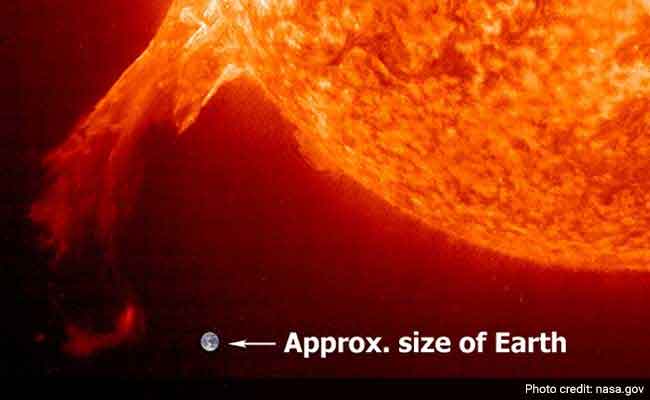
Unlike solar flares, which travel at the speed of light, CMEs move at a slower pace, averaging 800 kilometres (500 miles) per second. These eruptions originated from a massive sunspot cluster approximately 17 times wider than Earth, coinciding with the Sun's nearing peak activity within its 11-year cycle.
Professor Mathew Owens, specialising in space physics at the University of Reading, said that while the effects will primarily impact the planet's northern and southern latitudes, the extent of the impact will hinge on the storm's final intensity.
"Go outside tonight and look, would be my advice because if you see the aurora, it's quite a spectacular thing," Owens added, recommending the use of eclipse glasses for daytime observation of the sunspot cluster.
In the United States, areas such as Northern California and Alabama may witness the effects, according to officials.
NOAA's Brent Gordon encouraged the public to attempt capturing images of the night sky with phone cameras, even if auroras are not visible to the naked eye.
Concerns extend beyond disruptions to communication and power infrastructure. Fluctuating magnetic fields can induce currents in long wires, including power lines, potentially causing blackouts. Moreover, spacecraft are at risk of radiation exposure, though Earth's atmosphere provides protection. Additionally, biological compasses in species like pigeons could be affected.
The Carrington Event of September 1859, the most powerful geomagnetic storm on record, caused widespread disruption to telegraph systems due to excess currents, highlighting the potential risks associated with such solar phenomena.
Let the Truth be known. If you read VB and like VB, please be a VB Supporter and Help us deliver the Truth to one and all.
Polling begins for 152 assembly seats in 1st phase of Bengal elections
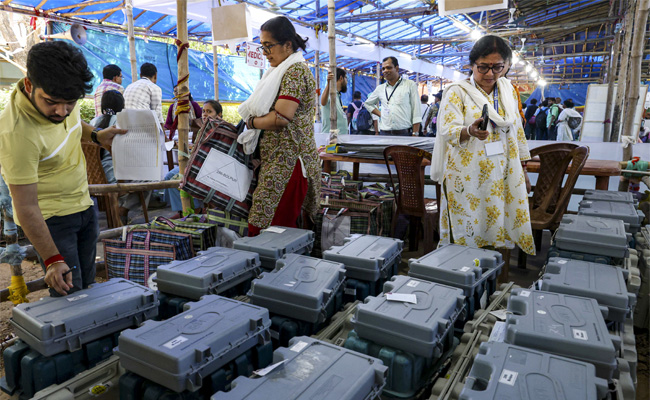
Kolkata (PTI): Voting began on Thursday in 152 constituencies in the first phase of the West Bengal assembly elections, amid unprecedented security arrangements and a high-stakes battle that could shape the direction of the entire contest.
Polling started at 7 am with voters queueing up outside booths in districts ranging from Darjeeling and Jalpaiguri in the north to Murshidabad, Nadia, Birbhum and Hooghly in the south.
The opening round covers more than half of the state's 294 assembly seats and is being seen as the BJP's best opportunity to make an early breakthrough and the ruling Trinamool Congress' most important test in its bid for a fourth consecutive term.
According to the Election Commission, over 3.60 crore electors are eligible to vote in this phase, including around 1.75 crore women and 465 third-gender voters.
A record 2,450 companies of central paramilitary forces, comprising nearly 2.5 lakh personnel, have been deployed across the state for the polls, with over 8,000 polling stations identified as highly sensitive.
The Election Commission has placed districts such as Malda, Murshidabad, Uttar Dinajpur, Cooch Behar, Birbhum and Purba Bardhaman under special surveillance.
More than 2,193 quick response teams, surveillance units and flying squads have also been deployed to prevent violence and ensure free and fair polling.
The first phase assumes political significance because it includes all 54 seats in north Bengal, the region that powered the BJP's rise in the 2019 Lok Sabha elections and helped it emerge as the principal challenger to the TMC in the 2021 assembly polls.
Of the 152 seats, the BJP had won 59 in 2021, while the TMC had secured 93.
For the saffron camp, retaining its dominance in north Bengal is crucial if it is to remain in contention in the statewide battle. For the TMC, led by Chief Minister Mamata Banerjee, preventing a BJP sweep in the north is equally important to establish momentum before the second round.
This phase is also being closely watched because it comes after the Special Intensive Revision of electoral rolls, which resulted in the deletion of around 91 lakh names from the state's voter list.
The controversy has sharply polarised the campaign, with the BJP alleging that the revision weeded out infiltrators and bogus voters, while the TMC has accused the Centre and the Election Commission of disenfranchising genuine electors, especially minorities and migrant workers.
Several high-profile candidates are in the fray in the first phase.
Key candidates in this phase include leader of the opposition Suvendu Adhikari (BJP, Nandigram), former Union minister Nisith Pramanik (BJP, Mathabhanga), state minister Udayan Guha (TMC, Dinhata), Goutam Deb (TMC, Siliguri), and Adhir Ranjan Chowdhury (Congress, Baharampur).
The second phase of polling will be held on April 29. Counting of votes will take place on May 4.