Scientists detect “strongest evidence till date” of life outside our solar system

London: Astronomers have reported the strongest evidence yet of potential biological activity on a distant planet named K2-18b, located about 124 light-years away from Earth. The planet, which is more than twice the size of Earth, has shown signs of atmospheric molecules that, on Earth, are produced only by living marine organisms.
The discovery was made by an international team of scientists led by Indian Origin scientist Dr. Nikku Madhusudhan of the University of Cambridge. Using data collected by NASA’s James Webb Space Telescope, the team analyzed the chemical composition of the planet’s atmosphere. They found molecular signatures that suggest the possible presence of life-supporting processes.
“This is certainly the strongest sign we have seen yet,” said Dr. Madhusudhan in a television interview. “I can realistically say that we could confirm this signal within one or two years.” He added that if life is found on K2-18b, it could point to the likelihood of life being common across the galaxy.
The planet K2-18b is located in the habitable zone of its host star, a red dwarf. This is the region where temperatures could allow for the existence of liquid water—a key ingredient for life. The planet is about 2.5 times the size of Earth and sits roughly 700 trillion miles away.
The James Webb Space Telescope, launched in 2021, is equipped to detect and analyze the faint light that passes through a planet's atmosphere as it transits its star. This allows scientists to identify the presence of specific molecules. In the case of K2-18b, the molecules detected appear to be those that, on Earth, are associated with biological activity.
However, experts are urging caution. While the findings are promising, they remain inconclusive. The scientific team is in the process of preparing a detailed paper on the discovery and is expected to seek further observations to validate the results.
Catherine Heymans, the Astronomer Royal for Scotland, noted that even more detailed data might not provide a definite answer. “Even with perfect data, you still won’t be able to say that this is definitely of biological origin,” she said. “There are many unknowns in the universe, and other non-biological processes could produce similar signatures.”
The research team hopes that continued observations using the James Webb Space Telescope and other advanced instruments will offer greater clarity in the coming years.
Let the Truth be known. If you read VB and like VB, please be a VB Supporter and Help us deliver the Truth to one and all.
Lt Gen NS Raja Subramani to be India's next Chief of Defence Staff
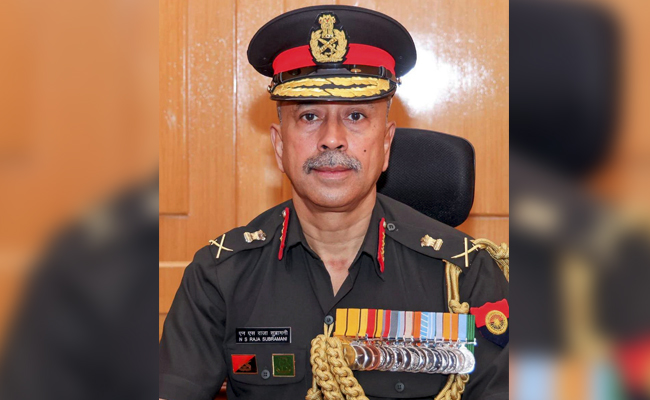
New Delhi (PTI): Lt Gen NS Raja Subramani will be India's new Chief of Defence Staff (CDS) and his key task is set to be to implement the ambitious theaterisation plan that seeks to ensure tri-services synergy.
He will succeed Gen Anil Chauhan whose tenure will come to an end on May 30.
Gen Chauhan, a former Eastern Army Commander, took charge as the country's senior-most military commander in September 2022, over nine months after the first CDS, General Bipin Rawat, died in a helicopter crash in Tamil Nadu.
The government has appointed Lt Gen NS Raja Subramani (Retd) as the Chief of Defence Staff, who will also function as the secretary of the Department of Military Affairs, the defence ministry said on Saturday.
Lt Gen Subramani is currently serving as the military adviser to the National Security Council Secretariat.
Prior to that, he was the Vice Chief of the Army Staff from July 1, 2024 to July 31, 2025, and was General Officer Commanding-in-Chief of the Central Command from March 2023 till June 2024.
As Chief of Defence Staff, Lt Gen Subramani's primary task will be to implement the theaterisation model to bring in tri-services synergy by rolling out integrated military commands.
The officer is a graduate of the National Defence Academy and the Indian Military Academy. He was commissioned into the eighth battalion of the Garhwal Rifles on December 14, 1985.
Lt Gen Subramani is an alumnus of Joint Services Command Staff College, Bracknell (UK), and the National Defence College, New Delhi. He holds a Master of Arts degree from King's College London and an MPhil in defence studies from Madras University.
In his illustrious career spanning over 40 years, Lt Gen Subramani has served across a wide spectrum of conflict and terrain profiles and tenanted a host of Command, Staff and Instructional appointments.
He commanded the 16 Garhwal Rifles in Counter-Insurgency operations in Assam as part of Operation Rhino, the 168 Infantry Brigade in Jammu and Kashmir, and the 17 Mountain Division in the Central Sector, all during a challenging operational environment.
He also has the distinction of commanding two Corps, including the Indian Army's premier strike Corps on the Western Front.