Space-Siren’s Call: Why Artemis 2 is Returning to the Hangar
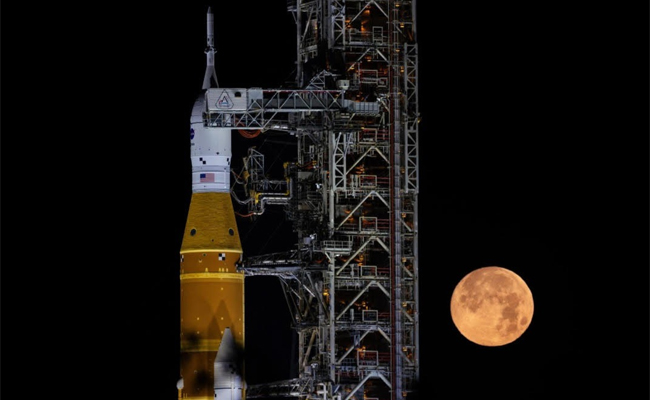
In the latest setback for the Artemis 2 mission, NASA said on Saturday that it will move the Space Launch System (SLS) rocket and the Orion spacecraft back to the Vehicle Assembly Building (VAB) starting February 24. Because of this delay, the first crewed Moon mission since Apollo 17 will now happen no earlier than April.
Just one day earlier, NASA had said it was ready to launch Artemis 2 as soon as March 6, after successfully completing a second wet dress rehearsal (a full fueling test and practice countdown) on February 19. However, on February 21, engineers found a problem when the helium supply to the rocket’s upper stage was unexpectedly interrupted.
Helium is used to keep pressure inside the rocket’s liquid hydrogen and liquid oxygen tanks. Without this pressure, the fuel cannot properly flow to the engine, which is needed to push the Orion spacecraft toward the Moon.
It is important to note that the helium system was working fine during the main practice test. The problem was found later during routine checks after the test was completed. This means the issue did not show up during the final major test that was supposed to confirm the rocket was fully ready to fly.
Engineers are trying to find out exactly where the problem is. They are checking the helium pipes that carry the gas, a control valve inside the rocket’s upper stage, and a filter that connects the ground equipment to the rocket.
Until they fix the issue, the team is using a backup system to keep the rocket’s upper stage safe, properly pressurized, and stable, so nothing gets damaged.
This problem is similar to one that happened during the Artemis 1 mission in 2022, when a faulty helium check valve in the same type of upper stage forced NASA to move the rocket back to the Vehicle Assembly Building (VAB). However, in that case, the issue was found during the wet dress rehearsal test itself.
No matter where the current problem started, the rocket has to be moved back to the Vehicle Assembly Building (VAB) before engineers can properly fix it. This 525-foot-tall building, one of the largest buildings in the world by volume, is the only place ever used to put together a rocket that carried humans to another world. Inside the VAB, engineers have large cranes and a controlled indoor environment, which help them safely repair and check the rocket’s upper stage.
To reach the building, the rocket will travel about 6.8 kilometres along a special road at a very slow speed of around 1.6 kilometres per hour, carried by NASA’s huge moving platform called the crawler. The crawler alone weighs about 3,000 tons (without load) and can carry up to 8,100 tons. It uses nearly 165 gallons (624.5 lts) of diesel for every mile it moves, showing how massive and powerful it is.
The launch pad platforms that were set up on February 20 for launch preparations had to be removed first. This was done to protect them from expected strong winds and also to clear the way in case the rocket needed to be moved back. Now that this work is finished, the path is clear for the rocket to return to the Vehicle Assembly Building (VAB) as early as February 24.
Because of the Moon’s flight path requirements, Artemis 2 can launch only during a short window of a few days, and this chance comes about once every four weeks. Due to the helium leak and the repair work needed, the mission will now miss the March 6–11 launch window.
As reported by astronomy.com , the next launch window is from April 1 to April 6, and NASA is now aiming for this period. However, if engineers are unable to fix the problem and prepare the rocket in time, the mission could be delayed even further. The agency will also hold a media briefing in the coming days to give more details.
The Artemis 2 crew — Commander Reid Wiseman, Pilot Victor Glover, Mission Specialist Christina Koch (NASA), and Mission Specialist Jeremy Hansen (Canadian Space Agency) — were released from quarantine and returned to Houston once again.
The crew had first started their usual 14-day pre-launch quarantine on January 23, but they were released early February after the launch was postponed from its planned February window to March.
(Girish Linganna is an award-winning science communicator and a Defence, Aerospace & Geopolitical Analyst. He is the Managing Director of ADD Engineering Components India Pvt. Ltd., a subsidiary of ADD Engineering GmbH, Germany.)
Disclaimer: The views and opinions expressed in this article are solely those of the author. They do not necessarily reflect the views, policies, or position of the publication, its editors, or its management. The publication is not responsible for the accuracy of any information, statements, or opinions presented in this piece.
Let the Truth be known. If you read VB and like VB, please be a VB Supporter and Help us deliver the Truth to one and all.
Real Madrid fines Valverde and Tchouaméni half a million euros each for altercation

Barcelona (AP): Real Madrid slapped players Federico Valverde and Aurélien Tchouaméni with half-a-million-euro ($588,000) fines on Friday for their altercation during practice.
The massive fines came a day after the midfielders tussled when the team trained. Valverde said in a post on social media on Thursday that no punches were thrown. But Valverde knocked his head on a table and he suffered a small cut that required a brief hospital visit.
On social media, Valverde initially called it a “meaningless fight” with a teammate and said “everything has been blown out of proportion."
His employers, however, considered it a significant enough breach of team discipline to nail both Valverde and Tchouaméni with fines that bite even the bank account of a top soccer player. The half-a-million euro penalties reflect the reputational damage the club was enduring in a chaotic end to a disappointing season.
In a statement, the 15-time European champion said its disciplinary action was concluded after both players expressed to the club “their complete remorse for what happened and apologized to one another.”
Madrid added they also apologized to their teammates, the coaching staff and club supporters, as well as showing their willingness to accept whatever disciplinary action the club deemed “opportune.”
Tchouaméni was back training with Madrid on Friday, two days before they play at Barcelona in a clasico. Madrid has to win otherwise Barcelona will be crowned La Liga champion.
After being notified of the fine, he posted a public apology to the club and its fans on social media.
“What happened this week in training is unacceptable,” Tchouaméni wrote. "I say this while thinking about the example we are expected to set for young people, whether in football or at school.
“Above all, I am sorry for the image we projected of the club.”
Valverde was not at practice due to the head knock.
Both players are set to play in the World Cup next month, with Tchouaméni playing for France and Valverde for Uruguay.
Chaotic end to a poor season
===================
The run-in between the players, who for seasons have played side by side in Madrid's midfield, came after they argued this week in previous training sessions. But tempers boiled over on Thursday. Spanish media was rife with reports that the players previously disagreed over the club's decision to let coach Xabi Alonso go after just months on the job.
It was not the only altercation involving Madrid players during training this week. Álvaro Carreras confirmed he was in a “minor” incident with a teammate. Spanish media said he and fellow defender Antonio Rüdiger got into a scuffle.
Álvaro Arbeloa, the coach who was promoted from Madrid's reserve team when Alonso was fired in January, will face tough questions on what went wrong inside the changing room when he gives a press conference on Saturday ahead of the clasico at Camp Nou.
Madrid is facing a second consecutive campaign without a major trophy amid rumors in the Spanish media that club president Florentino Pérez is considering bringing back Jose Mourinho to straighten out his underperforming team.