SpaceX's latest Starship test flight ends with another explosion

Brownsville (US), Mar 7 (AP): Nearly two months after an explosion sent flaming debris raining down on the Turks and Caicos, SpaceX launched another mammoth Starship rocket on Thursday, but lost contact minutes into the test flight as the spacecraft came tumbling down and broke apart.
This time, wreckage from the latest explosion was seen streaming from the skies over Florida. It was not immediately known whether the spacecraft's self-destruct system had kicked in to blow it up.
The 403-foot (123-meter) rocket blasted off from Texas. SpaceX caught the first-stage booster back at the pad with giant mechanical arms, but engines on the spacecraft on top started shutting down as it streaked eastward for what was supposed to be a controlled entry over the Indian Ocean, half a world away. Contact was lost as the spacecraft went into an out-of-control spin.
Starship reached nearly 90 miles (150 kilometers) in altitude before trouble struck and before four mock satellites could be deployed. It was not immediately clear where it came down, but images of flaming debris were captured from Florida, including near Cape Canaveral, and posted online.
The space-skimming flight was supposed to last an hour.
“Unfortunately this happened last time too, so we have some practice at this now,” SpaceX flight commentator Dan Huot said from the launch site.
SpaceX later confirmed that the spacecraft experienced “a rapid unscheduled disassembly" during the ascent engine firing. "Our team immediately began coordination with safety officials to implement pre-planned contingency responses,” the company said in a statement posted online.
Starship didn't make it quite as high or as far as last time.
NASA has booked Starship to land its astronauts on the moon later this decade. SpaceX's Elon Musk is aiming for Mars with Starship, the world's biggest and most powerful rocket.
Like last time, Starship had mock satellites to release once the craft reached space on this eighth test flight as a practice for future missions. They resembled SpaceX's Starlink internet satellites, thousands of which currently orbit Earth, and were meant to fall back down following their brief taste of space.
Starship's flaps, computers and fuel system were redesigned in preparation for the next big step: returning the spacecraft to the launch site just like the booster.
During the last demo, SpaceX captured the booster at the launch pad, but the spacecraft blew up several minutes later over the Atlantic. No injuries or major damage were reported.
According to an investigation that remains ongoing, leaking fuel triggered a series of fires that shut down the spacecraft's engines. The on-board self-destruct system kicked in as planned.
SpaceX said it made several improvements to the spacecraft following the accident, and the Federal Aviation Administration recently cleared Starship once more for launch.
Starships soar out of the southernmost tip of Texas near the Mexican border. SpaceX is building another Starship complex at Cape Canaveral, home to the company's smaller Falcon rockets that ferry astronauts and satellites to orbit.
Let the Truth be known. If you read VB and like VB, please be a VB Supporter and Help us deliver the Truth to one and all.
Lt Gen NS Raja Subramani to be India's next Chief of Defence Staff
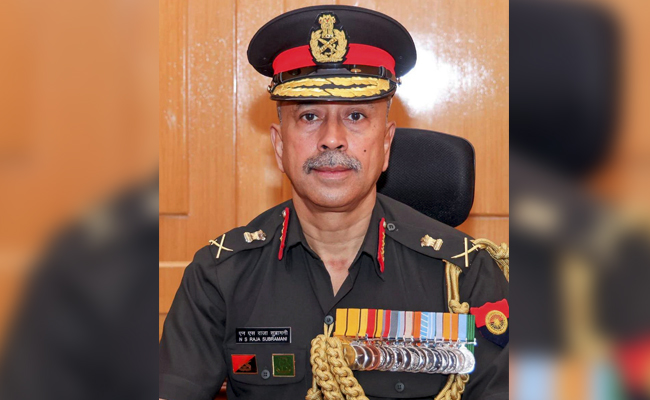
New Delhi (PTI): Lt Gen NS Raja Subramani will be India's new Chief of Defence Staff (CDS) and his key task is set to be to implement the ambitious theaterisation plan that seeks to ensure tri-services synergy.
He will succeed Gen Anil Chauhan whose tenure will come to an end on May 30.
Gen Chauhan, a former Eastern Army Commander, took charge as the country's senior-most military commander in September 2022, over nine months after the first CDS, General Bipin Rawat, died in a helicopter crash in Tamil Nadu.
The government has appointed Lt Gen NS Raja Subramani (Retd) as the Chief of Defence Staff, who will also function as the secretary of the Department of Military Affairs, the defence ministry said on Saturday.
Lt Gen Subramani is currently serving as the military adviser to the National Security Council Secretariat.
Prior to that, he was the Vice Chief of the Army Staff from July 1, 2024 to July 31, 2025, and was General Officer Commanding-in-Chief of the Central Command from March 2023 till June 2024.
As Chief of Defence Staff, Lt Gen Subramani's primary task will be to implement the theaterisation model to bring in tri-services synergy by rolling out integrated military commands.
The officer is a graduate of the National Defence Academy and the Indian Military Academy. He was commissioned into the eighth battalion of the Garhwal Rifles on December 14, 1985.
Lt Gen Subramani is an alumnus of Joint Services Command Staff College, Bracknell (UK), and the National Defence College, New Delhi. He holds a Master of Arts degree from King's College London and an MPhil in defence studies from Madras University.
In his illustrious career spanning over 40 years, Lt Gen Subramani has served across a wide spectrum of conflict and terrain profiles and tenanted a host of Command, Staff and Instructional appointments.
He commanded the 16 Garhwal Rifles in Counter-Insurgency operations in Assam as part of Operation Rhino, the 168 Infantry Brigade in Jammu and Kashmir, and the 17 Mountain Division in the Central Sector, all during a challenging operational environment.
He also has the distinction of commanding two Corps, including the Indian Army's premier strike Corps on the Western Front.