Stargazers alert - Comet C/2023 A3: Once-in-a-80,000 year celestial event visible this weekend
Comet C/2023 A3 has returned to Earth’s skies after 80,000 years, promises spectacular sky show
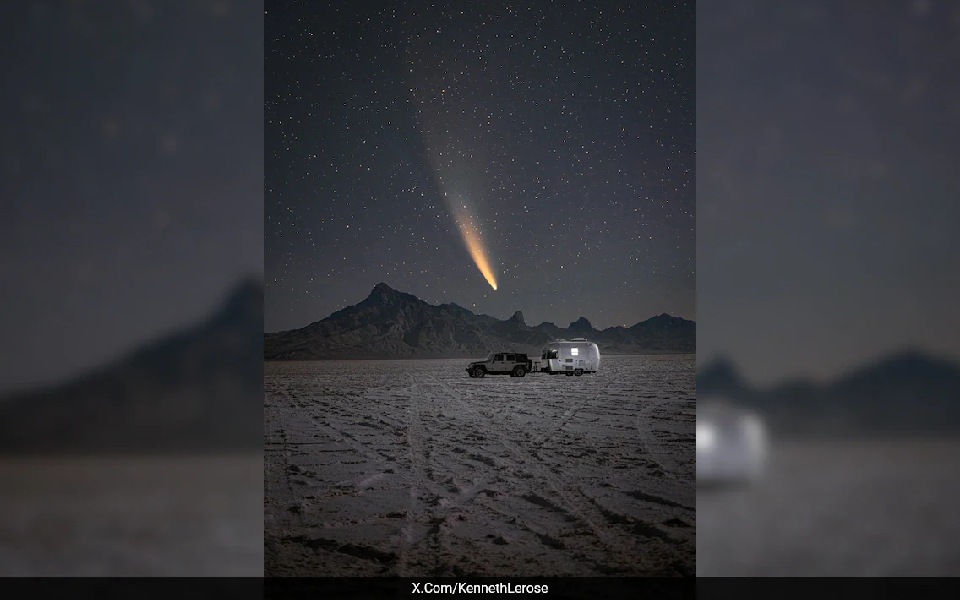
Comet C/2023 A3, also known as Tsuchinshan-ATLAS, is making a rare and breathtaking return to Earth's skies after an astonishing 80,000-year journey around the Sun. From Friday through Monday, early risers will have the unique opportunity to catch a glimpse of this celestial wonder in the early morning sky.
According to BBC Sky at Night Magazine, Comet C/2023 A3 completes its orbit every 80,000 years, making this an extraordinarily rare event for stargazers. The comet is expected to become a prominent object in the morning sky by late September 2024, shining brightly at a magnitude of +0.6 just before sunrise. The comet will reach its closest point to the Sun, known as perihelion, on September 28, 2024. As it ascends into the evening sky around October 10, observers can anticipate slightly dimmer views, with the comet predicted to shine at a magnitude of +0.8.
NASA astronaut Matthew Dominick, currently stationed aboard the International Space Station, shared a mesmerizing video of the comet on social media. In his post, he described the comet as appearing like "a fuzzy star" when viewed with the naked eye from the ISS's cupola windows. However, using a 200mm f/2 lens with a 1/8s exposure, Dominick captured more detailed images, showcasing the comet's potential for stunning visuals as it draws closer to the Sun.
Amateur astronomer Stuart Atkinson from Cumbria also provided insights into what viewers can expect. He noted on social media that the comet would resemble "a fuzzy star with a misty tail" positioned low in the eastern sky beneath the Moon. Atkinson suggested that using binoculars could enhance the viewing experience, offering a more detailed look at this once-in-a-lifetime celestial event.
Don't miss the chance to witness this extraordinary astronomical phenomenon as Comet C/2023 A3 graces our skies for the first time in millennia.
So far Comet Tsuchinshan-ATLAS looks like a fuzzy star to the naked eye looking out the cupola windows. But with a 200mm, f2 lens at 1/8s exposure you can really start to see it. This comet is going to make for some really cool images as it gets closer to the sun. For now a… pic.twitter.com/JstaSLJ4Ui
— Matthew Dominick (@dominickmatthew) September 19, 2024
Let the Truth be known. If you read VB and like VB, please be a VB Supporter and Help us deliver the Truth to one and all.
Lt Gen NS Raja Subramani to be India's next Chief of Defence Staff
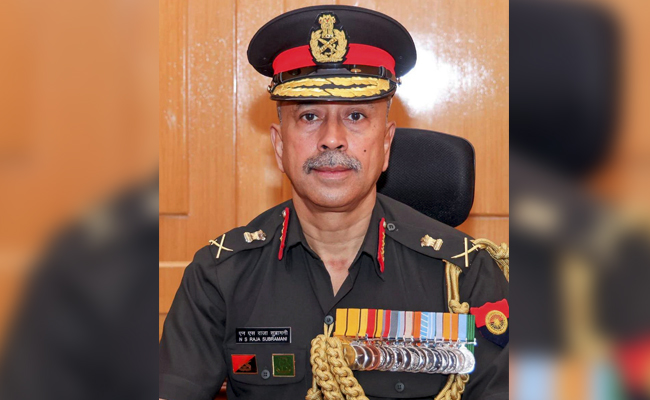
New Delhi (PTI): Lt Gen NS Raja Subramani will be India's new Chief of Defence Staff (CDS) and his key task is set to be to implement the ambitious theaterisation plan that seeks to ensure tri-services synergy.
He will succeed Gen Anil Chauhan whose tenure will come to an end on May 30.
Gen Chauhan, a former Eastern Army Commander, took charge as the country's senior-most military commander in September 2022, over nine months after the first CDS, General Bipin Rawat, died in a helicopter crash in Tamil Nadu.
The government has appointed Lt Gen NS Raja Subramani (Retd) as the Chief of Defence Staff, who will also function as the secretary of the Department of Military Affairs, the defence ministry said on Saturday.
Lt Gen Subramani is currently serving as the military adviser to the National Security Council Secretariat.
Prior to that, he was the Vice Chief of the Army Staff from July 1, 2024 to July 31, 2025, and was General Officer Commanding-in-Chief of the Central Command from March 2023 till June 2024.
As Chief of Defence Staff, Lt Gen Subramani's primary task will be to implement the theaterisation model to bring in tri-services synergy by rolling out integrated military commands.
The officer is a graduate of the National Defence Academy and the Indian Military Academy. He was commissioned into the eighth battalion of the Garhwal Rifles on December 14, 1985.
Lt Gen Subramani is an alumnus of Joint Services Command Staff College, Bracknell (UK), and the National Defence College, New Delhi. He holds a Master of Arts degree from King's College London and an MPhil in defence studies from Madras University.
In his illustrious career spanning over 40 years, Lt Gen Subramani has served across a wide spectrum of conflict and terrain profiles and tenanted a host of Command, Staff and Instructional appointments.
He commanded the 16 Garhwal Rifles in Counter-Insurgency operations in Assam as part of Operation Rhino, the 168 Infantry Brigade in Jammu and Kashmir, and the 17 Mountain Division in the Central Sector, all during a challenging operational environment.
He also has the distinction of commanding two Corps, including the Indian Army's premier strike Corps on the Western Front.