'Water found for first time on potentially habitable planet'
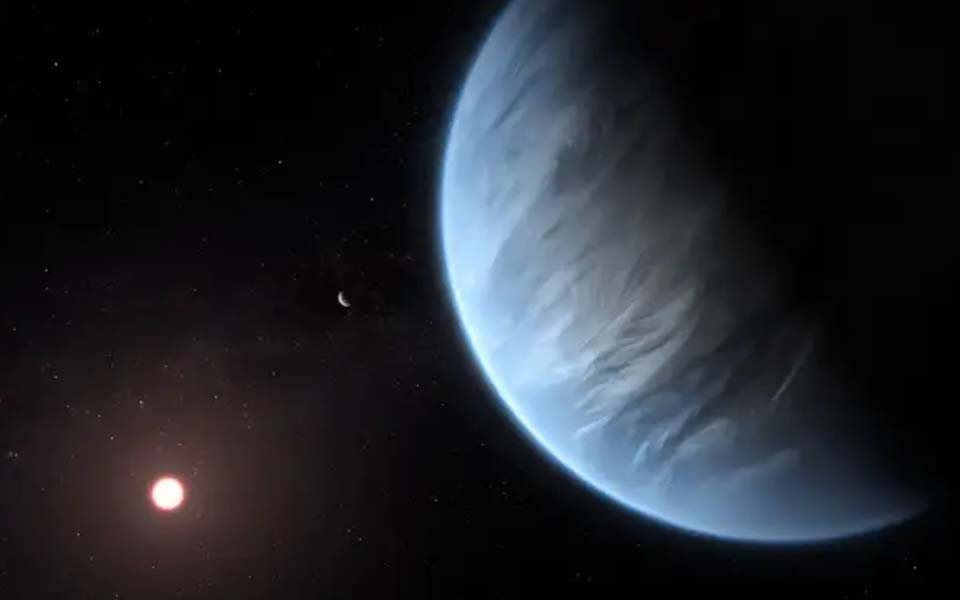
London, Sep 12: Astronomers have for the first time discovered water in the atmosphere of an exoplanet with Earth-like temperatures that could support life as we know it.
K2-18b, which is eight times the mass of Earth, is now the only planet orbiting a star outside the Solar System, or 'exoplanet', known to have both water and temperatures that could be potentially habitable, according to the study published in the journal Nature Astronomy.
The planet orbits the cool dwarf star K2-18, which is about 110 light years from Earth in the Leo constellation, researchers said.
The discovery is the first successful atmospheric detection for an exoplanet orbiting in its star's 'habitable zone', at a distance where water can exist in liquid form, they said.
"Finding water in a potentially habitable world other than Earth is incredibly exciting," said Angelos Tsiaras from the University College London (UCL) in the UK.
"K2-18b is not 'Earth 2.0' as it is significantly heavier and has a different atmospheric composition. However, it brings us closer to answering the fundamental question: Is the Earth unique?" said Tsiaras.
The team used archive data from 2016 and 2017 captured by the ESA/NASA Hubble Space Telescope and developed open-source algorithms to analyse the starlight filtered through K2-18b's atmosphere.
The results revealed the molecular signature of water vapour, also indicating the presence of hydrogen and helium in the planet's atmosphere, researchers said.
They believe that other molecules including nitrogen and methane may be present but, with current observations, they remain undetectable.
Further studies are required to estimate cloud coverage and the percentage of atmospheric water present, the researchers said.
Let the Truth be known. If you read VB and like VB, please be a VB Supporter and Help us deliver the Truth to one and all.
Efforts of party cadres will be rewarded on May 4: DMK chief Stalin
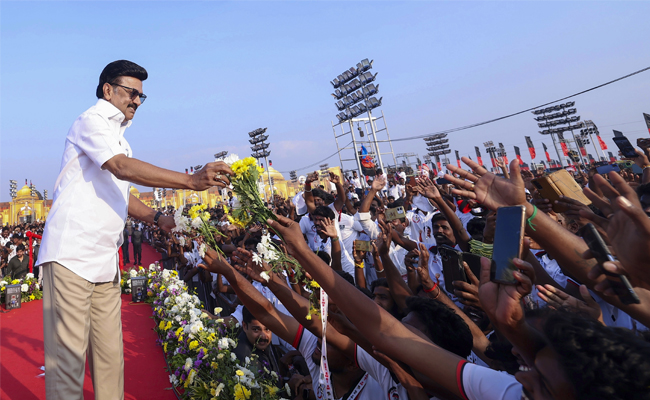
Chennai (PTI): Tamil Nadu Chief Minister M K Stalin on Friday said that the efforts made by his party cadres during the Assembly elections would be rewarded on May 4.
The counting of votes for the Assembly elections held on April 23 will be taken up on May 4.
"We are set to reap the rewards of the hard work put in by our party cadres on the coming fourth (May 4 counting day). There is absolutely no change in this and not even the slightest deviation," Stalin said at a May Day event here.
"There is no need for anyone to assume that I am speaking merely on the basis of exit polls," he added.
Stalin, who is also DMK chief, said that "good news" would come for those eagerly waiting for the election results.
Stating that the DMK governance is based on philosophy and principles, Stalin said, "This will continue."
He recalled the pivotal role of the then Chief Minister C N Annadurai, who first declared May Day as a government holiday, and subsequently, late CM M Karunanidhi, who was instrumental in extending it as a paid holiday across the nation.
"Responding to the request of Kalaingnar (Karunanidhi), the then Prime Minister V P Singh accepted the plea and declared it (May 1) a paid government holiday not merely for Tamil Nadu, but for the entire nation," Stalin said.