Facebook junks project to collect patients' health data: Report

San Francisco, April 6: In the wake of the Cambridge Analytica data breach, Facebook has reportedly suspended a research project where it was in touch with several major US hospitals to collect data about their patients.
According to a report in CNBC late Thursday, Facebook aimed to build profiles of patients and help the hospitals, including Stanford Medical School and American College of Cardiology, figure out which patients may need special care or treatment.
"This work has not progressed past the planning phase, and we have not received, shared, or analysed anyone's data," a Facebook spokesperson told CNBC.
A Facebook statement said: "Last year Facebook began discussions with leading medical institutions to explore whether scientific research using anonymised Facebook data could help the medical community advance our understanding in this area.
"The project could have raised new concerns about the massive amount of data Facebook collects about its users, and how this data can be used in ways users never expected."
Facebook, however, told The Verge that the patient data would instead be used more generally.
"The project would not attempt to provide health recommendations for specific people. Instead, the focus would be on producing general insights that would help medical professionals take social connectedness into account as they develop treatment or intervention programmes for their patients," a Facebook spokesperson was quoted as saying.
Facebook has admitted that information of up to 87 million people, mostly in the US, may have been improperly shared with the British political consultancy firm Cambridge Analytica.
Private data of over 5.6 lakh Indian Facebook users was also compromised by a private marketing firm that later sold the personal details acquired through a quiz app to Cambridge Analytica.
Let the Truth be known. If you read VB and like VB, please be a VB Supporter and Help us deliver the Truth to one and all.
PM Modi to address the nation tonight at 8.30 PM
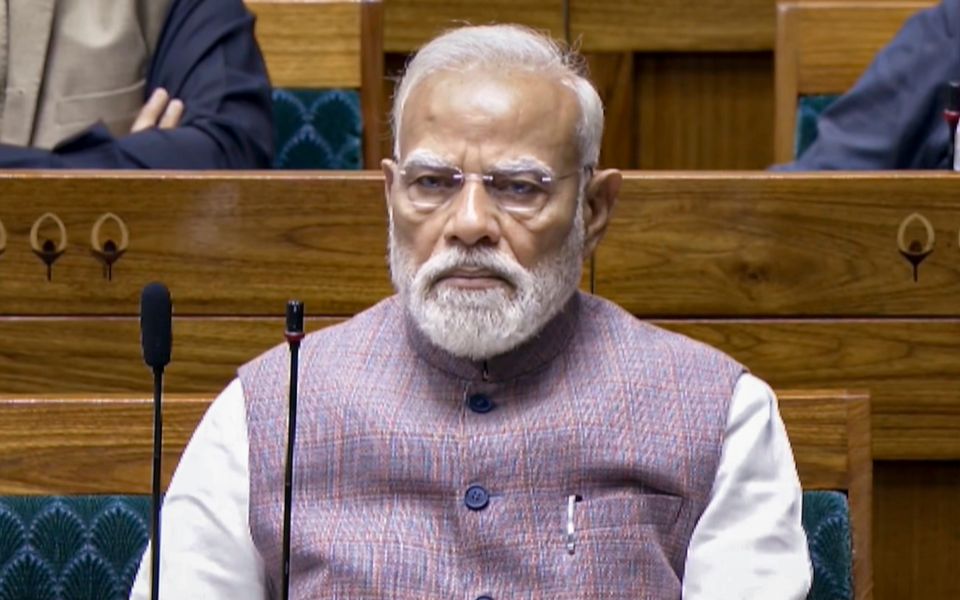
New Delhi (PTI): Prime Minister Narendra Modi will address the nation tonight at 8.30 PM, a day after a bill to implement women's reservation in legislatures was defeated in the Lok Sabha.
"The Prime Minister will address the nation at 8.30 PM (April 18, Saturday)," an official said.
Modi is expected to delve into the issue of implementation of women's quota and the happenings in Parliament, where opposition parties on Friday voted against the Constitution (131st Amendment) Bill.
Under the Bill, Lok Sabha seats were to be increased up to 816 from the current 543 to "operationalise" the women's reservation law before the 2029 parliamentary polls, following a delimitation exercise based on the 2011 Census. Seats were also to be increased in state and UT assemblies to accommodate 33 per cent reservation for women.
A two-thirds majority was required for the passage of the crucial bill but the ruling BJP-led alliance could not muster the numbers.
During polling on the bill in the Lok Sabha on Friday night, 298 members voted in its support, while 230 MPs voted against it.
Out of 528 members who voted, the bill required 352 votes for a two-thirds majority.