Fake claim by X user that Muslim woman had married her son debunked by Mohammed Zubair

Fact-checker Mohammed Zubair has debunked a false claim made by X user @swetasamadhiya, who is followed by Prime Minister Narendra Modi.
Sweta Srivastava who describes herself as an "Andhbhakt" and a "Hardcore Modi" supporter on her X bio had shared a video on her X account with a claim that a woman had married her own son in Kerala after the death of her husband.
In reality the video in question shows a mother congratulating her son after he completed the recitation of the Quran. However, it was falsely shared with the misleading assertion that a Muslim woman had married her son. Zubair's fact-check clarifies the actual context of the video, correcting the spread of misinformation
The video of Mother congratulating Son after completion of the Quran is shared with a false claim that a Muslim woman married her son. This account @swetasamadhiya is followed by PM Narendra Modi. pic.twitter.com/JNnONsudqo
— Mohammed Zubair (@zoo_bear) June 23, 2024
In the past also two edited photographs had gone viral on social media with the claim that "a father married his own daughter, prompting the mother to get furious and marry her own son." Back then also these claims were debunked by Alt News.
Many such false claims were earlier shared by right wing accounts. pic.twitter.com/dR5xtrYyyY
— Mohammed Zubair (@zoo_bear) June 23, 2024
Let the Truth be known. If you read VB and like VB, please be a VB Supporter and Help us deliver the Truth to one and all.
Bridge portion collapses on Jammu outskirts; 3-4 labourers feared trapped, 1 rescued
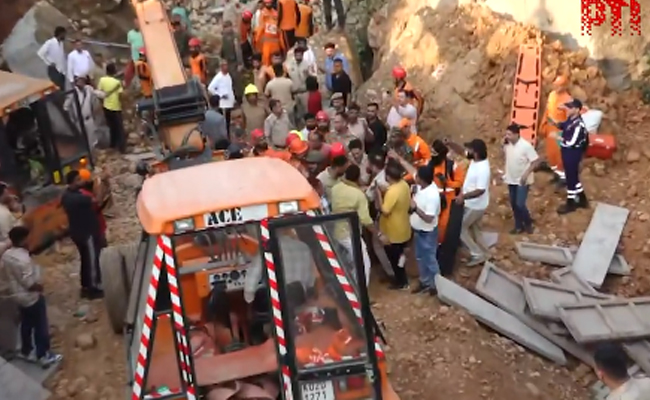
Jammu (PTI): A portion of a small bridge collapsed in the Bantalab area on the outskirts of Jammu city on Friday, trapping at least three to four labourers under the debris, while one injured worker was rescued, official sources said.
Authorities have closed the road link following the collapse of the portion of the bridge.
The incident occurred when labourers were carrying out repair work on a retaining wall near the bridge that was damaged in last year's flash floods, the sources said.
According to the sources, a section of the bridge suddenly gave way, burying workers engaged at the site under the rubble.
Police, Army and State Disaster Response Force (SDRF) teams launched rescue operations to extricate those buried under the debris. They pulled out one injured labourer and shifted him to a hospital, the sources said.
Family members of the labourers present at the site said around six workers engaged at the site at the time of the incident came under the debris when the structure collapsed. The family members said while two of the labourers managed to escape, four got trapped.
The sources said those trapped included the husband of a woman labourer, a mason, an unmarried labourer and a relative of the contractor.
There was no official confirmation on the exact number of persons trapped under the debris till the filing of this report.
The rescue operations are ongoing.