Google doodle celebrates Indian-American artist Zarina Hashmi's 86th birthday
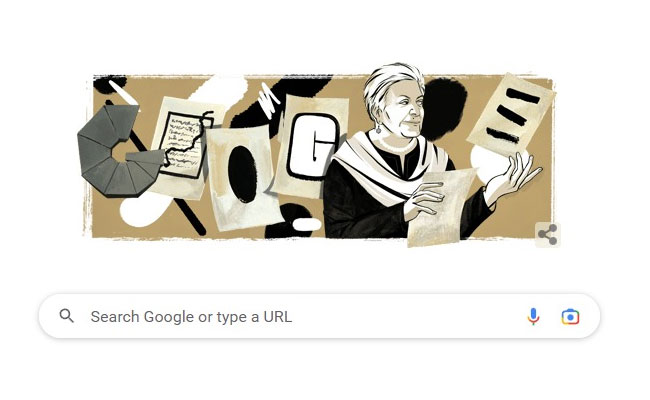
New Delhi (PTI): Search engine giant Google on Sunday celebrated the 86th birth anniversary of Indian-American artist and printmaker Zarina Hashmi, widely recognised as one of the most significant artists associated with the minimalist movement, with a special doodle.
Born on this day in 1937 in the small Indian town of Aligarh, Zarina's family was forced to flee to Karachi in the newly formed Pakistan during the Partition in 1947.
"Today's Doodle celebrates Indian American artist and printmaker Zarina Hashmi... Illustrated by New York-based guest artist Tara Anand, the artwork captures Hashmi's use of minimalist abstract and geometric shapes to explore concepts of home, displacement, borders, and memory," said the search engine in its description of the doodle.
At 21, Hashmi married a young foreign service diplomat and began travelling the world. She spent time in Bangkok, Paris, and Japan, where she became immersed in printmaking and art movements like modernism and abstraction, according to Google.
She moved to New York City in 1977 and became a strong advocate for women and artists of colour and taught at the New York Feminist Art Institute, which provided equal education opportunities for female artists.
In 1980, Hashmi co-curated an exhibition at A.I.R. Gallery called "Dialectics of Isolation: An Exhibition of Third World Women Artists of the United States". This ground-breaking exhibition showcased work from diverse artists and provided a space for female artists of colour.
A part of the Minimalism Art movement, Hashmi became internationally known for her striking woodcuts and intaglio prints that combine semi-abstract images of houses and cities where she had lived.
People all over the world continue to contemplate Hashmi's art in permanent collections at the San Francisco Museum of Modern Art, the Whitney Museum of American Art, the Solomon R Guggenheim Museum, and the Metropolitan Museum of Art, among other distinguished galleries.
Hashmi died in London from complications of Alzheimer's disease on April 25, 2020 at the age of 83.
Let the Truth be known. If you read VB and like VB, please be a VB Supporter and Help us deliver the Truth to one and all.
Malian defence minister killed in attack that saw jihadis and rebels seize towns, military bases
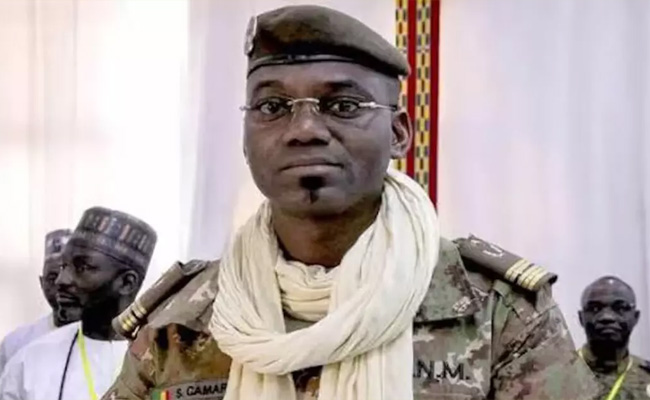
Dakar (AP): Malian Minister of Defence Gen. Sadio Camara was killed in an attack as jihadi and rebel forces seized towns and military bases across the country, according to a military officer and two other sources on Sunday.
There was no immediate comment from the Malian government.
“Unfortunately, the Ministry of Defence, Gen. Sadio Camara, has been killed during the attack which targeted his house yesterday,” said a military official who spoke on condition of anonymity because he did not have permission to speak to the media.
Two other people, a civil society leader and a security member, confirmed the information.
Separatist fighters on Saturday joined Islamic militants in launching one of the biggest coordinated attacks on the Malian army in the capital and several other cities that left at least 16 wounded.
The separatists have been fighting for years to create an independent state in northern Mali, while al-Qaida and Islamic State group-aligned militants have been fighting the government for over a decade.
Malian troops and Russian mercenaries withdrew from the northern city of Kidal after the attacks, the rebels said Sunday.
A spokesperson for the Tuareg-led Azawad Liberation Front, or FLA, a separatist group, said the Russian Africa Corps troops and the Malian military withdrew from the city after an agreement was reached for their peaceful exit.
“Kidal is declared free,” said FLA spokesperson Mohamed El Maouloud Ramadan.
The Malian army did not respond to requests for comment but in an earlier statement said they were “tracking down terrorist armed groups in Kidal.”
The separatists have been fighting for years to create an independent state in northern Mali. Kidal had long served as a stronghold of the rebellion before being taken by Malian government forces and Russian mercenaries in 2023. Its capture marked a significant symbolic victory for the junta and its Russian allies.
It was the first time the separatists worked alongside the al-Qaida-linked militant group JNIM, which also claimed responsibility for Saturday's attacks on Bamako's international airport and four other cities, including Kidal, in central and northern Mali.
“This operation is being carried out in partnership with the JNIM, which is also committed to defending the people against the military regime in Bamako,” Ramadan said.
Wassim Nasr, a Sahel specialist and senior research fellow at the Soufan Center security think tank, said that the coordination between the two groups, as well as the explicit call for the Russian military to leave, is new.
“The coordination, conducting attacks all over the country at the same time, real coordination on the military level but also on the political level because both claims of both groups they acknowledged that they worked together, this is a first,” said Nasr.
Mali government spokesperson Gen. Issa Ousmane Coulibaly said on state television late Saturday that 16 people were wounded, including civilians and military personnel, and that several militants were killed. He did not provide a death toll.
The governor of Bamako's district, Abdoulaye Coulibaly, announced a three-day overnight curfew, from 9 p.m. to 6 a.m.
The Economic Community of West African States has condemned the attacks and called on “all states, security forces, regional mechanisms and populations of West Africa to unite and mobilize in a coordinated effort to combat this scourge.”
The separatists called on Russia to “reconsider its support for the military junta in Bamako, whose actions have contributed to the suffering of the civilian population.”
Following military coups, the juntas in Mali, Niger, and Burkina Faso turned from Western allies to Russia for help in combating Islamic militants. But the security situation has worsened in recent times, with a record number of attacks by militants. Government forces have also been accused of killing civilians they suspect of collaborating with militants.
In 2024, an al-Qaida-linked group claimed an attack on Bamako's airport and a military training camp in the capital, killing scores of people.
Ulf Laessing, head of the Sahel program at the Konrad Adenauer Foundation, said that while the attacks were a major blow to the credibility of Mali's Russian partners, JNIM is unlikely to take control of Bamako in the near term due to opposition from the local population.
“The attacks are a major blow to Russia as the mercenaries had no intelligence about the attacks and were unable to protect major cities. They have unnecessarily worsened the conflict by not distinguishing between civilians and combatants,” Laessing said.