Growing reliance on AI news summaries raises questions over accuracy, media bias

Washington: The use of artificial intelligence to summarise news has expanded rapidly which has reshaped how readers consume and interpret daily information. Major technology companies have introduced AI-powered summaries across platforms, including tools that analyse scanned newspaper clippings and condensed search results. These are positioned as quicker alternatives to traditional news reading.
Earlier this year, a study highlighted by The Guardian warned that AI-generated summaries could have a “devastating impact” on digital news outlets, citing evidence of up to an 80 per cent drop in click-through traffic as readers increasingly rely on AI-generated answers instead of visiting original news websites.
ALSO READ: Supreme Court declines urgent hearing on plea against PM’s chadar offering at Ajmer Dargah
Beyond economic consequences, experts have raised alarms about factual accuracy and embedded bias. Tim Graham, Director of Media Analysis at the US-based Media Research Center, recently argued that AI news summaries cannot be fully accurate because they depend on source material that may itself be biased, even if such sources are categorised as credible by AI systems. Speaking on the programme No Spin News with American journalist Bill O’Reilly, Graham said this limitation applies across platforms, including Grok, ChatGPT and Gemini.
Echoing these concerns, media scholar Dr. Mrinal Chatterjee, professor at the Indian Institute of Mass Communication in Dhenkanal, told Hinduatan Times that current AI systems lack the contextual understanding and common sense required to identify and filter bias. He further claimed that artificial intelligence reflects the opinions encoded in its training data. It cannot independently identify prejudice or narrative.
Dr Chatterjee stresses that discerning bias is a human responsibility that requires awareness, education, and critical engagement with news content. He points out that media bias can result from either deliberate influence or unintentional errors, and that while not all media organizations are biased, the risk is always there.
To address these challenges, while some readers and institutions are turning to analytical tools designed to assess media bias, platforms such as AllSides are providing comparative analysis of news outlets across ideological spectrums.
In the United States, the White House has also launched an online portal aimed at tracking media bias and misinformation. The platform catalogues what it describes as false or misleading reports, maintains a public list of repeat offenders.
Let the Truth be known. If you read VB and like VB, please be a VB Supporter and Help us deliver the Truth to one and all.
ED arrests Punjab minister Sanjeev Arora in fresh PMLA case
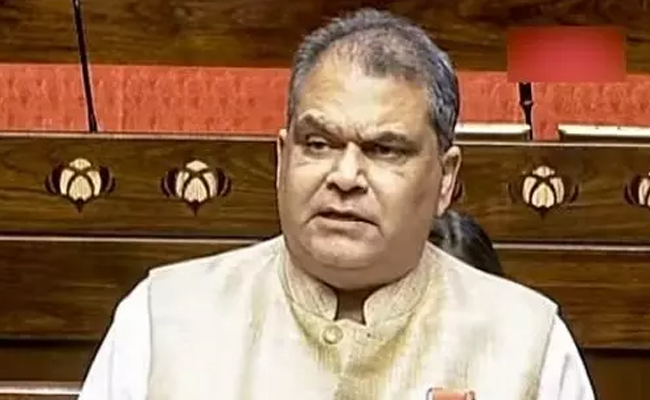
New Delhi/Chandigarh (PTI): The Enforcement Directorate on Saturday arrested Punjab industries minister Sanjeev Arora in a fresh money laundering case against him and some entities allegedly linked to him, officials said.
Arora was taken into custody under the Prevention of Money Laundering Act (PMLA) after raids were conducted at his official residence in Chandigarh since early morning, they added.
Officials claimed Arora (62) was "non-cooperative" during the probe. He is expected to be produced before a local court on Saturday, where the agency will seek his custody for a detailed interrogation.
The ED carried out the searches at five premises across north India as part of the action.
The raids also covered two premises in Delhi and that of a company named Hampton Sky Realty Ltd in Gurugram's Udyog Vihar.
The searches were launched after the central agency registered a fresh case under the criminal sections of the Prevention of Money Laundering Act (PMLA), the officials said.