Purported video of Mandsaur Panchayat member of BJP in objectionable position on highway goes viral
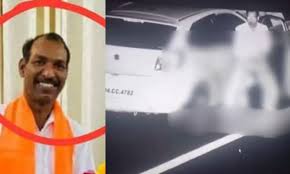
Mandsaur, Madhya Pradesh: A purported CCTV video showing Manohar Lal Dhakad, a District Panchayat member from Mandsaur, in a compromising position with a woman on a newly built public highway has gone viral on social media, triggering outrage and prompting a police inquiry. The incident reportedly took place on May 13 and has since attracted significant public attention.
Manohar Lal Dhakad, a resident of Bani village in Mandsaur district, can be seen in the clip engaging in objectionable behaviour on the 8-lane highway. The woman seen with him is not identified. Dhakad’s wife is also a sitting member of the Mandsaur District Panchayat, adding further interest to the case.
Reacting to the viral video, Mandsaur BJP District President Rajesh Dixit stated that a proper investigation will be carried out before any action is taken. He also clarified that Dhakad is not a BJP office-bearer. “We are awaiting details of the incident. The party will not shield anyone found guilty,” he said.
State BJP spokesperson Yashpal Singh Sisodia reaffirmed the party’s position on discipline. He said, “The BJP is committed to maintaining moral standards. If any wrongdoing is confirmed, appropriate action will be taken.” Meanwhile, BJP State President V.D. Sharma also confirmed that Manohar Lal Dhakad is not a primary member of the party.
Police have not registered any case so far, and no official complaint has been filed by any party. However, the viral nature of the video and the public reaction has forced authorities to act.
Deputy Inspector General of Police, Ujjain Range, Manoj Kumar Singh, condemned the act. “Such conduct is highly inappropriate, especially in a public place. We are in the process of verifying the location and authenticity of the video. If the video is found to be genuine, suitable action will be taken in accordance with the law,” he said.
As of now, the identity of the woman and the full context of the video remain unclear.
Let the Truth be known. If you read VB and like VB, please be a VB Supporter and Help us deliver the Truth to one and all.
3 killed, 4 injured in truck-autorickshaw collision in UP
Shahjahanpur (UP) (PTI): Three people were killed and four injured in a collision between a truck and an autorickshaw here on Sunday afternoon, police said.
Superintendent of Police (SP) Saurabh Dixit said the truck was coming from the Jalalabad side and the auto-rickshaw from the opposite direction.
Due to the impact of the collision, Ramkshatriya (28), an unidentified 40-year-old woman and Kallu (45) died on the spot, the SP said.
On receiving information about the accident, police rescued four injured people, who were admitted to the government medical college for treatment. The bodies have been sent for post-mortem, Dixit said.
The truck driver fled the scene after the accident and the vehicle has been seized. Efforts are underway to trace the driver, police said.