50th part of landmark verdicts on Ayodhya dispute, right to privacy, adultery
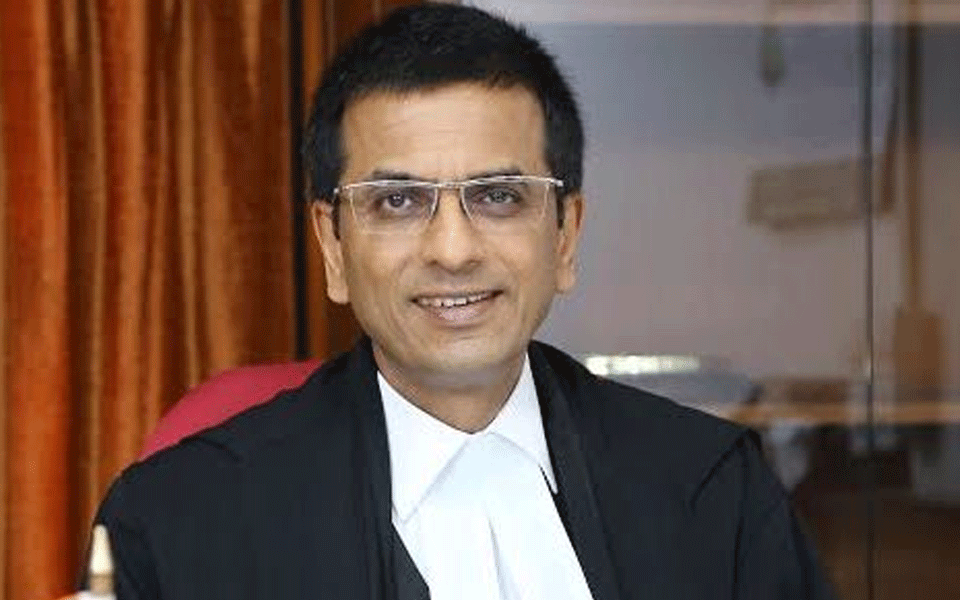
New Delhi (PTI): Justice Dhananjaya Y Chandrachud, who took over as India's 50th chief justice of India, has played a pivotal role in digitisation of the judiciary and been part of benches that delivered landmark verdicts on issues such as the Ayodhya land dispute, Section 377 and right to privacy.
The apex court's most senior judge follows in the footsteps of his father and former chief justice of India, the late Y V Chandrachud, who was at the helm of the judiciary from February 22, 1978 to July 11, 1985 and was India's longest serving CJI. This is the first instance of a father and son occupying the highest seat of justice.
CJI Chandrachud, often referred to as DYC in legal circles, was sworn in by President Droupadi Murmu. He takes over from Uday Umesh Lalit, who recommended him as his successor to the Centre on October 11.
Unlike his predecessor who served for 74 days, India's new CJI will be in office for two years till November 10, 2024. Supreme Court judges retire at the age of 65.
Justice Chandrachud, born on November 11, 1959 and considered a Delhi University product who studied in St Stephen's College and the Campus Law Centre before going to Harvard, was elevated to the top court on May 13, 2016.
Counted as a judge who enriched the verdict docket' of the apex court, Justice Chandrachud is viewed as sharp, articulate and forward looking. Expected to advance judicial frontiers, he was a member of benches that delivered judgements on decriminalising part of Section 377 of the Indian Penal Code and the entry of women in Sabarimala.
The list of important judgements that settled many a debate is long.
He was also part of an important verdict expanding the scope of the Medical Termination of Pregnancy Act and the corresponding rules to include unmarried women for abortion between 20-24 weeks of pregnancy.
Justice Chandrachud was among the two judges of the apex court collegium who recently objected to the method of "circulation" adopted for eliciting the views of its members on the appointment of judges to the top court.
During the COVID-19 pandemic, a bench led by Justice Chandrachud passed several directions to address the miseries faced by people while terming the second wave a "national crisis". The bench, for instance, directed the Centre to ensure supply of oxygen to hospitals across the nation for proper treatment of patients.
Known as a doer, he presided over a bench that worked five hours beyond regular working hours on September 30, 2022 to hear 75 cases to clear the board before the onset of the Dussehra vacations.
In a landmark verdict in February 2020, a bench headed by Justice Chandrachud directed that women officers in the Army be granted permanent commission and command postings, rejecting the Centre's stand of physiological limitations as being based on "sex stereotypes" and "gender discrimination against women".
Later, a Justice Chandrachud-led bench also paved the way for granting permanent commission to women officers in Indian Navy, saying a level playing field ensures that women have the opportunity to overcome "histories of discrimination".
He has been part of several Constitution benches.
Justice Chandrachud was part of a five-judge Constitution bench that on November 9, 2019 in a unanimous verdict cleared the way for the construction of a Ram Temple at the disputed site at Ayodhya, and directed the Centre to allot a five-acre plot to the Sunni Waqf Board for building a mosque.
He also wrote the lead judgement for a nine-judge Constitution bench in the Justice K S Puttaswamy versus Union of India case in which it was unanimously held that right to privacy constituted a fundamental right under the Constitution.
Justice Chandrachud was a member of the five-judge Constitution bench that unanimously decriminalised part of the 158-year-old colonial law under section 377 of Indian Penal Code, which criminalises consensual unnatural sex between consenting adults, saying it violated the rights to equality.
Another five-judge bench including Justice Chandrachud unanimously held that Section 497 of the Indian Penal Code, which criminalised adultery, was unconstitutional on the ground of being arbitrary, archaic and violative of the right to equality and privacy.
In a strong dissent, Justice Chandrachud differed with other members of a five-judge Constitution bench which by a majority verdict upheld the constitutional validity of the unique biometric identity number Aadhaar. He held Aadhaar to be unconstitutional and violative of fundamental rights.
He concurred with the majority verdict in the Sabarimala case in holding that the practice of prohibiting women of menstruating age from entering the Sabarimala temple was discriminatory and violative of women's fundamental rights.
Besides, Justice Chandrachud was part of a landmark judgment by a five-judge Constitution bench which recognised 'living will' made by terminally-ill patients for passive euthanasia.
A bench headed by Justice Chandrachud ordered demolition of Supertech's twin 40-storey towers in its Emerald project in Noida which were held illegal for violation of norms.
In November 2020, he headed a bench granting interim bail to journalist Arnab Goswami in a 2018 abetment to suicide case, saying it will be a "travesty of justice" if personal liberty is curtailed.
In July this year, a bench led by him ordered the release of Alt News co-founder Mohammad Zubair on interim bail in all the FIRs lodged in Uttar Pradesh against him for alleged hate speech, saying "exercise of the power of arrest must be pursued sparingly" and transferred all the cases in Uttar Pradesh to Delhi.
Justice Chandrachud was chief justice of the Allahabad High Court from October 31, 2013 till his elevation to the apex court.
He became judge of the Bombay High Court from March 29, 2000 until his appointment as the Chief Justice of Allahabad High Court.
He was designated senior advocate by the Bombay High Court in June 1998 and also became Additional Solicitor General in the same year.
After completing BA Honours in Economics from Delhi's St Stephen's College, Justice Chandrachud did his LLB from Campus Law Centre, Delhi University, and obtained LLM degree and a Doctorate in Juridical Sciences (SJD) from Harvard Law School, USA.
He practised law at the Supreme Court and the Bombay High Court and was a visiting professor of comparative Constitutional law at the University of Mumbai.
Let the Truth be known. If you read VB and like VB, please be a VB Supporter and Help us deliver the Truth to one and all.
India, Jamaica agree to boost trade, skilled mobility: Jaishankar
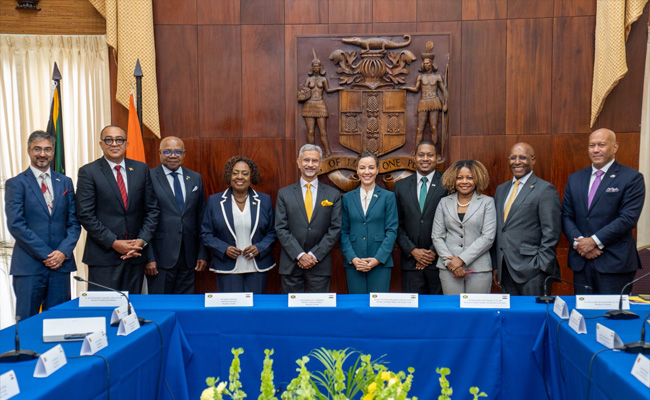
Kingston (PTI): India and Jamaica agreed to further strengthen trade linkages and explore cooperation for recruitment and mobility of skilled professionals, including healthcare workers and teachers, External Affairs Minister S Jaishankar said.
Addressing a joint press conference here after talks with his Jamaican counterpart Kamina J Smith on Monday, Jaishankar said the discussions were comprehensive, and they reviewed the entire gamut of bilateral ties, identifying new avenues to deepen the partnership.
"We signed several important agreements and discussed effective implementations of MOUs which have been recently concluded in the fields of digital transformation, cultural exchange, sports and digital payments to ensure tangible outcomes on the ground," he said.
India recognised Jamaica's growing role as a logistics hub and gateway to the Caribbean for trade and investment, Jaishankar said.
ALSO READ: Actor Santhosh Nair killed in road accident in Pathanamthitta
"We agreed to further strengthen trade, business and investment linkages, explore cooperation for recruitment and mobility of skilled professionals, including nurses, healthcare workers and teachers," he said.
The two sides also discussed expanding cooperation in defence and security, healthcare, digitisation, agriculture, education and infrastructure, the minister said.
Highlighting development cooperation as a key pillar of ties, Jaishankar noted the successful completion of the Improving Rural Livelihoods Project in Kitson Town in March 2026, implemented with Indian assistance of USD 1 million under the India-UN Development Partnership Fund, benefiting over 200 individuals and impacting thousands more.
He said India is also discussing the feasibility of establishing an artisan empowerment hub in Jamaica and reiterated support for the country's recovery following Hurricane Melissa.
As part of humanitarian assistance, India has supplied relief material, deployed a medical team and is in the process of providing 30 dialysis units. It is also sending 40 fishing boats and 200 GPS units to aid recovery efforts.
The ministers reaffirmed close cooperation in multilateral fora and discussed issues such as reformed multilateralism, climate justice and priorities of the Global South.
India appreciated Jamaica’s support for its candidature for a non-permanent seat at the UN Security Council for 2028-29.
Both sides strongly condemned terrorism in all its forms and called for early finalisation of the Comprehensive Convention on International Terrorism.
Jaishankar also highlighted growing people-to-people ties, noting the popularity of yoga and Ayurveda in Jamaica and the contribution of the Indian diaspora to the country’s development.
He announced a contribution of two million Jamaican dollars towards celebrations marking 181 years of the arrival of Indians in Jamaica on India Heritage Day.
According to the website of the High Commission of India in Kingston, Jamaica has an Indian diaspora of around 70,000 people whose forefathers came mostly from Uttar Pradesh and Bihar as indentured labour between 1845 and 1917. Some also came from South India.
The diaspora constitutes around 3 per cent of Jamaica's population and continues to nurture an abiding interest in Indian culture, music, dance and history, serving as a cultural bridge between the two countries. May 10 is observed as India Heritage Day in Jamaica.
Later in the day, Jaishankar interacted with Jamaica’s industry and business leaders, underlining the need to deepen economic engagement as countries diversify partnerships globally.
“Emphasised that as we all diversify and seek reliable partners, the imperative to deepen India-Jamaica business ties is that much stronger,” he said in a social media post, noting that the potential for bilateral and regional economic cooperation should be "explored more vigorously".
He also appreciated Industry Minister Aubyn Hill for convening the interaction with business leaders.
Jaishankar arrived in Kingston on Saturday, marking the first leg of his nine-day tour of Jamaica, Suriname, and Trinidad and Tobago, aimed at further strengthening India's strategic and cultural ties with the Caribbean nations.