Images of 2015 Pak heatwave viral as casualties of the Balakot airstrike by IAF
A set of images doing rounds on social media is being shared with claims that it depicts the impact of Indian Air Force’s airstrike in Pakistan. The photographs show mass graves and shrouded dead bodies. “बालाकोट हमले का सबूत सभी हरामी नेताओं को है ये ताकी तुम सभी ग़द्दार अपने मुह पर चपल मार कर चुप रहे और सेना का माजक न उड़ाऐ |जय हिंद की सेना! (This proof of Balakot attack is for the ha**** ministers so that you traitors hit your faces with slippers and keep your mouths shut instead of making fun of our forces.),” is the commonly used caption accompanying the photographs. Another caption that is being used to share the images is – “यह है सबूत अच्छी तरह से चशमा लगा कर देख लिजियेगा जी। (This is the proof. See properly with spectacles on.)“
Image 1
An image in the set of photographs shows shrouded dead bodies placed in what looks like a tunnel dug for mass graves.

We found the original photograph on Getty Images, which described the pictures as, “Pakistani Edhi charity volunteers bury the bodies of unclaimed heatwave victims at a graveyard in Karachi on June 26, 2015. Pakistani welfare volunteers on June 26 held a mass funeral for 50 victims of Karachi’s worst heatwave in decades, whose bodies had gone unclaimed.”

Image 2
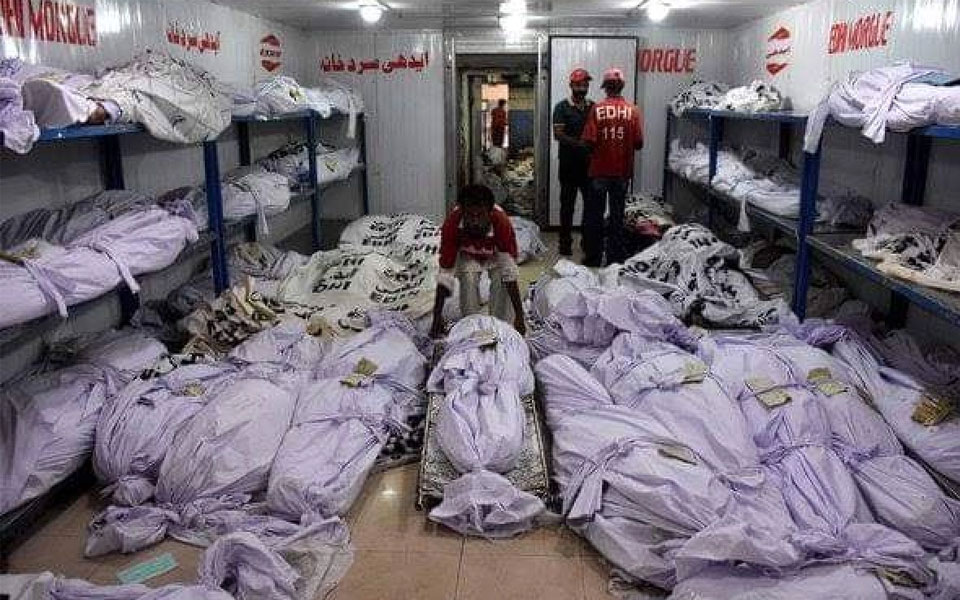
Another viral image shows a room where a man is covering several dead bodies covered with white cloth.

Reverse-searching this photograph on Google led us to the original photo on Getty Images. This photograph also depicted the 2015 heatwave in Pakistan which caused hundreds of deaths. The dead bodies in the photograph were the unclaimed ones and the man was putting identification papers on their shrouds.

Image 3 and 4
Two other similar images of shrouded bodies are being shared on social media, claiming that these are the Pakistani casualties of the Balakot airstrike.

These images are also of the 2015 heatwave in Pakistan. While the image on the left was found on TIME magazine, the one on the right was traced back to Getty Images.

Image 5
The last photograph shows people burying the dead in mass graves.

This image has already been debunked by Alt News. While we were unable to trace its origin, we found that it has existed on the internet since at least 2016.

Google reverse-image search also threw up a 2013 New York Times article carrying a similar image. The photograph was sourced to Associated Press, which described it as, “Pakistani men prepare the graves of Saturday’s bombing victims in Quetta, Pakistan, Sunday, Feb. 17, 2013.” This photograph seemed to be of the same location as the viral image but taken from a different angle.
Misinformation on social media related to the Balakot airstrike has increased manifold, especially after reports of no casualties in the attack. In the past, we have debunked 2005 Kashmir earthquakeimages being circulated as the devastation caused by the Indian Air Force’s airstrike on JeM camps.
Courtest: www.altnews.in
Let the Truth be known. If you read VB and like VB, please be a VB Supporter and Help us deliver the Truth to one and all.
Navy ensures security of Indian commercial ships, oil tankers: Defence Minister Rajnath Singh
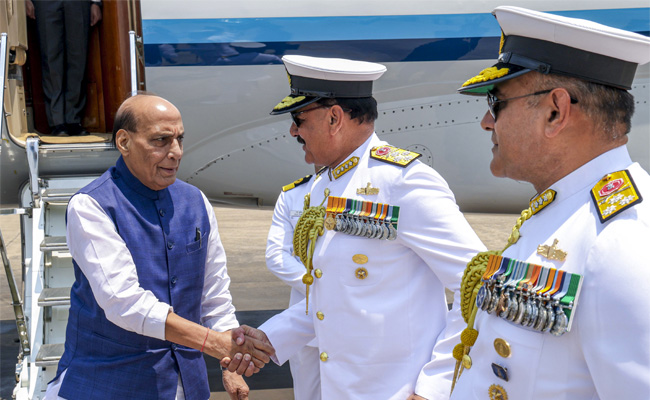
Visakhapatnam (PTI): Pointing out that 95 per cent of the country’s trade, including energy supplies, is conducted through sea, Defence Minister Rajnath Singh on Friday noted the Indian Navy's indispensable role in securing commercial shipping lanes and oil tankers against emerging maritime threats.
Speaking at the commissioning ceremony of INS Taragiri here, the Defence Minister said the Indian Navy continuously maintains its presence in the Indian Ocean--whether it is the Persian Gulf or the Malacca Strait.
Singh’s comments assume significance following the disruption of oil supplies and blockage of oil tankers in view of the prevailing situation in West Asia.
According to him, a strong and capable navy is not an option for the country, but a necessity.
“There are many sensitive points in the sea where our Navy has continuously made its active presence to ensure the smooth supply of goods. Whenever there is a situation of tension there, the Indian Navy has ensured the security of our commercial ships and oil tankers,” he said.
The Indian Navy has proven that it is not only capable of protecting the interests of the country, but if necessary, can also take every step to ensure the safety of its citizens and trade routes around the world, he added.
Citing history, he said without strengthening the naval power, no country can be considered powerful in the right sense and therefore, when Prime Minister Narendra Modi talks about Viksit Bharat by 2047, the basis of marine power becomes very important.