‘Modi’s win will see India’s soul lost to a dark politics,’ says ‘The Guardian’ editorial
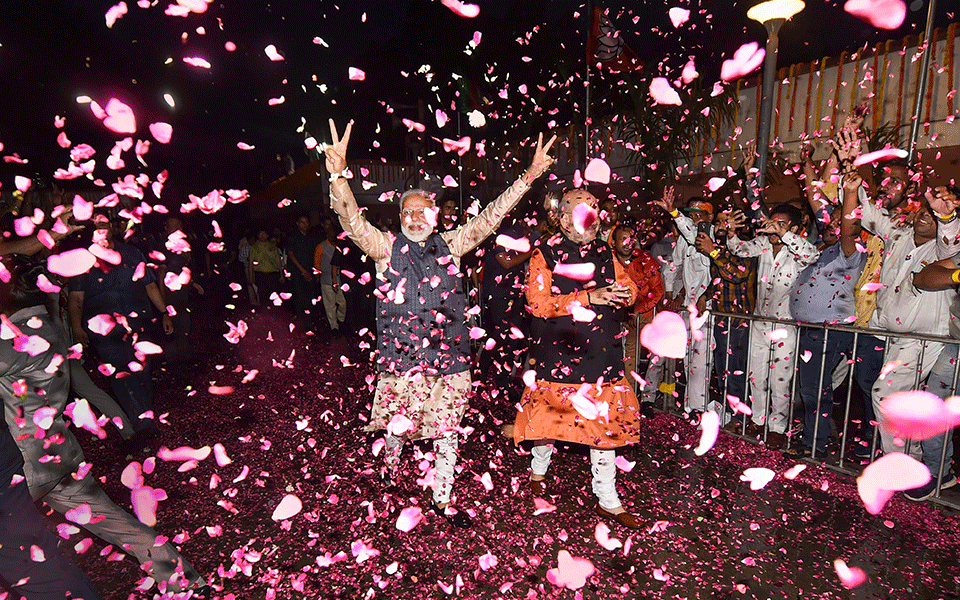
Prime Minister Narendra Modi’s victory in the national elections will see India’s soul “lost to a dark politics”, and this is bad news for the country and the world, British newspaper The Guardian said in an editorial on Thursday. The editorial said Modi had threatened “independent India’s most precious facet: a functioning multi-party democracy”.
The newspaper’s criticism of Modi noted that he is a “divisive figure” but “undoubtedly a charismatic campaigner”, who “deployed with terrible effect false claims and partisan facts”. The Congress and the Nehru–Gandhi family, meanwhile, will have to “seriously rethink” how to defeat him, the editorial said.
The editorial said the Hindu nationalism movement that Modi is part of is changing India for the worse, with its focus on upper-caste Hindus, pro-corporate economic growth, cultural conservatism, “intensified” misogyny, and a “firm grip on the instruments of state power”.
The article made remarks about Indian Muslims being “political orphans”, their declining seat share in Parliament, and how Hindutva views them as second-class citizens. It said Modi had recklessly taken India and Pakistan close to war earlier this year.
But Modi’s victory, despite a “spluttering economy”, should perhaps not be surprising, the editorial said, citing a 2017 survey that showed that India had the greatest support for autocratic rule.
About the Bharatiya Janata Party, the newspaper said the party “pays lip service to reducing the yawning inequalities that disfigure India”, and the role of caste and religious conflict in India’s party system suits the outfit. The Opposition, meanwhile, needs to run a “distinctive campaign on an egalitarian platform”, and replace identity-based fights with “political competition over how to benefit all Indians”, the editorial said. “That will require an Opposition in India far savvier and more in touch with the country’s poor than exists today,” it said.
Pankaj Mishra in The New York Times
In an article for The New York Times, journalist and author Pankaj Mishranoted how Modi’s “raw wisdom” had made India suffer for five years, proving him to be “dangerously incompetent”. He wrote about threats to minorities and lower-caste Hindus, as well as dissenting journalists and women. Mishra said that during Modi’s rule, India had witnessed a “savage assault on not just democratic institutions and rational discourse but also ordinary human decency”.
In the article titled “How Narendra Modi Seduced India With Envy and Hate”, Mishra wrote that voters had chosen overwhelmingly to “prolong this nightmare”. “The sources of Mr. Modi’s impregnable charisma seem more mysterious when you consider that he failed completely to realize his central promises of the 2014 election: jobs and national security,” Mishra said.
The writer also said that corporate-owned media had “fervently built up Modi as India’s saviour”.“Since 2014, Mr. Modi’s near-novelistic ability to create irresistible fictions has been steadily enhanced by India’s troll-dominated social media as well as cravenly sycophantic newspapers and television channels,” said the author of the book Age of Anger. He added that the Opposition was right to suggest that the Election Commission had been “shamelessly partisan”.
Mishra said Modi had exploited the “long dormant rage” against India’s “self-perpetuating post-colonial rulers”, noting how previous governments had left “no possibility of dialogue with a metropolitan ruling class of...Godlike aloofness, which had cruelly stranded us in history while itself moving serenely toward convergence with the prosperous West”.
Meanwhile, satirical website The Onion also had a take on Modi’s huge victory. The Onion put up a photo of Modi accompanied with the headline, “India Continues Surge Towards Status as First-world Nation by Reelecting Racist Right-wing Authoritarian”.
courtesy: scroll.in
Let the Truth be known. If you read VB and like VB, please be a VB Supporter and Help us deliver the Truth to one and all.
Bihar: Over 150 children fall ill after consuming 'mid-day meal' in Saharsa

Saharsa (PTI): More than 150 children were taken ill after allegedly consuming food that was part of the mid-day meal in a school in Bihar’s Saharsa district, a senior official said on Thursday.
The incident occurred at a middle school in Baluaha village of the district.
The official said that 115 children were undergoing treatment at the Sadar Hospital, while around 50 students were admitted to Mahishi Public Health Centre.
“We received information that several children fell ill after consuming the mid-day meal in Baluaha. The children were initially treated at the primary health centre, but later, many were referred to the Sadar Hospital,” Saharsa District Magistrate Deepesh Kumar told reporters.
“According to doctors, the health condition of the children has improved, but they will be kept under observation for some time. There is no need to panic. Some kids are having mild fever. They are being treated accordingly,” Kumar said.
Meanwhile, family members of some children claimed that a snake was found in the container in which cooked pulses was stored at the school.
Of the 545 students present in the school, 200 had already eaten their meals by the time the snake was spotted, and later complained of stomach ache and vomiting, they said.
Regarding the claims, the DM said food samples have been collected from the school.
“We will be able to comment on this only after the results of the tested samples arrive,” he said.