10-yr-old British-Indian Bodhana Sivanandan defeats Grandmaster Peter Wells
2025 British Chess Championships
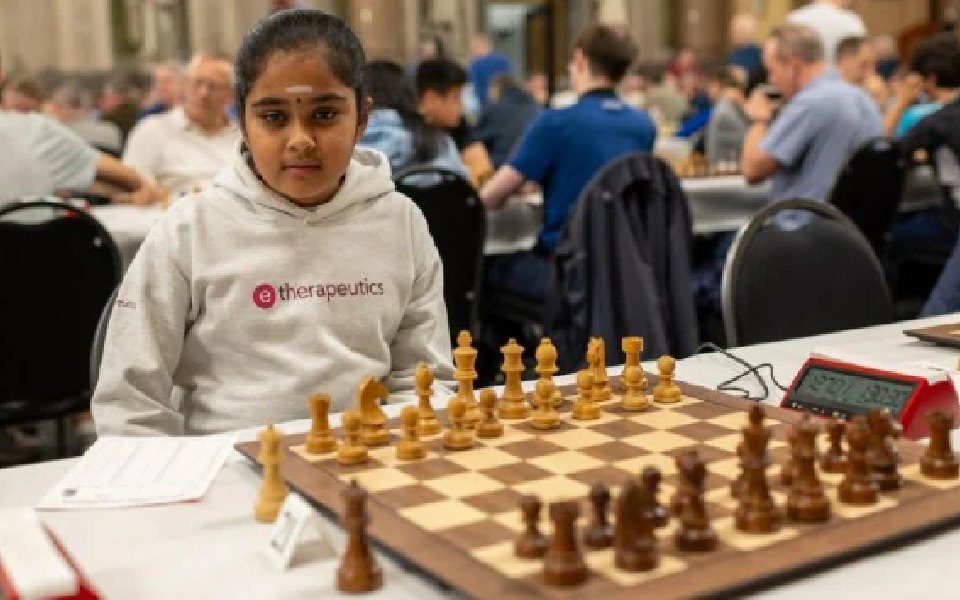
LIVERPOOL: Bodhana Sivanandan, a 10-year-old British chess player of Indian descent, made history at the 2025 British Chess Championships by defeating Grandmaster Peter Wells in the tournament’s final round. The chess prodigy set a new record as the youngest female player to beat a grandmaster, surpassing the previous mark set by American Carissa Yip in 2019, reported The Indian Express.
Born and raised in London, Bodhana’s family originally hails from Trichy, Tamil Nadu. Her father, Sivanandan Velayutham, an IT professional, relocated the family to the UK in 2007. At a very young age Bodhana became a prominent figure in British chess circles. She was also invited to 10 Downing Street by former Prime Minister Rishi Sunak in 2023.
Young Bodhana uses a cushioned seat to reach the chessboard. Her father said that she began playing at five after discovering a chessboard at home. Initially, he supported her learning by downloading free instructional videos on Chess.com, not expecting her to pursue the game seriously.
Since then, Bodhana has garnered three world junior titles. Her victory over the experienced 60-year-old Wells was a surprise, as she faced considerable difficulty mid-game. By the 19th move, Wells’ knights were threatening her king and by the 26th move, she seemed likely to lose. Even at move 37, the outlook was bleak. However, a tactical error by Wells followed by precise moves from Bodhana reversed the position, leading to Wells’ resignation. English Chess Federation commentator Danny Gormally described the win as almost magical.
She chose to compete in the open event. Bodhana earned 24 rating points with her win and her joint was placed 26th open category. Her favourite players are Judit Polgar and Magnus Carlsen.
According to the report, Bodhana appreciates the way chess uses the brain and involves strategy and calculation. Bodhana also plays piano and violin.
Tim Wall, Director of Junior Chess at the English Chess Federation, lauding Bodhana's poise and maturity on the board, said that she would reach the grandmaster level within three to four years.
Let the Truth be known. If you read VB and like VB, please be a VB Supporter and Help us deliver the Truth to one and all.
Congress using hijab issue to pacify minority anger, alleges Karnataka LoP R Ashoka
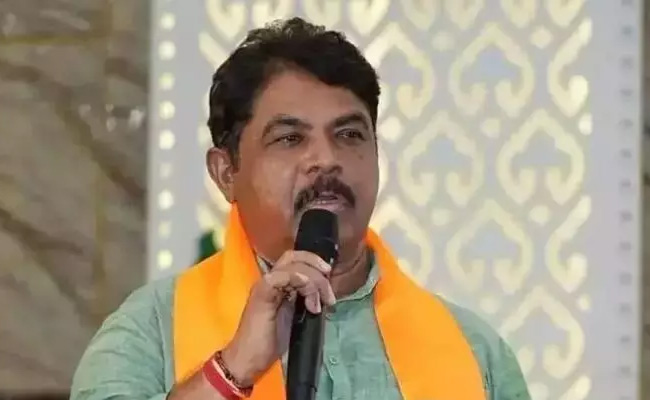
Bengaluru: Leader of Opposition in the Assembly R. Ashoka has accused the Congress government of using the hijab issue to placate what he described as discontent among minority voters after the Davanagere by-election.
In a post on X on Wednesday, Ashoka alleged that the state government, instead of addressing issues such as price rise, corruption, farmers’ distress and law and order, was attempting to retain its minority vote base by reviving the hijab issue.
Referring to the 2022 dress code introduced by the BJP government, which prohibited hijab in schools and colleges, Ashoka said the Karnataka High Court had upheld the policy and emphasised the importance of discipline in educational institutions.
He questioned the Congress government’s move to revisit the issue and asked whether setting aside the court-backed policy to benefit one community could be described as secularism.
Ashoka further alleged that while the government was willing to permit hijab, it continued to prohibit saffron shawls.
He accused the government of dividing students on religious lines rather than treating schools and colleges as spaces of equality.
Drawing a comparison with Mamata Banerjee’s government in West Bengal, Ashoka claimed that excessive appeasement politics had harmed the state and warned that the Congress in Karnataka could face a similar political response.
He said voters in Karnataka would teach the Congress a lesson for what he termed “vote-bank politics” and for compromising constitutional and judicial principles.