22-time Grand Slam champion Rafael Nadal announces retirement from tennis
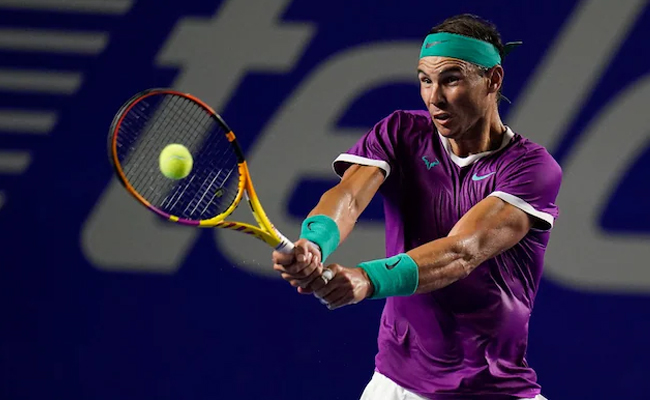
Madrid (AP): Rafael Nadal announced Thursday he will retire from tennis at age 38 following next month's Davis Cup finals.
Nadal won 22 Grand Slam singles titles during an unprecedented era he shared with his rivals in the so-called Big Three, Roger Federer and Novak Djokovic.
In an announcement on social media, the Spaniard indicated his decision was related to persistent injury problems.
“The reality is that it has been some difficult years, these last two especially. I don't think I have been able to play without limitations. It is obviously a difficult decision, one that has taken me some time to make. But in this life, everything has a beginning and an end,” Nadal said.
Nadal added he was “very excited” to finish his career at the Davis Cup, which will be played in Malaga, Spain.
Nadal has not played since the Paris Olympics, where he lost to old rival Djokovic in the second round of the singles tournament and reached the quarterfinals of the men's doubles with Carlos Alcaraz.
Let the Truth be known. If you read VB and like VB, please be a VB Supporter and Help us deliver the Truth to one and all.
Skipper Rahane urges KKR to embrace tough days, play with freedom
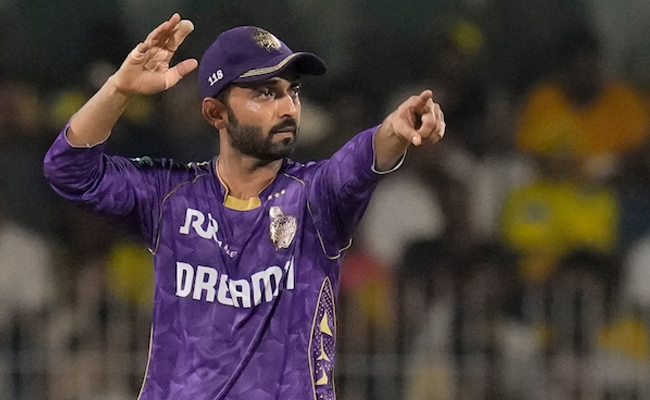
Ahmedabad (PTI): Winless after six matches, time is running out for Kolkata Knight Riders playoff hopes but their embattled skipper Ajinkya Rahane has urged the side to "embrace tough phases, play with freedom, and focus on one game at a time".
Loss has been one constant for the three-time former champions this season as they endured a five-wicket loss against Gujarat Titans to slump to their fifth defeat from six matches with their solitary point coming courtesy a rain washout against Punjab Kings at Eden Gardens.
“It’s about accepting and embracing these tough days. Every day is a new day... trying to do better, playing with freedom, and backing each other," Rahane was at his philosophical best at the post-match media interaction here on Friday.
A minimum of seven wins is needed from a 10-team league to keep a team's playoff aspirations alive.
With eight matches to go and one point in their kitty, the task will be an improbable one for KKR from here on.
'Nothing to lose'
ALSO READ: ALSO READ: South Africa beat India by six wickets in 1st Women's T20I
Rahane, however, said they have nothing to lose and it's all about playing with freedom.
“We’re thinking one game at a time. It’s tough when you lose games, but everyone is trying their best. No one wants to lose any match -- we all want to win -- but that’s what sport is all about... keep your heads up. For us, it’s about going out there, being positive, and playing with freedom. We’ve got nothing to lose.
“Let me tell you one thing: everyone is working really hard. For us, it’s all about playing for our fans and the people of Kolkata, and we’re trying to do our best.
"After each and every game, there’s discussion about how we can improve. Obviously, when you lose, you tend to think about combinations and the areas we can get better at, so the discussion is always on."
Rahane won a fourth toss from six matches this season, but his decision to bat first once again raised eyebrows. Even his counterpart Shubman Gill said at the toss he would have preferred to bowl, keeping the dew in mind.
The call backfired as KKR slipped to 32 for 3 in four overs before their Rs 25.20-crore acquisition Cameron Green bailed them out with his best innings for the franchise so far, a 79 off 55 balls.
“It’s never easy when things are not going your way, and the courage he showed was fantastic. All credit to him," Rahane said.
“Yes, as a batting team we were thinking about 200 on this wicket. It would have been challenging, but let’s not take anything away from his innings.
“Attacking Rashid Khan and their fast bowlers, he was fantastic tonight for us.”
'Proud of bowlers'
The KKR skipper also admitted in the media interaction that there was a "bit of dew" but he hailed their inexperienced bowlers for taking the match till the final over.
From being 95/1 in nine overs in their chase of 181, GT were made to sweat with Jos Buttler, Washington Sunder, Glenn Phillilps and a well-set Gill falling against the run of play.
Rahul Tewatia and Shahrukh Khan eventually sealed the nervy chase with two balls to spare.
“Special mention to our bowling unit. It’s such an inexperienced attack with just two seniors in Sunil Narine and Varun Chakravarthy, but the kind of improvement they’ve shown, especially in the last three games, has been fantastic," said Rahane.
“Kartik Tyagi, Vaibhav Arora, and Anukul Roy have also been fantastic, bowling tough overs in the powerplay and picking up wickets.
“Our support staff is doing a great job of keeping the environment really good. It’s all about accepting, but we will keep trying our best.”