2nd Test, Day 1: South Africa 35/1 at stumps, trail India by 167 runs
Ajinkya Rahane, Pujara flop show continues as Indian middle-order disappoints again
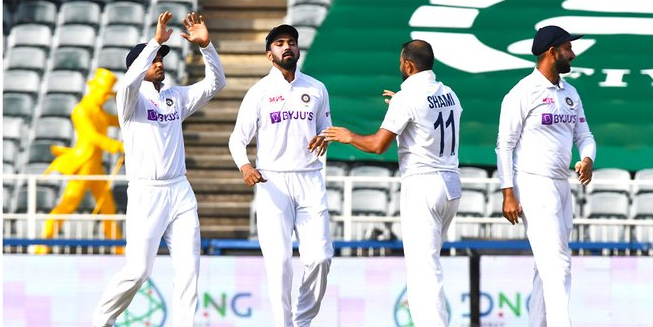
Johannesburg, Jan 3: Cheteshwar Pujara and Ajinkya Rahane's saga of failures compounded a shoddy batting performance by India even as stand-in skipper KL Rahul impressed with a defiant show amid the ruins on the opening day of the second Test against South Africa here on Monday.
Rahul's patient 50-run knock on a day when India missed Virat Kohli due to back spasms and Ravichandran Ashwin's cavalier 46 at the rear end ensured that India scored 202 in their first innings on a bouncy Wanderers track.
At stumps, Mohammed Shami sent back Aiden Markram even as Dean Elgar (11 batting) and Keegan Peterson (14 batting) took South Africa to 35 for 1. It could have been two down had Rishabh Pant snapped Peterson off Jasprit Bumrah, which seemed a regulation catch.
Worse, Mohammed Siraj hobbled off with what looked like a hamstring strain and if it's bad news, then India would be left with four bowlers.
However, a lot of blame should go to India's batters as some like Pujara didn't show intent to score while others like Rahane seemed completely short of confidence.
It prompted the legendary Sunil Gavaskar to say it as it is on air, "I think the next innings will be their last chance."
Having given up hopes to play for England, Duanne Olivier (3/67 in 17 overs), playing his first game for South Africa in three years, dismissed Pujara (3 off 33 balls) and Rahane (0) off successive deliveries to make it difficult for the Indians.
Marco Jansen (4/31 in 17 overs), with his giant frame, created awkward lengths for every Indian batter while Kagiso Rabada (3/64 in 17.1 overs), despite not being at his best, got wickets when it mattered.
In his first game as captain, Rahul concentrated hard as he played 133 deliveries. He was peppered with short balls. He would sway to some and duck the others while pulling the ones that he could.
His back-foot driving was majestic and he rode the bounce while going for the flashy cut shots.
Such is beauty of sport that Rahul, who till five months ago wasn't supposed to start as an opener in England, is now being groomed as an all-format India captain.
If the first day composure is any indication, he won't do a bad job.
But then there was a moment's indiscretion when he played one pull shot too many and holed out in the fine leg region.
Prior to that shot, the occasional pull that he played, Rahul rolled his bat over and tried to keep it down the ground but in this case, he got under the Jansen short ball and didn't get the required elevation.
He had a nice little partnership of 42 runs with Hanuma Vihari (20) before an inspirational close-in catch from Rassie Van der Dussen at short leg sent the latter back.
Rishabh Pant (17) and an attacking Ashwin (24 batting 21 balls) added 40 in quick time but what India needed was a partnership of at least 75 if not 100.
At the start, Mayank Agarwal (26) looked fluent in the first hour with five boundaries before Jansen pitched one in the spot from where it wasn't on drivable length as it climbed on. The opener went for a drive only to edge that to wicketkeeper Kyle Verreynne.
Rahul, on his part, survived strong caught behind and leg before appeals which were negated by debutant umpire Allahudien Palekar, someone who impressed on debut.
But what would disappoint Pujara and Rahane most is that on a day when they should have taken more responsibility in Kohli's absence, they couldn't even inject a sense of positivity in India's approach.
The manner in which Pujara hopped and skipped to rising deliveries actually would have made the dressing room feel jittery about demons in the pitch which wasn't the case. But there was definitely seam and bounce which one expects here in South Africa.
He once again got into a shell and was very uncomfortable against steep bounce which finally became his undoing.
Olivier's natural back of length deliveries were perfect recipe for disaster as he fended one that was wide of the short leg fielder but the next one lobbed up to the man at point for an easy catch.
Rahane's dismissal was that of a player, whose confidence has been torn to pieces.
The ball pitched on the fourth stump channel, created indecision on whether to play or not and Rahane dangled his bat for the catch to be taken in the slips.
This match will certainly not last the distance and if they can't make a difference in the second innings, the enormous patience that the Indian team management has shown towards them will definitely start wearing thin.
Let the Truth be known. If you read VB and like VB, please be a VB Supporter and Help us deliver the Truth to one and all.
Tribal man brings dead sister's skeleton to bank to withdraw money from her account
Keonjhar (PTI): A tribal man in Odisha's Keonjhar district on Monday brought the skeleton of his dead sister to a bank to withdraw the money deposited in her name, police said.
The incident occurred at Maliposi branch of Odisha Grameen Bank located at Patana block of Keonjhar district. The man was identified as Jeetu Munda (50) of Dianali village. He was seeking to withdraw Rs 20,000 from the bank account of his elder sister, Kalra Munda (56), who died on January 26, 2026.
"I have run several times to the bank, and the people there told me to bring the account holder to withdraw money deposited in her name. Though I told them that she had died, they did not listen to me and insisted on bringing her to the bank. Therefore, out of frustration, I dug the grave and brought out her skeleton as proof of her death," an illiterate Jeetu Munda told reporters.
Patana Police Station Inspector in charge (IIC) Kiran Prasad Sahu, who reached the bank after getting information, said, "Jeetu is an illiterate tribal man. He does not know what the legal heir or nominee is. The bank officials have failed to make him understand the procedure to withdraw money from the dead person's account."
However, after the incident, the police assured Jeetu Munda that they would facilitate the withdrawal of money from the bank account of his dead sister. Later, the skeleton was again buried at the graveyard in presence of police.
Meanwhile, local Block Development Officer (BDO) Manas Dandpat said that he was not approached by anyone for the legal heir of late Kalra Munda. "Today only, I came to know about it. We will see what can be done to resolve the issue," the BDO said.
Meanwhile, bank sources said that the nominee in Kalra Munda's bank account was also dead. Therefore, Jeetu Munda was the lone claimant over the money deposited in her name.
The local administration has directed the bank officers to make arrangements and ensure that Jeetu Munda, who is the only claimant as per the rules, gets the money as soon as possible.