Abhimanyu Mithun becomes 2nd bowler to take hat-trick on birthday

Bengaluru, Oct 25: Birthday boy Abhimanyu Mithun snared five wickets, including a hat-trick, as a dominant Karnataka defeated Tamil Nadu by 60 runs via VJD method in a rain-marred final to lift the Vijay Hazare Trophy for the fourth time here on Friday.
Karnataka fast bowler Abhimanyu Mithun has become the second bowler after Australia's Peter Siddle in professional cricket history to take a hat-trick on birthday.
Mithun, who turned 30 on Friday, returned with impressive figures of 5 for 34, which includes a hat-trick in the final over, to bowl out Tamil Nadu for 252 in 49.5 overs after opting to bowl.
Chasing the target, Karnataka were coasting at 146 for one in 23 overs when rain played spoilsport, interrupting play for almost 40 minutes.
The match was later called-off by the on-field umpires as they believed there wasn't enough time to complete the game.
Brief Scores:
Tamil Nadu: 252 all out in 49.5 overs (Abhinav Mukund 85, Baba Aparajith 66; Abhimanyu Mithun 5/34).
Karnataka: 146 for one in 23 overs (Mayank Agarwal 69, KL Rahul 52; Washington Sundar 1/51).
Karnataka won by 60 runs via VJD method.
Let the Truth be known. If you read VB and like VB, please be a VB Supporter and Help us deliver the Truth to one and all.
Rickelton's ton in vain as SRH beat MI by 6 wickets
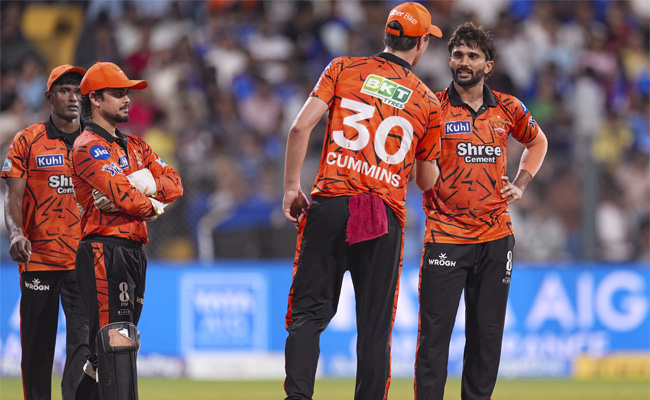
Mumbai (PTI): Ryan Rickelton's whirlwind unbeaten ton was overshadowed by Heinrich Klaasen's unbeaten 65 as Sunrisers Hyderabad defeated Mumbai Indians by six wickets in an IPL match here on Wednesday.
Chasing an imposing 244-run target, Travis Head (76 off 30) and Abhishek Sharma (45 off 24) shared 129 runs for the opening wicket to set the platform for SRH.
Klaasen (65 not out off 30 balls) then displayed his all-round hitting abilities to guide SRH home with the help of Nitish Kumar Reddy (21) and Salil Arora (30 not out off 10) in 18.4 overs.
Earlier, Rickelton's knock powered MI to 243 for five.
MI rode on a 93-run stand between Rickelton (123 not out off 55 balls) and Will Jacks (46 off 22) in 7.1 overs for the opening stand to power the side.
MI skipper Hardik Pandya scored a valuable 31 off 15 balls before being dismissed.
Praful Hinge (2/54), Eshan Malinga (1/29), Sakib Hasan (1/39) and Nitish Kumar Reddy (1/31) were the wicket-takers for SRH.
Brief Scores:
Mumbai Indian: 243 for 5 in 20 overs (Ryan Rickelton 123 not out; Praful Hinge 2/54).
Sunrisers Hyderabad: 249 for 4 in 18.4 overs (Travis Head 76, Heinrich Klaasen 65 not out; AM Ghazanfar 2/51).