Abhishek Sharma, Markram fifties steer SRH to 195/6 against GT

Mumbai, Apr 27: Opener Abhishek Sharma and Aiden Markram struck sparkling half-centuries as Sunrisers Hyderabad posted 195 for six against Gujarat Titans in their Indian Premier League match here on Wednesday.
Abhishek blazed away to 65 off 42 deliveries, while Markram made a 40-ball 56 during a third-wicket stand of 96 runs.
Then, Shashank Singh (25 off 6 balls) smashed Lockie Ferguson (0/52 in 4 overs) for three successive sixes to score 25 runs in the innings' final over.
To start with, SRH were helped by Mohammed Shami's (3/39 in 4 overs) 11-run opening over in which a first-ball beauty was followed by five leg-side wides, not once but twice.
Yash Dayal too conceded 11 runs, thanks to two boundaries by Abhishek Sharma on the off side, as SRH raced to 22 for no loss in two overs.
Kane Williamson clipped Shami over square leg for his first boundary but that's all the SRH skipper could do with the bat as, three balls later, the seasoned India pacer went through the gate with a lovely seaming delivery to dismiss the Kiwi and give his team the match's first breakthrough.
Having got a life at point even before he could open his account, Rahul Tripathi smashed Shami for 6, 4, 4 before a review found that the batter was trapped in front of the wicket in an eventful fifth over, which went for 14 runs.
Unperturbed by the fall of two wickets, Abhishek collected two successive fours off Alzarri Joseph -- first he lofted over the infield and then found the gap through a packed off-side -- to help SRH score 53 runs in the six power play overs at the Wankhede Stadium.
SRH needed a partnership at that stage and the duo of Abhishek and Markram not just provided them that but also kept the scoreboard moving at a very good rate by regularly finding the boundaries.
While Markram dealt with the likes of pacers such as Alzarri, Abhishek went after Rashid Khan, hitting the Afghanistan spin ace for his third six to reach his half-century in style.
Against Rashid, Abhishek was particularly strong on the on-side, getting his three sixes over long-on and deep mid-wicket.
However, the 21-year-old's fine innings came to an end when he inside-edged a slower delivery from Alzarri in the first ball of the 16th over.
Shami came back to dismiss the big-hitting Nicholas Pooran (3) cheaply before Markram got to his fifty by pulling the bowler for a six over deep mid-wicket. Stationed in the deep, Rashid's day in the field got worse as he misjudged it.
Let the Truth be known. If you read VB and like VB, please be a VB Supporter and Help us deliver the Truth to one and all.
It's govt's responsibility to support youth who dare to dream: Omar Abdullah
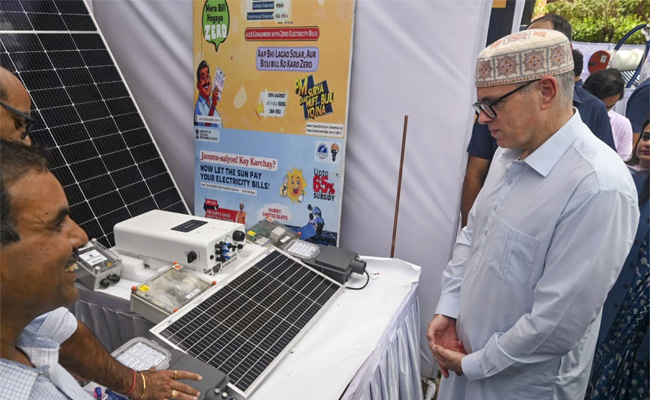
Jammu (PTI): Jammu and Kashmir Chief Minister Omar Abdullah on Monday said the government may not be able to provide jobs to everyone, but it can create an ecosystem for youngsters to become entrepreneurs and innovators.
It is the responsibility of the government to support youth who dare to dream, he said.
After inaugurating the 11th National Conference and Exhibition on Emerging and Innovative Trends in Engineering Technology (NCEEITET) at the Government College of Engineering and Technology (GCET) in Jammu, Abdullah said, “We may not be able to provide jobs to everyone, but we can certainly create an environment where our youngsters become entrepreneurs and innovators.”
The two-day conference is being organised by the GCET in collaboration with the Indian Institute of Technology-Kharagpur and the World University Consortium (WUC).
Addressing the gathering, Abdullah assured that all necessary steps would be taken to strengthen infrastructure and support systems at the GCET, ensuring that it continues to evolve as a premier institution.
The chief minister also inaugurated a new building for the School of Architecture in the college, built at Rs 19.71 crore.
Stressing the need to balance modernity with the region’s cultural and historical identity, Abdullah said, “Not every building needs to be made of glass and steel. Our structures must reflect our heritage and preserve our cultural ethos.”
Highlighting the role of emerging technologies such as artificial intelligence and machine learning, Abdullah said they could significantly improve tourism management, visitor experience and service delivery in Jammu and Kashmir.
However, he cautioned that technological advancement should complement human effort rather than replace jobs, especially in a region where unemployment remains a concern.
The chief minister said that attracting tourists to Jammu and Kashmir was not difficult, but ensuring repeat visits required consistently enriching experiences and better infrastructure across tourism segments, including pilgrimage, border and leisure tourism.
To address the infrastructure gaps in the college, Abdullah announced that funds would be provided this year for the construction of an auditorium.
He also assured support for setting up an incubation centre in GCET.
During the event, Abdullah also released the e-proceedings of the conference, comprising 28 shortlisted research papers.