Accidental chess player Vidit Gujrathi says it's worked out well for him
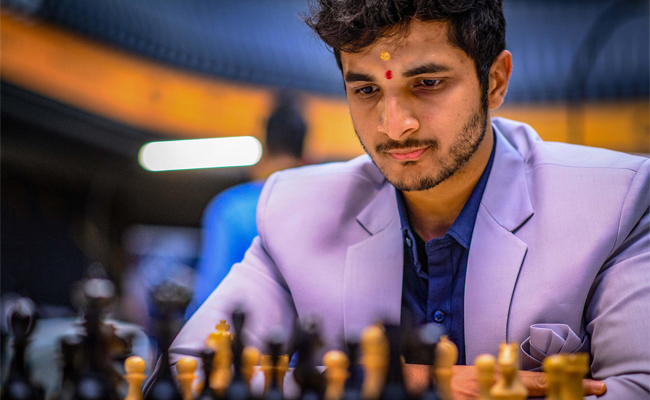
New Delhi (PTI): A self-proclaimed accidental chess player, Indian Grandmaster Vidit Gujrathi says he thought of sports as a more "stable" career option after watching his doctor parents being called to work at odd hours, an "error of judgement" that has ultimately "worked out well" for him.
The 29-year-old from Nashik will be turning up for Mumba Masters in the second season of the Global Chess League, a joint venture between Tech Mahindra and FIDE, from October 3 to 12 in London.
Gujrathi was around six when he was advised to put his ambition of playing cricket on hold till he was older by a local club. He decided to pursue chess instead as he was already familiar with the sport after spending considerable time playing with his father.
"I saw it as a good opportunity to learn and beat him. It was a complete accident, but a happy one," Gujrathi recalled in a press release issued by the event organisers.
Having seen his doctor parents work at odd hours due to late-night emergencies, Gujrathi said he wanted a relatively easy-going life and thought of sports as the right option.
"I did not realise then that sports can be more volatile. I made a judgment error, but it worked out well," he quipped, referring to long hours he has to devote to training.
In 2017, he became the fourth Indian after Viswanathan Anand, Krishnan Sasikiran, and Pentala Harikrishna, to cross the 2700 Elo rating.
Gujrathi, who still holds a rating of over 2700, was among three Indians who competed in this year's Candidates Tournament, an eight-man competition held to determine the Challenger for the World Chess Championship slated for November.
He did log some impressive results but could not win the tournament.
Talking about the upcoming league and his team Mumba Masters, Gujrathi said, "Definitely, our eyes are on the trophy this year. But I wish to improve my performance."
Mumba Masters retained most of their squad from the first season, with Maxime Vachier-Lagrave returning as the Icon Player while Gujrathi and Alexander Grischuk came back as Superstar Men players.
Koneru Humpy and Harika Dronavalli have joined once again as Superstar Women, with Raunak Sadhwani as the Prodigy for the franchise in the second season.
"Last year, we got along well with each other, and the team had a great atmosphere. We will be there for around a couple of weeks, and hence, it is important to also have a good time," Gujrathi said.
Let the Truth be known. If you read VB and like VB, please be a VB Supporter and Help us deliver the Truth to one and all.
Women’s Reservation Bill: K'taka CM accuses PM Modi of adopting 'double standard'
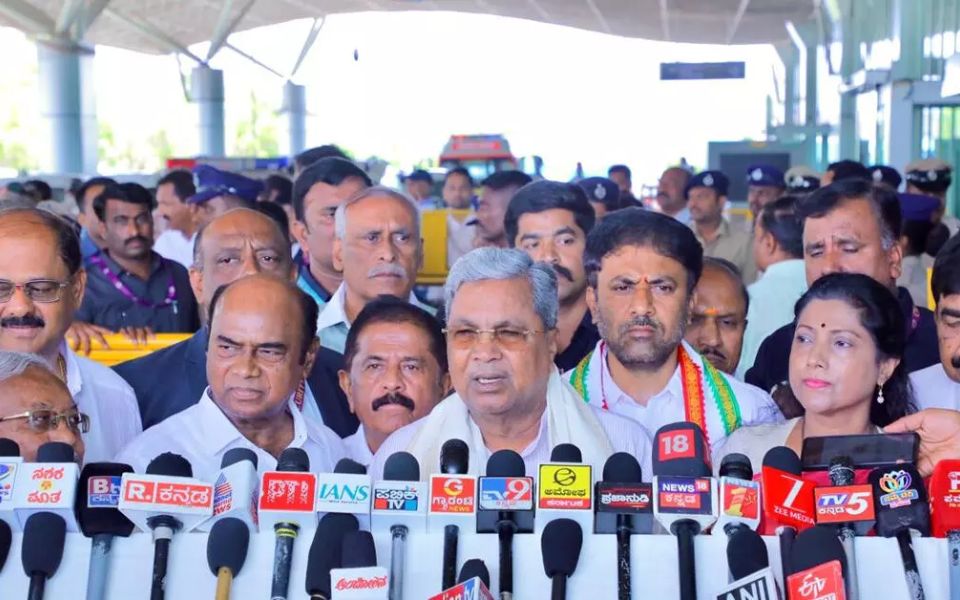
Mysuru (Karnataka) (PTI): Karnataka Chief Minister Siddaramaiah on Monday accused Prime Minister Narendra Modi of adopting a “double standard” on women’s reservation, alleging that the Centre had delayed implementation despite having the opportunity to act earlier.
Addressing reporters here, Siddaramaiah said the BJP and Modi had earlier opposed welfare guarantees and were now replicating them, while also questioning the timing and intent behind the women’s reservation move.
“That’s what I call double standards. Narendra Modi is not for social justice. If he was, this would have been done long ago. How many years has he been in power? It’s been 12 years. Why hasn’t it been done so far?” he asked.
The Chief Minister reiterated that the Congress had consistently supported women’s reservation and accused the Centre of "politicising" the issue.
“We spoke about women’s reservation. The Prime Minister asked me what our stand was. I said we are in favour of women’s reservation,” he said, referring to recent discussions with the PM.
He maintained that delimitation should only be carried out after a fresh Census to ensure equitable representation among states.
“In my view, delimitation should be done after a new census. That is why we opposed it. We have not opposed women’s reservation. We have always supported it,” he said.
Highlighting Congress’ past role, he said, “Who brought the 73rd and 74th amendments? Rajiv Gandhi and the Congress party. Those amendments ensured 50 per cent reservation for women in local bodies. Why would we oppose it?”
Siddaramaiah further questioned the union government’s delay in implementation. “Narendra Modi indulged in politics and got it passed in 2023. Why didn’t he implement it immediately? Then why did he wait so long? He could have implemented it immediately. If he is committed to women’s reservation, he should have implemented it,” he said.
On the linkage between delimitation and reservation, he asked, “Why did the Centre link it with delimitation? Why did it go for a constitutional amendment?” adding that such a move could disadvantage southern states that have successfully controlled population growth.
“Southern states have controlled population well, but northern states haven’t. Naturally, it benefits them and disadvantages us,” he said.
Responding to BJP’s criticism that women would “teach Congress a lesson,” Siddaramaiah said, “They are doing politics. If Modi had brought this earlier, who would have opposed women’s reservation?”
On electoral prospects elsewhere, he said he had no direct information on Tamil Nadu but was optimistic about ruling DMK's victory.
"According to the information I have, DMK and its alliance are likely to win,” while asserting that Kerala would also be won by the opposition.
In a major setback to the BJP-led Central government, a Constitution Amendment Bill to implement 33 per cent reservation for women in legislatures in 2029 and increase the number of Lok Sabha seats to 816 was defeated on Friday, with the ruling dispensation asserting that the struggle to give the rights to women will continue.
While 298 members voted in support of the bill in Lok Sabha, 230 MPs voted against it. Out of 528 members who voted, the bill required 352 votes for a two-third majority.
According to the Constitution (131st Amendment) Bill, Lok Sabha seats were to be increased to 816 from the current 543 to "operationalise" the women's reservation law before the 2029 parliamentary polls, following a delimitation exercise based on the 2011 Census.
Seats were also to be increased in state and Union territory assemblies to accommodate 33 per cent reservation for women.