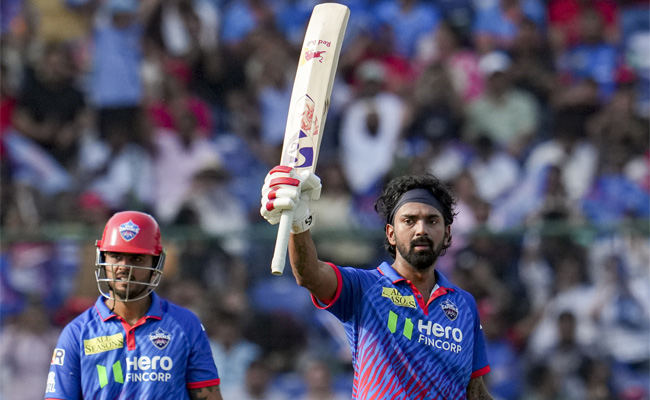
All-round CSK outclass Gujarat Titans to make it two in row
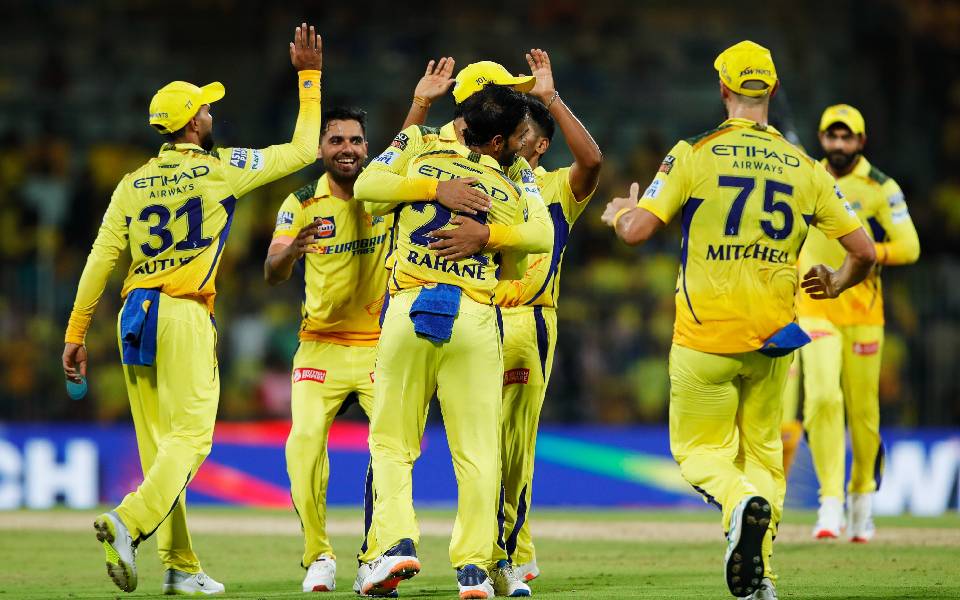
Chennai, Mar 26: Chennai Super Kings batters dazzled before the bowlers ran riot to choke Gujarat Titans in a comprehensive 63-run victory in their second IPL match here on Tuesday.
Ruturaj Gaikwad's team has covered all its bases and it was evident as Rachin Ravindra prepared a platform with 20-ball-46 allowing Shivam Dube to unlock his beast mode with a 23-ball-51. In between, Gaikwad himself maintained the balance with 36-ball-46 as Chennai's 206 for 6 was a Herculean total in every sense. Titans in reply could manage only 143/8 as Chahar (2/28 in 4 overs), Mustafizur Rahman (2/30 in 4 overs), Tushar Deshpande (2/21) and Matheesha Pathirana (1/29 in 4 overs) one by one tightened the noose on Titans batting unit.
If Gujarat needed to make a match of it, Shubman Gill needed to fire but his poor shot selection of a Deepak Chahar delivery, which wasn't as short as expected for a pull-shot, brought about his downfall.
Once Shubman was gone, Gujarat didn't even have a chance in hell with players like Wriddhiman Saha (21 off 17 balls) and B Sai Sudharsan (37, 31 balls), players, who on most days are pillion riders, playing second fiddle to perfection.
As it was the case, finishers like David Miller (21) and Rahul Tewatia (1) didn't have enough on the board to go for the improbable chase and the inevitable happened. Put into bat, Rachin's slam-bang approach and Dube's final flourish got CSK past 200-run mark.
Rachin made full use of Powerplay, racing to 46 off 20 balls while Dube, a nightmare for spinners then used his long levers to whack 51 in only 23 deliveries to increase the challenge of GT batters by manifold. Dube's innings had as many as five sixes.In between, skipper Ruturaj Gaikwad's chiselled 46 off 36 balls also was a significant contribution in another impactful batting performance on a hard bouncy track that was on offer. Not to forget CSK's Rs 7.60 crore recruit Sameer Rizvi (14 off 6 balls), who pummeled Rashid Khan (2/49 in 4 overs) for two sixes to mark a memorable IPL debut.
It was Rachin, who has already become a darling of the CSK fans, enthralled all and sundry with his audacious stroke-play. While he missed out again on a half-century but team's 'spiritual skipper' Mahendra Singh Dhoni would be all smiles knowing that his choice was perfect to the T. The three sixes -- a flick behind the square and one over long-on off the normally profligate Umesh Yadav and one off Azmatullah Omarzai were hit with so much disdain that it did put Gujarat Titans in a spot. There were some crunchy cover drives as Ravindra let his skipper Gaikwad breathe a little easy at the other end.
Finally, it was GT's 'Go-To' bowler Rashid, who drew the first blood but more because of smart work from Wriddhiman Saha, who removed the bails in a flash after the Black Caps opener lost his balance moved out of his crease trying to whip the delivery.
Saha's next stumping was way easier as Sai Kishore shortened the length and drew him out of his crease for an indiscreet loft. The ball deviated enough and the keeper completed mere formality.
Gaikwad wasn't as fluent as Ravindra to begin with but in his five boundaries and a six, he oozed class before becoming Saha's third victim with the gloves trying to pull Spencer Johnson, only to end up edging one behind the stumps.
After that it was Dube, who just plonked his front-foot and bludgeoned Sai Kishore for two monstrous sixes and also sent Johnson's delivery soaring for a maximum. Dube had the composed Daryl Mitchell for company, who also chipped in with an unbeaten 20-ball-24 in a stand of 57 runs for the fourth wicket in 5.5 overs.
2⃣ in 2⃣ for Chennai Super Kings 👏👏
— IndianPremierLeague (@IPL) March 26, 2024
That's some start to #TATAIPL 2024 for the men in yellow 💛
Scorecard ▶️ https://t.co/9KKISx5poZ#TATAIPL | #CSKvGT | @ChennaiIPL pic.twitter.com/njrS8SkqcM
Let the Truth be known. If you read VB and like VB, please be a VB Supporter and Help us deliver the Truth to one and all.
Bird flu: Karnataka completes 10-day H5N1 surveillance, containment operation
Bengaluru (PTI): The Karnataka government has successfully completed a 10-day intensive surveillance and containment operation following the detection of the H5N1 Avian Influenza outbreak here, officials said on Saturday.
The outbreak was reported in the State Poultry Rearing Training Centre in Mathkuru village, Hesaraghatta, on April 14, they said.
The surveillance was conducted by the Department of Health and Family Welfare of the state government in coordination with the Animal Husbandry and Veterinary Services Department, officials said.
According to an official statement, once the outbreak was confirmed, following laboratory reports from the National Institute of High Security Animal Diseases (NIHSAD-Bhopal), State and District Rapid Response Teams along with Hesaraghatta and Sonnenahalli PHC (Primary Health Centres) teams were immediately deployed.
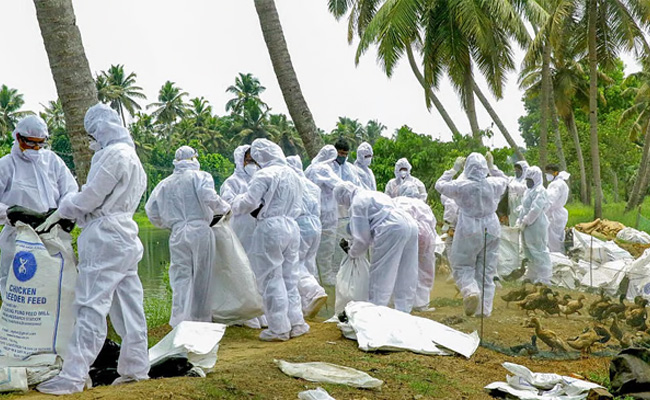
An infected zone of 0-3 km and a surveillance zone of 3-10 km radius was established. The Department of Animal Husbandry and Veterinary Services, culled all the birds and safely disposed of eggs and of contaminated feed, adhering to national and international biosecurity protocols, it said.
The health department said the surveillance zone from the infective focus in the 10 km radius, a total population of 28,172 across 22 villages was surveyed from day 1 to day 10. Multiple rounds of surveillance were conducted and sanitation activities were completed as per protocol.
During the surveillance period, nasopharyngeal samples collected from all quarantined staff on Day 5, sent to NIV-Bengaluru, were found to be negative for H5N1, it said.
On day 10, nasopharyngeal samples were collected and the results are awaited. No human case of H5N1 infection has been detected in the infected or surveillance zones, the health officials said.
"All healthcare facilities in Bengaluru have been instructed to continue ILI/SARI (Influenza-Like Illness/Severe Acute Respiratory Infection) case surveillance, and ensure adequate stocks of PPE, triple-layer medical masks, oseltamivir, viral transport medium, and throat swab kits," it said.
The Department of Animal Husbandry and Veterinary Services issued a Sanitization Certificate on April 21, officials said.
"No poultry activity will be undertaken for a period of 90 days as a precautionary measure. During the three months of surveillance, the entire area of the farm will be repeatedly disinfected by fumigation (indoors) or sprays (open place) every 15 days," it further stated.
The public has been advised to avoid handling or consuming meat or eggs from sick or dead poultry and report sightings of sick or dead birds promptly to local veterinary or health authorities.
Ensure poultry meat and eggs are thoroughly cooked before consumption, as proper cooking effectively inactivates the virus, they said.
"The public is advised to follow official health advisories and avoid spreading unverified information," the department added.